Nigerian State Oil Company Reports Full Restoration of Main Pipelines
Read more
CGTN
cgtn.com

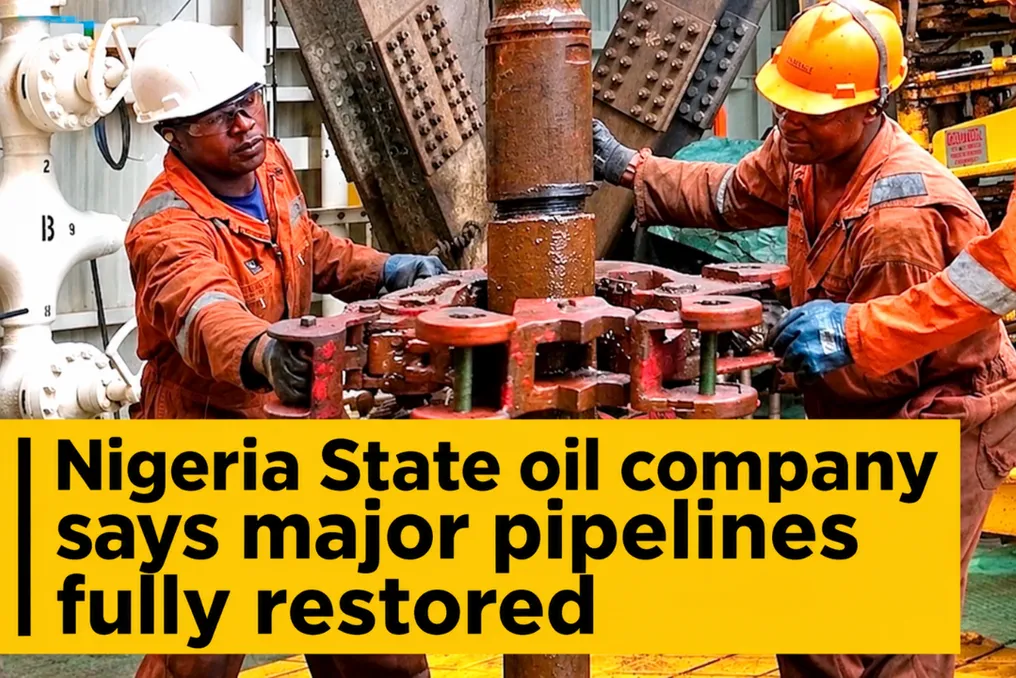
Nigerian State Oil Company Reports Full Restoration of Main Pipelines

The Nigerian state oil company announced that the country's main oil and gas pipelines are fully operational again after two decades. This restoration was made possible by overcoming long-standing issues related to oil theft, vandalism, and infrastructure failures.

The state-owned company explained the successful recovery by improving surveillance systems, strengthening security coordination, and fostering closer engagement with local communities.

Audu Ibrahim, Executive Director of the Nigeria Gas Infrastructure Company, emphasized that cooperation with local residents and security services played a crucial role in resuming pipeline operations.

This achievement could potentially allow Nigeria to strengthen oil production, increase exports, and improve gas supply to power plants and industrial enterprises. Nigeria is one of Africa's leading oil producers, but constant disruptions in pipeline operation negatively affected production, exports, and government revenue.

Similar stories

Iraq resumes oil exports to Turkey via pipeline to bypass Strait of Hormuz
Read more
www.middleeasteye.net

Iraq resumes oil exports to Turkey via pipeline to bypass Strait of Hormuz

Iraq has resumed crude oil pumping for export to Turkey through the Kirkuk-Ceyhan pipeline, aiming to avoid using the Strait of Hormuz.

The Iraqi Minister of Oil, Bassem Khudair, stated in a release distributed by the state Iraqi news agency on Tuesday that Iraq plans to pump up to 120,000 barrels of oil per day (bpd) through the 960-kilometer pipeline. This pipeline connects the Iraqi city to the Mediterranean port of Turkey.

He also noted that after the successful completion of technical, operational, and restoration maintenance of the pipeline, which had been out of service for over ten years, the flow could reach 500,000 bpd.

Iraq is one of the countries most affected by competing blockades from the US and Iran in the Strait of Hormuz. Before the war between the US and Israel against Iran, almost all Iraqi oil exports passed through this waterway, and revenues from sales accounted for 90 percent of Iraq's budget.

The resumption of oil flows from Kirkuk to Ceyhan is the first step in Iraq's efforts to reduce dependence on Hormuz. Baghdad aims to connect Basra, its energy hub in southern Iraq, to the Mediterranean via the Syrian port of Baniyas and the Turkish port of Ceyhan.

Middle East Eye media first reported on US efforts to restore the connection of the pipeline between Kirkuk and Baniyas. The US Ambassador to Iraq, Tom Barrack, welcomed the reopening of the Kirkuk-Ceyhan line on Tuesday in his social media post, writing: 'Forward, Iraq, forward.'

Iraq began reexporting oil to Turkey in September 2025 from the semi-autonomous Kurdistan region after a two-year dispute. According to this agreement, the Kurdistan Regional Government (KRG) and foreign oil producers operating in the region agreed to allow raw oil to flow to the Turkish port of Ceyhan in volumes ranging from 180,000 to 190,000 bpd.

However, the announcement made on Tuesday will allow oil from the federal government of Iraq to go directly to Ceyhan.

Turkey insists on a direct connection between Basra and Ceyhan. The capacity of the Kirkuk pipeline exceeds 1.5 million bpd.

Energy industry experts inform MEE that tens of billions of dollars will be spent in the coming years on new infrastructure to bypass Hormuz. The UAE is leading the construction of pipelines around this choke point.

Nevertheless, recent attacks on Saudi Arabia's East-West pipeline, attributed to Houthis and militias in Iraq, highlight the vulnerability of these bypass routes.

USA returns over 10.8 billion in oil revenues to Venezuela under energy agreement
Read more
noticiasaominuto.com

USA returns over 10.8 billion in oil revenues to Venezuela under energy agreement

The Trump administration announced that it returned more than 12 billion dollars (equivalent to 10.8 billion euros), which represents almost 99% of the revenue generated from the sale of Venezuelan oil since the detention of former President Nicolás Maduro.

A report issued by the U.S. Department of State, and prepared by the consultancy KPMG, detailed that the commercialization of Venezuelan oil, combined with small amounts of gold, minerals, and fertilizers, totaled 12.26 billion dollars.

According to the report, practically all of this amount was transferred to Venezuela due to a comprehensive energy pact established with the country's provisional authorities.

The document points out that as of September 30, the end date of the 2026 fiscal year, there was a balance of 168.6 million dollars held in a blocked account managed by the U.S. Treasury Department.

Under the agreed terms, Venezuelan oil is traded on the open market, with the proceeds deposited into an account supervised by the U.S. Subsequently, Venezuelan officials request authorization for these funds to be returned to the country, aiming to finance infrastructure and humanitarian assistance.

The report also provides a financial perspective on the Venezuelan government since the U.S. arrested Maduro in January of this year, transporting him to New York to answer drug trafficking charges, at which time the U.S. assumed operational control of the country's deteriorating oil industry.

The majority of the more than 12 billion dollars in oil profits collected by the U.S. until September was distributed to individuals and corporations in Venezuela through currency operations conducted in local commercial banks.

However, the document shows that approximately 133 million dollars were specifically directed to cover expenses or essential supplies for the Venezuelan government. The U.S.-sanctioned transactions included 5 million dollars allocated to the law firm Greenberg Traurig, based in Miami; nearly 24 million for the acquisition of dialysis and coal mining equipment; and 8.7 million to settle Venezuela's debts related to vaccine purchases from the Pan American Health Organization.

It is important to note that the report does not specify the names of the 20 companies that acquired oil and gold in the first nine months of 2026. However, each of these companies had to undergo verification by the U.S. government to ensure compliance with sanctions and anti-money laundering controls, which constitutes a change from previous practices when the Venezuelan government enjoyed little oversight in managing its oil funds.

Oil and gas leak in Niger ceases after 25 days of activity
Read more
noticiasaominuto.com

Oil and gas leak in Niger ceases after 25 days of activity

The oil and gas leak that occurred in Niger, which began in late September in the country's northeast, was ended on October 20, after a period of twenty-five days of intense activity, according to the Government.

This spill, characterized by the projection of large volumes of oil and gas more than ten meters high, started on September 25. Nigerien authorities classified this event as an environmental incident of 'exceptional gravity' at the time.

The Ministries of Petroleum and Environment issued a statement on Tuesday night, read on public television, informing that 'on October 20, around 07:00 (06:00 in Lisbon), the leak at the Goumeri W8 well ceased, after 25 days of intense activity.'

According to the Government, the leak stopped naturally, without the need for decisive human intervention. The statement also guaranteed that the cessation was confirmed both by a permanent state mission on site and through satellite observations.

Since the closure, no new leaks have been detected at the site, where security operations continue to be maintained, according to the two ministries.

The incident happened in the Agadem oil block, located approximately 1,700 km from Niamey, the capital. This area is operated by CNPC Niger Petroleum S.A., which functions as a local subsidiary of the Chinese multinational China National Petroleum Corporation (CNPC).

Authorities declared that the leak did not impact the production of the Agadem block nor the national supply of petroleum derivatives.

An inquiry commission will be appointed to investigate the causes of the leak. Furthermore, the ministries informed that samples of water, soil, vegetation, and animals were collected, and the results of these analyses will be made public as soon as possible.

Niger, which has been under military rule since a coup d'état in 2023, has been an oil producer since 2011. Currently, production in Agadem reaches 20 thousand barrels per day of refined crude oil and 90 thousand barrels of crude oil.
Popular