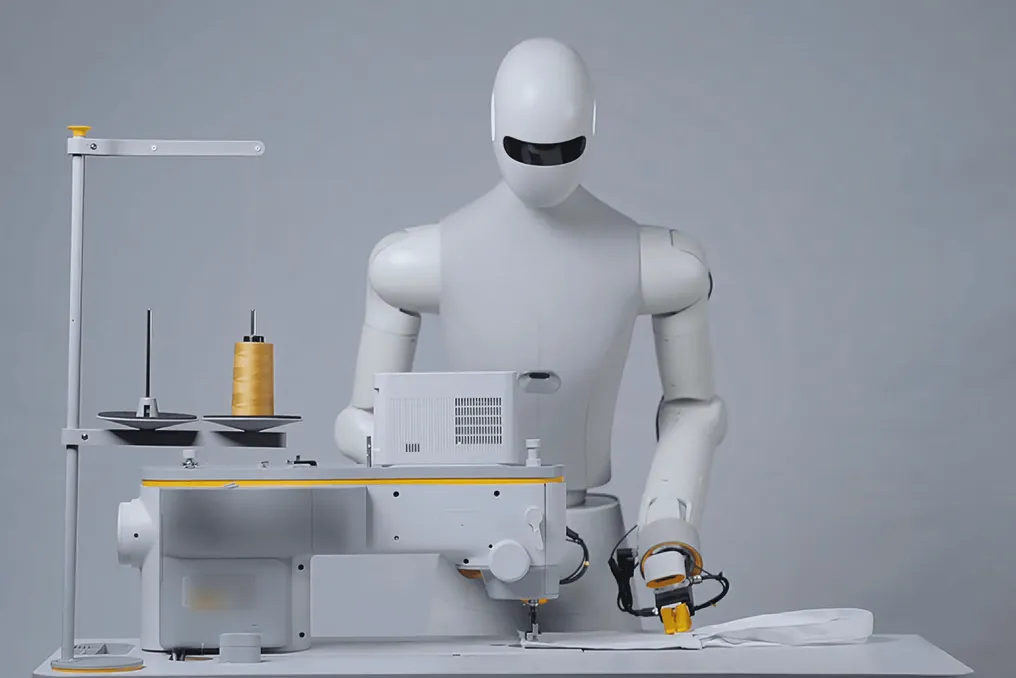
Peacebird is conducting tests of sewing robots developed in collaboration with Aitu at its factory in Ningbo. During a demonstration on November 18, the machines showed the ability to process shirt cuff components.
Reports published on November 19 and 21 concern validation on small batches at the factory, not the launch of a new robot or a fully automated sewing department.
At the demonstrated station, the robot is capable of identifying and picking up cut fabric, placing two pieces into a template, after which the sewing process is transferred to connected sewing equipment. It is important to note that the robotic processing system and the sewing machine work together, rather than a humanoid performing every stage of clothing production independently.
Manipulating fabric is more difficult than handling a rigid factory part because its thickness, elasticity, and friction can vary, and thin or slippery material may deform during gripping. Aitu claims that their system combines visual perception with tactile and force feedback to correct the method of picking up and positioning parts.
For fabrics trained in the standard way, the company reports a successful capture rate of over 96%. However, this figure does not reflect the yield of finished products, the completion of the entire sewing process, or that the robot performs equally well with every textile part.
According to the company's data, the overall productivity at this station is approximately 50%–70% of the productivity of a skilled worker, meaning the machines are still slower than experienced people. More complex operations, such as installing zippers and assembling sleeves with curves, still require further refinement.
One bottleneck is coordination: after placing the material, the robot waits for the template to pass through the sewing process. Aitu proposes a solution by overlaying the next placement onto the sewing process, as well as improving fixtures and algorithms. Any increase in productivity remains a development goal, not an achieved production metric.
The reports separately describe samples that were completed in just three hours using digital design, automatic cutting, and template-based production. This represents a broader selection workflow, not the time required for this robot to autonomously sew an entire garment.
Peacebird plans to conduct an internal review of the technology before considering wider application and sharing proven methods with suppliers. Current data pertains to a specific factory and limited operations, and it does not prove implementation across all suppliers, elimination of skilled seamstress jobs, or an independently audited production economy.