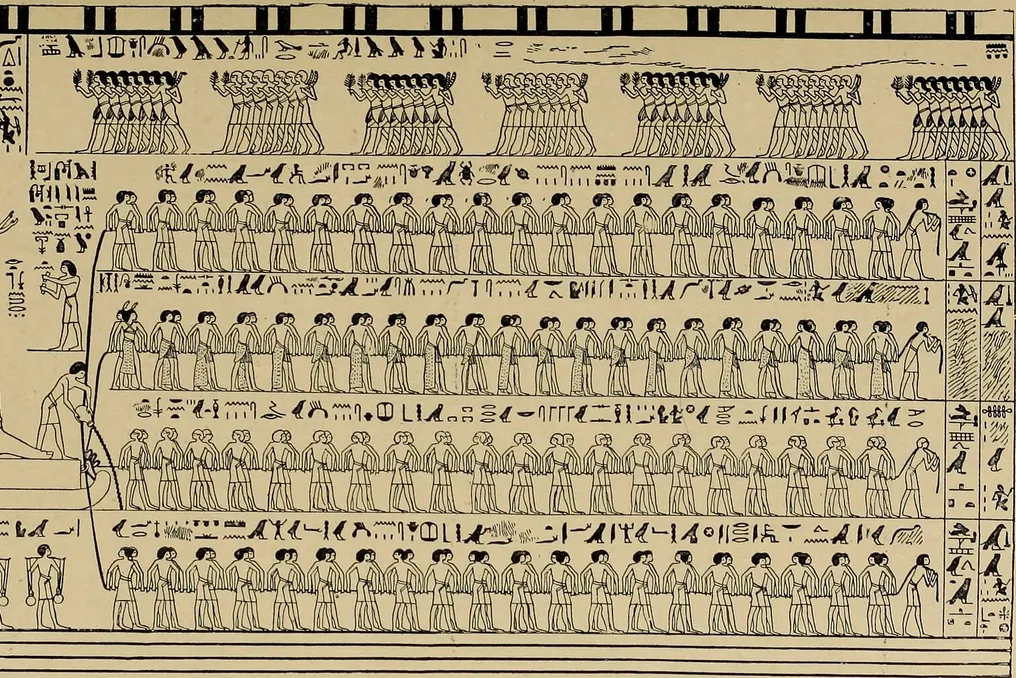
A detailed study of ancient history reveals one of the oldest recorded labor protests, which occurred more than three millennia ago, involving workers responsible for constructing royal tombs in Egypt.
During the reign of Ramesses III, who ruled from 1184 to 1153 BCE, Egypt faced a period marked by increasing political and economic instability. These difficulties deeply affected daily life and government functioning, exemplified by the case of the strike by laborers tasked with building the royal sepulchers.
Knowledge of this event comes from various documents found in the settlement of Deir el-Medina, located on the west bank of ancient Thebes (now Luxor). These written records document the workers' demands and the measures they took to force the public administration to meet their requirements.
Deir el-Medina was the settlement where artisans and workers dedicated to the construction and decoration of the royal tombs of the Theban necropolis lived, including those in the Valley of the Kings and the Valley of the Queens. This location, situated in a desert area on the west bank of Thebes, housed a community of highly skilled professionals whose labor was vital for preparing the pharaonic burials and decorating their burial chambers.
The community had a well-established work structure. Artisans were divided into two teams, corresponding to the left and right sides of the tomb, and each team was supervised by a foreman. Scribes were responsible for noting tasks, working days, and absences, maintaining communication with administrative managers. Simultaneously, other workers provided essential supplies and services for the maintenance of the village, such as water supply, firewood, and necropolis surveillance.
In exchange for their effort, the residents of Deir el-Medina received compensation in goods, distributed periodically in the form of grains, which were used to produce basic foodstuffs like bread and beer, as well as other necessities. This subsistence depended directly on the governmental administration responsible for providing rations.
When deliveries were late or insufficient, it put the food supply of both the workers and their families at risk. This situation was recorded in the Turin Strike Papyrus, an administrative document detailing the workers' protests during the 29th year of Ramesses III's reign.
This incident occurred during the planting season, known as Peret in the Egyptian calendar, covering the period from mid-March to mid-July. On the tenth day of the second month, the men stopped working and left the boundaries of the necropolis to demand the rations they had not received, shouting: 'We are hungry!', as stated in the papyrus.
The strikers proceeded to the funerary temples located on the west bank of Thebes, places that, besides having religious functions, were important centers for the storage and redistribution of food. There, they claimed the grains owed to them. Although the protest generated an initial effect, the resolution was temporary. Due to the persistence of the problem, the workers resumed the stoppage and demanded that their grievances be brought before the pharaoh and the vizier.
The concerns of the workers of Deir el-Medina were not based on a theoretical demand but on the fundamental need to receive the food necessary to sustain their families. In a society where remuneration was tied to state distributions, delays threatened the survival of the entire community.
However, this episode also demonstrates the ability of workers to organize collectively, suspend their activities, and pressure authorities to fulfill their obligations. The great works of Pharaonic Egypt were not merely achievements of the kings, but rather the result of the work of individuals with needs, concerns, and power to act. Thanks to preserved documents, their voices have reached the present, allowing us to recognize, behind the grand tombs, those who also left their mark on History.