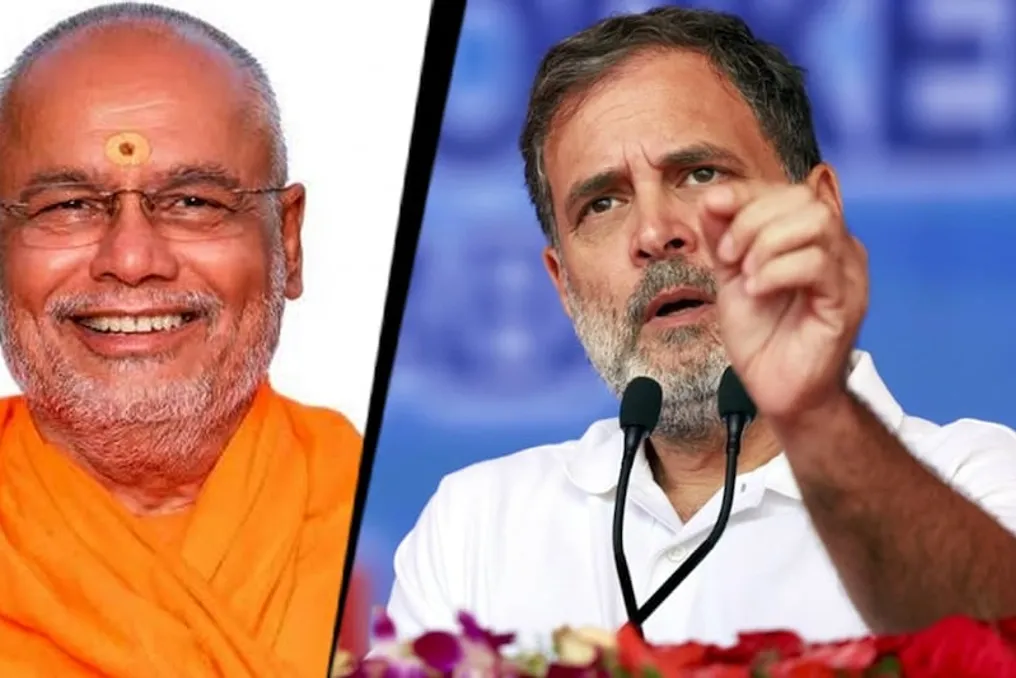
Indian Saint Writes Open Letter to Rahul Gandhi Regarding Post Featuring Shiva and Parvati
Read more
Aaj Tak
www.aajtak.in

Indian Saint Writes Open Letter to Rahul Gandhi Regarding Post Featuring Shiva and Parvati

Paramatmanand Saraswati, coordinator of the Acharya Sabha of Hinduism, sent an open letter to Congress politician Rahul Gandhi and Priyanka Gandhi Vadra. This letter was a reaction to a recent social media post by Rahul Gandhi, which featured a photograph of Mother Parvati sitting on the lap of God Shiva.

In his letter, Paramatmanand explained the philosophical significance of this photograph, linking it to the deep knowledge of the Upanishads, as well as to the concepts of Maya, Brahman, and Shakti. The letter, titled 'Open Letter to Rahul and Priyanka,' began with the greeting: 'With blessings, hello Rahul-Priyanka.'

Paramatmanand Saraswati noted that he was not entirely clear what message Rahul Gandhi intended to convey through this photograph, but he felt compelled to write to the Congress leaders because the significance of this image is much deeper than it appears at first glance.

The entire dispute began during the presentation of Sonia Gandhi's book, 'Belonging: A Journey of Love.' At this event, Rahul Gandhi shared childhood memories, recounting how his mother used to sit on his father Rajiv Gandhi's lap during family meals. This statement drew sharp criticism from politicians from the Bharatiya Janata Party (BJP).

Subsequently, on November 17, Rahul Gandhi posted a photograph of a Hoysala temple in Halebidu, Karnataka, dating back to the 12th century, on the social network X. The picture depicts God Shiva and Parvati seated on Nandi.

Accompanying this photograph, Rahul Gandhi wrote that fear, anger, and hatred have woven a net in the hearts of BJP and RSS supporters, preventing them from experiencing love. He also stated that as a true Hindu, it is his duty to free them from this trap. His publication sparked a new political debate, and many BJP leaders, including the Chief Minister of Assam Himanta Biswa Sarma, criticized Rahul Gandhi's remarks.

In turn, the Congress defended its leader, asserting that love does not need to be hidden, and attachment is not a weakness. Meanwhile, in his letter, Paramatmanand Saraswati emphasizes that the image of Uma-Maheshwara, where Mother Parvati sits on the lap of God Shiva, is not merely a picture but a symbol of profound Upanishadic knowledge.

Explaining the philosophical meaning, he writes that Maya functions as a title or conditioning adjunct through which people can view Brahman as the cause of creation without considering real changes within it. In his view, the universe manifests in the order of God through Maya, and this is understood as an illusion or dependent reality that has no independent existence from Brahman. Paramatmanand notes that this connection finds a clear symbolic expression in two images: Mother Parvati sitting on the lap of God Shiva, and Ardhanarishvara, where Shiva and Parvati are presented as two parts of a single form. He concludes: 'This image shows that the creative power of Maya belongs to Shiva, who is free from it, while Maya itself is not free.'
Similar stories

Unveiling the Mystery: Who Was the Dog Accompanying the Pandavas on Their Final Journey to Heaven?
Read more
www.aajtak.in

Unveiling the Mystery: Who Was the Dog Accompanying the Pandavas on Their Final Journey to Heaven?

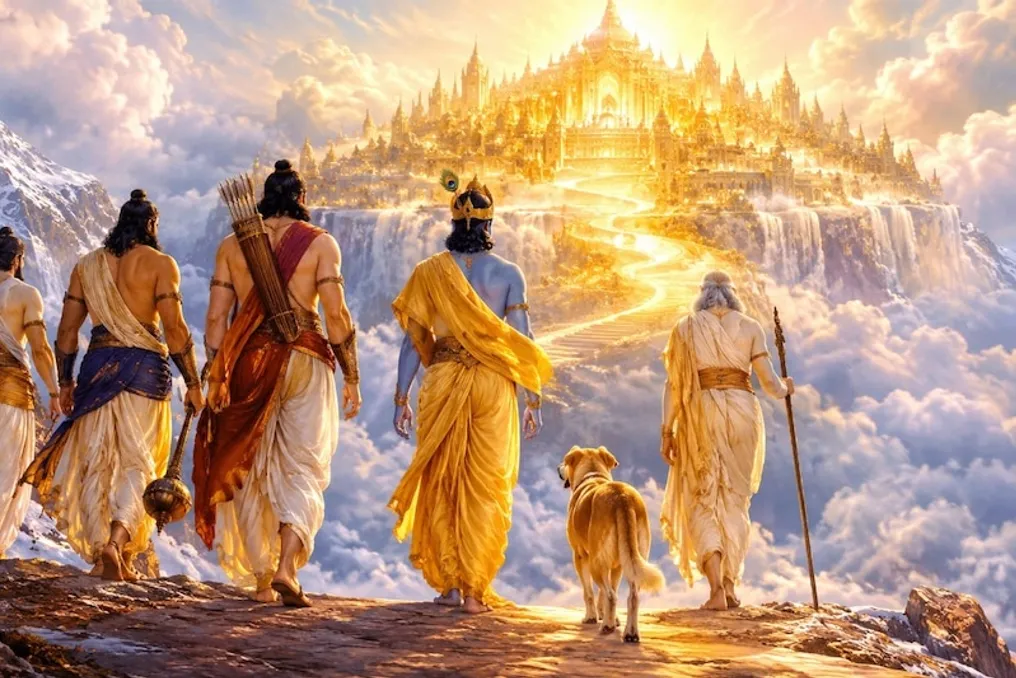
The Pandavas were heading towards Mount Swargarohini from Badrinath on their final journey. The name Swargarohini itself means the path of ascent to heaven, although this does not imply the existence of physical gates through which a person could enter paradise. This episode from the Mahabharata symbolizes the spiritual path, self-sacrifice, and the victory of Dharma.

According to information, Vaikuntha Chaturdashi falls on November 23rd this year. There is a belief that on this day, Hari-Hara, meaning the gods Vishnu and Shiva, are worshipped. Vaikuntha Chaturdashi is the only day of the year when the path to heaven is believed to open. Among the stories associated with heaven, the episode of Draupadi's and the five Pandavas' last journey is considered extremely mysterious and inspiring.

When the five Pandavas and Draupadi set out on their final journey, leaving behind royal treasures, a dog began to accompany them. While passing through the difficult mountainous regions of the Himalayas, Draupadi and four of the Pandavas began to fall one after another. However, Yudhishthira did not look back. Only this dog remained with him until the end of the journey.

When they reached the gates of heaven, Indra asked Yudhishthira to enter heaven, leaving the dog behind. He refused this offer. It was at this moment that the greatest test of Dharma, compassion, and devotion occurred.

According to Mahaprasthanika Parva, the dog that accompanied the Pandavas during their last journey was actually Dharmadeva (Yamaraja). He took the form of a dog to test Yudhishthira. When Indra invited him to heaven alone and forbade him from taking the dog, Yudhishthira clearly stated that he could not accept the bliss of heaven while leaving the animal that had accompanied him through difficult times. By making such a decision, Yudhishthira pleased Dharmadeva, who appeared in his true form. He informed him that Yudhishthira had once again demonstrated Dharma and compassion. After this, the path to heaven was opened to him.

The last journey of the Pandavas is associated with the inaccessible peaks of the Himalayas, which are visible today in the Gadwal region of Uttarakhand. The Pandavas moved further away from the Badrinath region towards Mount Swargarohini. The name Swargarohini literally means the path of ascent to heaven. Mount Swargarohini is located near the Gangotri region in Uttarkashi district, Uttarakhand, and is part of the high Himalayan ranges. The area around it is very inaccessible, and reaching it is not easy. This area is known for both mountaineering and challenging Himalayan treks.

Swargarohini is considered the site of the Pandavas' last journey. Nevertheless, this does not mean that there is a physical entrance where a person can enter heaven. The episode from the Mahabharata serves as a symbol of the spiritual journey, renunciation, and the triumph of Dharma. Swargarohini is not just a mountain range, but a place connected to faith and mythological history. The difficult geographical conditions here remind man of the limits of life and the greatness of nature. The message of the Pandavas' last journey is that at the end of life, what remains with a person is not wealth, power, and luxury, but their deeds, truth, and Dharma.

Explanation of the Tradition of Joint Worship of Shiva and Vishnu on Vaikuntha Chaturdashi 2026
Read more
www.aajtak.in

Explanation of the Tradition of Joint Worship of Shiva and Vishnu on Vaikuntha Chaturdashi 2026

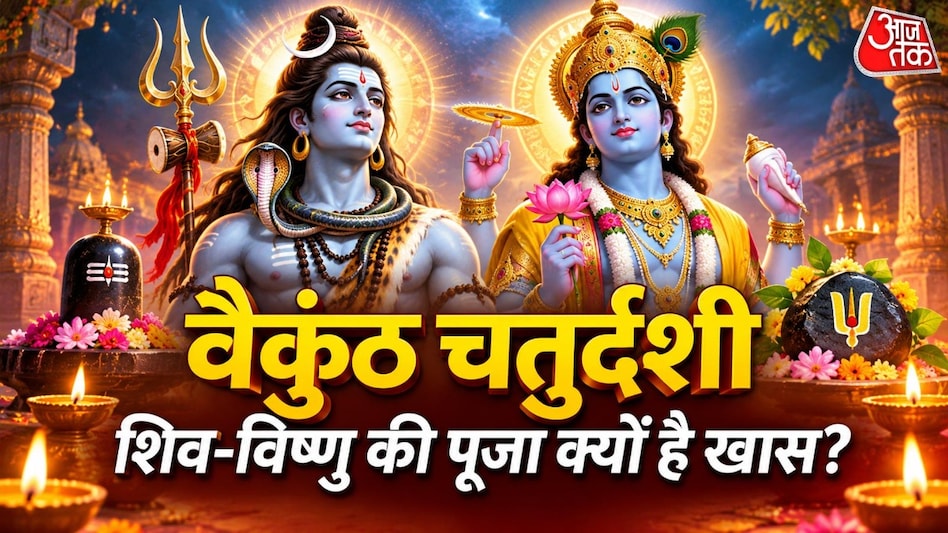
In Hinduism, the day of Vaikuntha Chaturdashi holds a special place as it is dedicated to both deities—Lord Vishnu and Lord Shiva. There is a tradition of worshipping these two deities simultaneously, which in religious beliefs is called 'Hari-Hara Milan.' In this context, 'Hari' denotes the God Vishnu, and 'Hara' denotes the God Shiva.

According to beliefs, during the Chaturmas period, Lord Vishnu remains in a state of yogic sleep, during which Lord Shiva takes responsibility for maintaining the universe. After Vishnu awakens on Deuthani Ekadashi, on the day of Vaikuntha Chaturdashi, Shiva once again transfers this responsibility to him.

Vaikuntha Chaturdashi Date 2026

Vaikuntha Chaturdashi is celebrated annually on the fourth day of the lunar month of Kartik (Shukla Paksha). This festival falls after Deuthani Ekadashi and precedes Kartik Purnima by only one day. According to panchang data, in 2026, this day will fall on November 23rd. In places like Kashi and Ujjain, special religious events and services are held in temples. It is believed that sincere worship of Shiva and Vishnu on this day brings the blessings of both deities.

Reasons for Observing Hari-Hara Milan

According to mythological narratives, Lord Vishnu enters a state of yogic sleep from Dashayani Ekadashi, and this period is known as Chaturmas. During this time, the care of the universe rests on the shoulders of Lord Shiva. Then, on Deuthani Ekadashi, Vishnu wakes up from his sleep. It is believed that it is on the day of Vaikuntha Chaturdashi that Shiva returns the governance of the universe to him. This event is called Hari-Hara Milan. This festival emphasizes that both Lord Shiva and Vishnu possess unique significance, being complementary forces in the governance of the universe, rather than adversaries.

Significance of Joint Worship of Shiva and Vishnu

Religious doctrines state that Vaikuntha Chaturdashi symbolizes mutual respect and devotion between Lord Shiva and Lord Vishnu. According to legend, on this day, Lord Vishnu presented a thousand lotuses to Lord Shiva. In return for this devotion, Shiva gifted him the Sudarshana Chakra. This is why there is a tradition of worshipping both deities together. It is believed that such reverence ensures the blessings of both Shiva and Vishnu, and also promotes prosperity and happiness in the family.

Popular