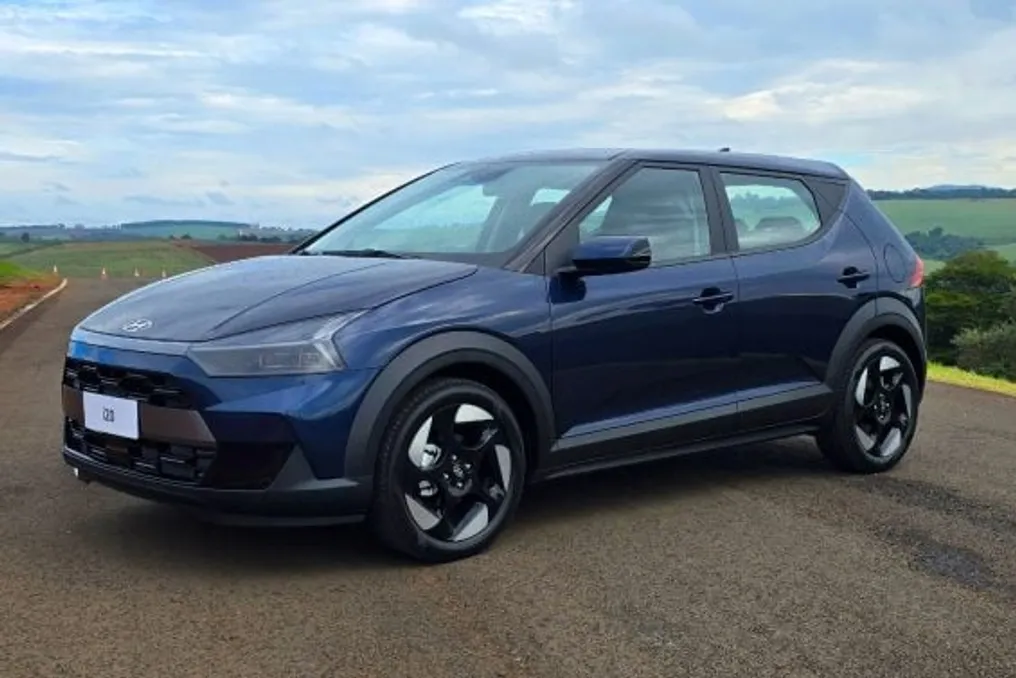
The new compact hatchback from Hyundai, named i20 Ultimate, is positioned in the segment between the HB20 and Creta models and draws attention with its robust design. Although it lacks SUV or crossover characteristics, it incorporates notable aesthetic solutions, such as the attractive design of the front and rear pillars, even eliminating roof rails that were merely decorative.
A significant improvement observed at the rear was the relocation of the bumper's turn signals to a higher position, aligned with the taillights, in addition to brake lights that have become much more visible.
Technical specifications include a length of 4,130 mm, wheelbase of 2,580 mm, width of 1,780 mm (2,045 mm with mirrors), and height of 1,780 mm. The volumes are 346 liters for the trunk and 50 liters for the tank. The vehicle has a mass of 1,205 kg.
The engine is a 1-liter three-cylinder turbo, available in flex versions, generating 115 hp (E)/(G) of power and 17.5 kgfm (E)/(G) of torque. In terms of consumption (Inmetro km/L, city/highway), the values are 8.8/10.1 (E) and 12.6/14.3 (G). The estimated range (Inmetro km, city/highway) reaches 440/505 (E) and 630/715 (G). The traction is front-wheel drive, and the gearbox is a six-speed epicyclic automatic. Acceleration from 0 to 100 km/h takes 11.7 seconds (E)/(G).
Among the positive aspects, the ample interior space stands out, including the rear seat, the good trunk volume, and the standard equipment. These include wireless inductive phone charging, a 10.25-inch multimedia center with wireless mirroring, and leather-upholstered seats. However, flaws were pointed out in the instrument panel, where all pointers are virtual, and the reverse lights remain on the bumper, being poorly visible.
In dynamic analysis, the good performance of advanced driver assistance systems was a strong point, providing safety without excessive intervention. The auto-hold system also contributes to tranquility in heavy traffic. Other highlights include the good resolution of the multimedia screen and the ease of adjusting audio volume via the right steering wheel spoke or a rotary button in the center of the dashboard. The four-wheel disc brakes demonstrate efficiency.
On uneven surfaces, the suspensions exhibit a discreet roughness. Although the engine power suffered a slight reduction to comply with the Sustainable Car program, the torque remained stable, and drivability was minimally impacted. The selling price is R$ 139,990.