India's Environment Minister States That Lack of COP31 Decision Will Not Halt Country's Climate Actions
Read more
The times of India
timesofindia.indiatimes.com

India's Environment Minister States That Lack of COP31 Decision Will Not Halt Country's Climate Actions

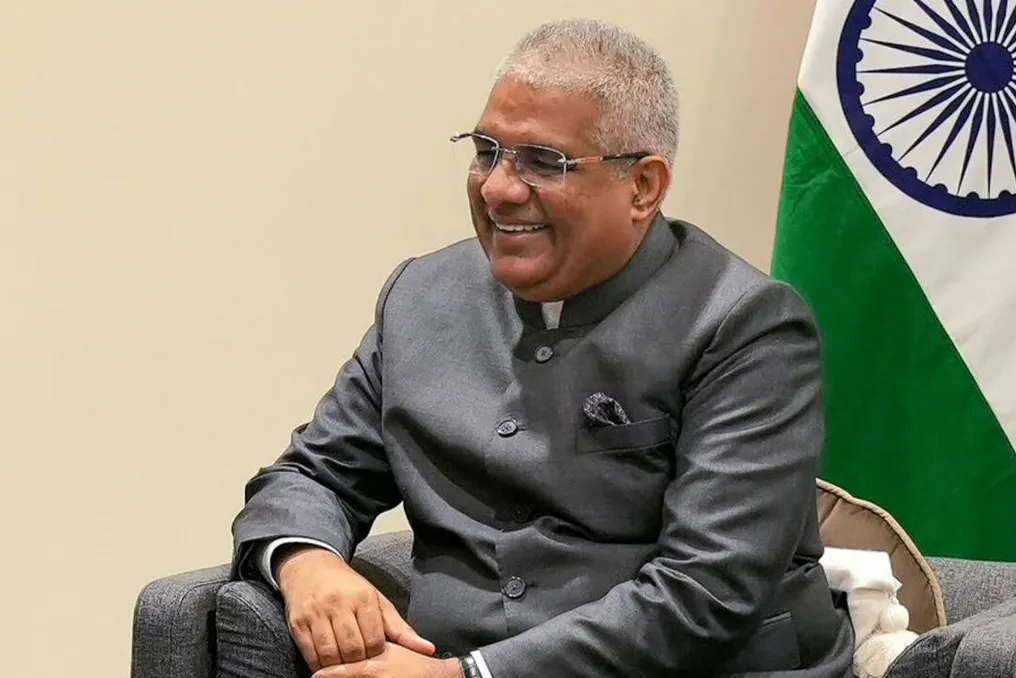
The Union Minister of Environment of India, Bhupender Yadav, stated that the absence of a decision at COP31 will not lead to a halt in climate activities in the country. He emphasized that India continues to fulfill its domestic obligations and maintains commitment to a multilateral consensus approach on the way to COP32.

Yadav, who headed the Indian delegation at the COP31 conference held in Antalya, Turkey, also cited the example of the expansion of the share of renewable energy in India. Thanks to this, the solar capacity in the country has already exceeded 170 GW.

Similar stories

India and developing countries challenge EU proposals on climate finance at COP31
Read more
business-standard.com

India and developing countries challenge EU proposals on climate finance at COP31

A tense atmosphere prevails at the COP31 conference as India, Russia, and other developing nations in West Asia oppose attempts by the Global North, led by the European Union, to ignore its commitments on climate finance.

Despite an agreement reached two years ago at COP29 in Baku, Azerbaijan, for an annual climate finance package of $300 billion for developing countries, representatives from developed and developing nations told Business Standard about the EU's indecisiveness.

It is reported that the EU, Switzerland, and New Zealand objected to the substance of the final draft text on climate finance, seeking to exclude all key provisions obligating them to a climate finance program, as well as its duration. The EU insists on concluding this program next year, while developing states believe it should run until 2028, since work on the program has not yet begun.

Signs of the EU's attempt to evade financial obligations were evident in the modest sums proposed on Tuesday. Responding to the Adaptation Fund Pledge Session the evening before COP31, Pooja Dave, Head of Adaptation at Climate Action Network International, stated: 'Adaptation is a matter of survival, but what was presented is sheer injustice. Last year, only $135 million was promised; now, only $50 million.'

According to the latest 2026 Adaptation Gap Report by UNEP, developing countries will require $420 billion annually, adjusted for inflation. Climate activists note that developed countries have provided only 5 percent so far and resist the binding commitment to triple adaptation flows annually to $120 billion.

Dave added: 'Four years of unfulfilled promises is not a funding gap, but a failure of political will by developed countries.'

Environment Minister Bhupender Yadav, representing India at COP 31, stated on Wednesday that India calls for climate action based on justice and climate justice. He emphasized: 'The warming of the planet is a consequence of two centuries of industrialization and economic growth in some countries, fueled by unlimited greenhouse gas emissions. It is unreasonable to expect the Global South to bear the burden of solving the consequences of these historical emissions in the name of 'higher ambitions.'

Global Electrification and Fossil Fuel Phase-out Discussed at COP31
Read more
noticiasaominuto.com

Global Electrification and Fossil Fuel Phase-out Discussed at COP31

The second day of discussions at the 31st United Nations Climate Change Conference (COP31), held in Turkey, concluded with focus on promoting global electrification and phasing out fossil fuels. The working agenda was also approved on this day.

The conference chairman, Turkish Environment Minister Murat Kurum, noted the positive start to negotiations following the adoption of the working agenda, as similar procedures at UN meetings previously led to multi-day deadlocks. Kurum reiterated the call for cooperation to solve this global problem, stating: 'We want this COP to be a COP of implementation and to adopt decisions that change the situation.'

The second day of COP31 centered on energy and transport issues. It was marked by calls to accelerate the transition, which is necessary not only to reduce emissions but also to protect economies from oil and gas price volatility. For instance, UN Secretary-General António Guterres made similar statements.

Simon Stiel, UN Executive Secretary for Climate Change, emphasized that in less than ten years, renewable energy has surpassed coal in global electricity generation. He compared this progress to what was 'unimaginable' at the time the Paris Agreement was signed in 2015.

Fatih Birol, Executive Director of the International Energy Agency (IEA), stated that the current energy crisis has shifted government priorities. He noted that for the first time in a long time, energy security goals and the transition to clean energy are closely linked. Birol also reported that electric vehicle sales outside of China grew by 60% over the last nine months, and the number of nuclear power plants under construction reached 90 gigawatts—the highest level in four decades.

Turkey and Australia, which jointly chair the conference, advocate for increasing the share of electricity in global energy consumption from the current 23% to 35% by 2035. However, this proposal faces resistance from hydrocarbon-producing countries, who object to the electrification goal because it implies the exclusive use of renewable and nuclear energy sources.

Birol added that this commitment could, in any case, send a clear signal to markets that 'electricity is the future.'

The day was also remembered for Brazil's presentation of a roadmap designed to help countries gradually phase out oil, coal, and gas. This initiative aims to translate commitments made in Dubai in 2023 into concrete measures, marking the first time the start of the fossil fuel transition was agreed upon. The document does not set mandatory requirements but provides tools for assessing each country's energy dependence and developing strategies tailored to its realities.

During the presentation, former US Secretary of State John Kerry stated: 'We don't need more promises. We need plans,' a sentiment supported by the UN Secretary-General.

Mobility issues in Antalya, which began with the opening of COP31 on Monday, worsened today due to traffic restrictions imposed before the arrival of heads of state and government. The President of Brazil was among those who arrived at the world leaders' summit today, Wednesday. Turkish authorities suspended classes on Wednesday and Thursday to reduce traffic during the leaders' meeting on those days.

Swedish activist Greta Thunberg participated in the conference, returning to the UN climate summit for the first time since Glasgow (UK) in 2021. She criticized the fact that despite decades of negotiations, emissions continue to rise.

COP31 begins in Turkey with divergences over climate finance and action targets
Read more
noticiasaominuto.com

COP31 begins in Turkey with divergences over climate finance and action targets

The 31st United Nations Climate Change Conference (COP31) has begun in Turkey. The event takes place after a year marked by extreme weather events, such as floods and heatwaves, generating tensions regarding the financial resources needed for adaptation and mitigation of the climate emergency.

António Guterres, UN Secretary-General, called on leaders to 'be up to the task,' while Murat Kurum, Turkish Minister of Environment and conference president, emphasized during the opening session that 'any delay weighs particularly heavily on climate action.'

In 2026, the planet was again affected by climate change, evidenced by fatal floods in Nepal, heatwaves in Europe, and fires in Indonesia. Simultaneously, the energy crisis, driven by the Middle East conflict, has pressured costs and created significant budgetary challenges for governments, which ultimately diminishes climate ambition.

Held at the large exhibition center of the Turkish coastal city of Antalya, COP31 aims primarily to transform commitments made in previous UN meetings into practical measures. Maria da Graça Carvalho, Portugal's Minister of Environment and Energy, had previously argued that COP31 should be a conference focused on actions.

COP31, which brings together nearly 200 nations under the UN umbrella and has 68,544 accredited participants, is expected to be the forum for the 'implementation' of promises, according to Murat Kurum. Delegations spent the early hours of the start day negotiating the agenda. The main point of disagreement lies in the funding promised by developed countries—historically the largest greenhouse gas emitters—to developing countries.

A representative from the European Union had already signaled on Friday a lack of political will to increase spending. Jasper Inventor, leader of the Greenpeace delegation, described the start of COP31 as 'difficult,' warning that rich countries are refusing, especially, to include certain funding items on the agenda.

The 'Climate Finance Working Programme,' a mechanism defined at COP30 in Brazil in 2025 to discuss financial agreements, will be officially discussed. However, the tripling of funding for climate change adaptation, crucial for protecting nations most susceptible to droughts, floods, or sea-level rise, is not guaranteed.

The UN reported last week that developing countries will need $305 billion annually by 2035, an amount almost ten times higher than what they currently receive from wealthy nations. Simon Stiell, the UN's Climate Change Officer, acknowledged that 'frustration is palpable' in this context.

Another controversial issue is Turkey's intention to make electrification a central focus of COP31, suggesting that countries commit to raising the share of electricity in global energy consumption to 35% by 2035, compared to the current 20%. The European Union supports electrification with renewable sources, a position also defended by Maria da Graça Carvalho. However, several hydrocarbon-producing countries show resistance to accepting this proposal.

COP30, held in Belém, in the Brazilian Amazon, concluded without explicitly mentioning fossil fuels. In contrast, Brazil presented last week a 'roadmap' for countries to voluntarily replace oil, coal, and gas with renewable energies.

During a summit co-chaired by Turkey and Australia, Chris Bowen, Australian Minister for Climate Change, encouraged delegations to overcome divergences and prove that international cooperation can still yield results. He argued that 'we will show the world that multilateralism works,' despite the boycott by the US government, motivated by President Donald Trump's denial of climate change.
Popular