Three works by Aleijadinho are being presented for the first time in the Vatican Museums from November 17 to February 13, 2027. This master from Minas Gerais is featured in an exhibition titled 'Antônio Francisco Lisboa, known as Aleijadinho – Master of Brazilian Baroque.' It showcases images of Sant'Ana Meira, São Joaquim, and São Manuel, which were brought from various communities in Minas Gerais after restoration in 2021.
These sculptures are displayed in the Borgia Tower halls, which are part of the route to the Sistine Chapel. In addition to the three images, the exhibition includes photographs taken by Marcel Gôter in Congonhas, provided by the Moreira Sales Institute, as well as video recordings of the restoration process and the celebration of Sant'Ana Meira.
This initiative is part of the program celebrating two centuries of diplomatic relations between Brazil and the Holy See, bringing the baroque master closer than ever to one of the world's largest collections of sacred art.
Curated by Alex Calheiros, the exhibition demonstrates different stages of the sculptor's work. His work merges European Baroque and Rococo references with his own language developed in Minas Gerais.
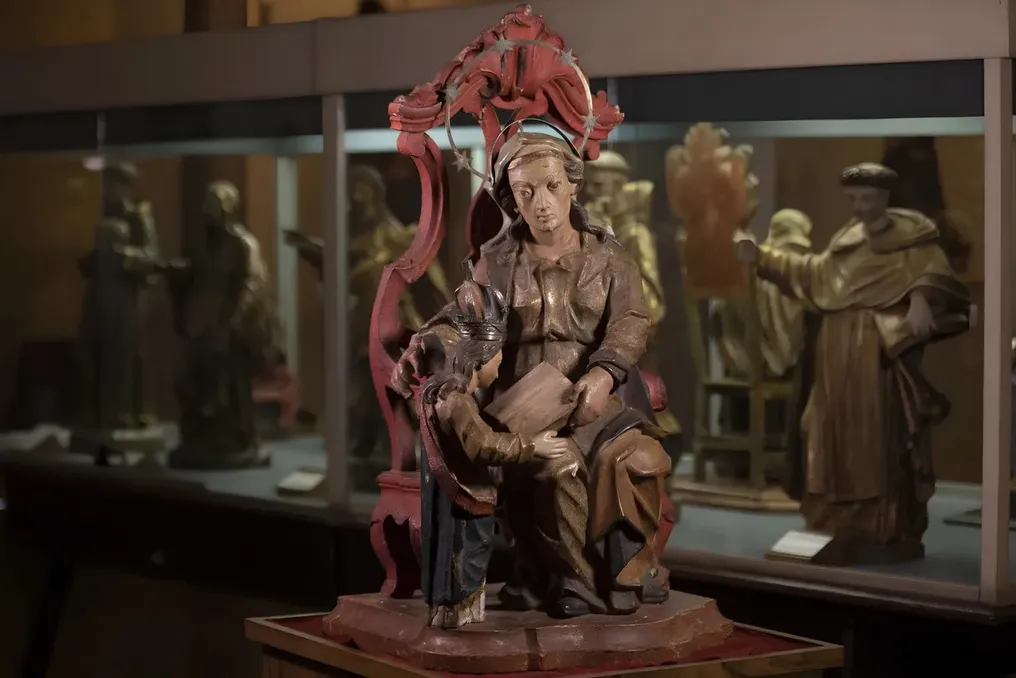
The first image, Sant'Ana Meira, is located in the chapel dedicated to this saint in the Chapada de Ouro Preto community. The sculpture depicts the mother of Mary and the grandmother of Jesus teaching her daughter the first letters. This work was created between the late 18th and early 19th centuries.
The dynamic drapery of the saint recalls the Baroque, while the details of the chair and the elongated body suggest Rococo influence. It is possible that this work was executed at the same time as Aleijadinho's sculptures for the Bom Jesus de Matosinhos Sanctuary in Congonhas.
São Joaquim belongs to the parish of Nossa Senhora da Conceição in Raposo. The image presents the grandfather of Jesus as an elderly man with a gray beard and hair, leaning on a staff. The posture and gaze give the figure movement, and its elongated proportions follow Rococo aesthetics. Devotion to São Joaquim has grown in Minas Gerais alongside the cult of Sant'Ana.
The third piece, São Manuel, belongs to the parish of Nossa Senhora do Bonsucesso in Caeté and represents a less common depiction in Brazilian sacred art. Having Eastern origins, this saint is associated with Persia and is mentioned in apocryphal tales. His veneration reached Minas under Portuguese influence. Aleijadinho depicted him with marks of martyrdom: nails pass through his ears and flanks of the chest, and his neck indicates decapitation. Standing, with folded hands and a silver glow above his head, the figure has a vertical composition characteristic of the Rococo.
Before entering the Vatican Museums, the three sculptures underwent a preservation process in Belo Horizonte. The work was carried out in 2021 by Casa Fiat de Cultura in partnership with Grupo Oficina de Restauro and technical support from the National Historical and Artistic Heritage Institute (Iphan).
The project, titled 'Aleijadinho Baptized, Art Revealed,' lasted five months and required over 500 hours of work. During this time, the sculptures were subjected to X-ray, infrared, and ultraviolet fluorescent examinations. These procedures helped study the structure of the sculptures, identify old interventions, and determine necessary care measures.
The public could also observe the work in a display workshop specially equipped so that visitors could see the procedures and daily activities of the specialists.
The analyses led to discoveries about the history of the works. In the case of São Manuel, the studies confirmed the originality of the painting. The sculpture was cleaned, and cracks in the wood joints were treated without erasing traces of time.
Regarding São Joaquim, infrared and ultraviolet fluorescent range studies showed that the oldest paint had been completely removed. Researchers discovered a subsequent layer of paint dated December 7, 1921.
Sant'Ana Meira required additional care as she underwent restoration in the 1960s. Examinations revealed details hidden under layers of mass, such as the drawing of a high and clearly defined eyebrow, as well as facial features and hair.
After completion, all three works were returned to the Minas communities responsible for their custody. Iphan also provided recommendations for preserving the collection, which is now gaining international recognition in the Vatican.
Antônio Francisco Lisboa (1738–1814), known as Aleijadinho, was a sculptor, carver, and architect born in Ouro Preto, Minas Gerais. He is considered one of the main figures of colonial Brazilian art, whose work combines elements of Baroque and Rococo.
His works are scattered throughout the historic cities of Minas, such as Ouro Preto, Sabará, Tiradentes, and São João del Rei. Among his most famous works is the complex of the Bom Jesus de Matosinhos Sanctuary in Congonhas. This complex unites sculptural and architectural elements created by the artist and is recognized as a UNESCO World Heritage site. This work strengthened Aleijadinho's significance in the history of Brazilian art.