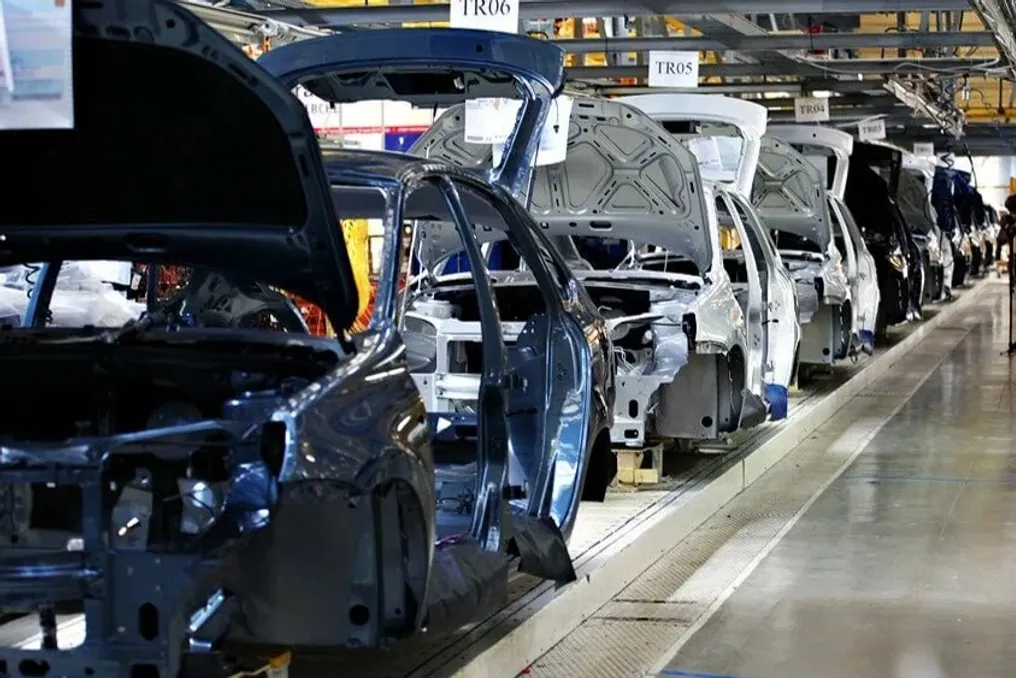
Vehicle production in Iran has dropped to 400 thousand units in seven months
Read more
Tehran Times
www.tehrantimes.com

Vehicle production in Iran has dropped to 400 thousand units in seven months

According to a report by Mehr News Agency, Soheil Memarbashi, deputy of the Iranian Industrial Development and Reconstruction Organization (IDRO), stated in a television interview that 610 thousand vehicles were produced in the first seven months of last year. However, since the beginning of the current year until the end of Mehr (October 20), this figure has decreased to approximately 400 thousand cars.

Memarbashi added that the production decline amounted to about 33% compared to the same period last year. The reason for this is the restriction on foreign currency distribution and limitations on the import of auto parts. He also noted that efforts are being made to compensate for the drop in production volumes during the remaining period until the end of the year.

Furthermore, Memarbashi explained that automotive policy is determined by the Automotive Committee of the Ministry of Industry, Mining, and Trade. This committee includes the Deputy Minister of Industry, Mining, and Trade for Mechanical Engineering and Equipment, the CEO of the Industrial Development and Reconstruction Organization, and the head of the Consumer and Producers Protection Organization. They are the ones who make decisions regarding the allocation of foreign currency for raw materials and components, methods of vehicle supply, and price control.

Similar stories

MARUTI Fronx model reaches 600 thousand units shipped
Read more
www.aajtak.in

MARUTI Fronx model reaches 600 thousand units shipped

MARUTI Suzuki is the largest automotive company in the country, selling millions of cars monthly in India. One of this brand's powerful SUV models has reached a new significant milestone. This refers to the MARUTI Suzuki Fronx, with 600 thousand units shipped wholesale. This figure covers the period from April 2023.

The Fronx is the only SUV sold through NEXA MARUTI dealerships that has reached the mark of 600 thousand shipped units. For the financial year 2027, 130,149 units of this car were sold. These figures relate to the period from October 2026 to April 2026. In the current financial year, this model has surpassed the Baleno.

The MARUTI Suzuki Fronx has become the best-selling NEXA car this year. Furthermore, the company exported 220 thousand units of this model to other countries. In the financial year 2024, 134,735 units of this car were sold. In the financial year 2025, 166,216 units were shipped, and in the financial year 2026, 172,363 units were shipped.

As mentioned earlier, in the current financial year, the company shipped 130,149 units of the Fronx, totaling 603,463 shipped units. Currently, this car is available in Sigma, Delta, Delta Plus, Gamma, and Alpha trims. Its price ranges from 6.90 lakh to 11.89 lakh rupees, including export duties.

The car is equipped with a 1.2-liter four-cylinder petrol engine with an output of 90 hp. In the CNG version, this engine provides 77.5 hp. A 1.0-liter three-cylinder turbocharged engine is also available. The petrol engine offers options with a five-speed manual transmission and a five-speed AMT automatic transmission. The CNG option is available only with a five-speed manual transmission. The turbocharged engine is offered with a five-speed manual transmission and a six-speed torque converter automatic transmission.

The CNG version provides a fuel consumption of 28.51 kilometers per kilogram. The car is equipped with safety features such as 6 airbags, hill hold assist, ABS, EBD, and ESP. The MARUTI Suzuki Fronx directly competes with models such as Renault Kiger, Nissan Magnite, and Hyundai Venue.

Uzbekistan's auto industry produced over 356 thousand vehicles, with Chevrolet Cobalt dominating
Read more
podrobno.uz

Uzbekistan's auto industry produced over 356 thousand vehicles, with Chevrolet Cobalt dominating

Over 356 thousand passenger cars were produced in Uzbekistan during the first nine months of 2026. These production volumes demonstrated a noticeable growth compared to the same period last year. The Chevrolet Cobalt once again proved to be the most sought-after model.

According to data from the National Committee on Statistics, 356.3 thousand passenger cars were manufactured in the country from January to September. This represents an increase of 29.9 thousand units, which is a growth of 9.2% compared to the same period in 2025.

The Chevrolet Cobalt was the leader in production volume, with 120.7 thousand units rolling off the assembly lines over nine months. Damas took second place, producing 63.4 thousand cars. Additionally, 34 thousand Tracker, 27.2 thousand Onix, 26.7 BYD models, and 24.8 thousand KIA vehicles were produced during the reporting period.

Uzbek enterprises also produced 7.2 thousand Chery, 6.9 thousand Haval, and 2.1 thousand Chevrolet Damas Move vehicles. Production of the TANK 500 during the same period amounted to only two units. It should be noted separately that slightly over 43 thousand special passenger cars were produced from January to September.

The German automotive group Volkswagen intends to begin manufacturing seven different car models in Uzbekistan. Initially, knock-down assembly will be organized in Tashkent, after which the full production cycle will be transferred to a new plant located in the 'Angren' free economic zone.

Popularity of alternative fuel vehicles grows in India: CNG, hybrids, and EVs surpass gasoline and diesel models
Read more
www.aajtak.in

Popularity of alternative fuel vehicles grows in India: CNG, hybrids, and EVs surpass gasoline and diesel models

A noticeable shift is occurring in the Indian automotive market: the dominance of gasoline is weakening as vehicles running on compressed natural gas (CNG), hybrid, and electric models gain popularity. In October, the share of these three types of vehicles exceeded that of gasoline cars.

Meanwhile, the total volume of car sales decreased by 14.23% year-on-year. However, compared to September, the market showed an increase of 18.86%, indicating that the market is not stagnant but rather that consumer preferences are changing. Data provided by FADA confirms this trend.

According to the latest FADA data, 507,768 passenger vehicles were sold in October. Nevertheless, the timing of Diwali in November influenced October's sales. This month sees a significant change in buyer preferences, with consumers increasingly choosing alternative fuel vehicles over gasoline and diesel ones.

Comparing with last year, 592,032 passenger vehicles were sold nationwide in October of the previous year. Compared to this year, the figure dropped to 507,768 units, reflecting a 14.23% decline in year-on-year sales. However, when compared to September 2026, the picture looks much better: 427,213 passenger vehicles were sold in September, while in October, the number increased to 507,768 units, representing a monthly sales growth of 18.86%.

FADA believes that the drop in annual sales should not be seen as a lack of market demand. The main reason is the high demand last year, when the Navratri and Diwali festivals occurred simultaneously in October. Furthermore, purchases grew despite the reduction in tax rates under GST 2.0. In 2026, customers postponed their purchases for a while because Diwali was moved to November, which affected October figures.

In October, sales of passenger vehicles grew in both urban and rural areas, with the urban market showing better results. Compared to September, retail sales of cars in urban areas rose by 20.10%, accounting for 61.7% of total sales. In rural areas, the monthly growth was 16.90%, with the rural sector accounting for 38.3% of the total passenger vehicle sales.

The most significant change in the automotive market in October relates to fuel choice. For the first time, the combined share of vehicles with supplementary fuels, such as CNG, hybrids, and electric vehicles, surpassed the share of gasoline and ethanol blends. According to statistics, the overall share of gasoline and ethanol vehicles decreased to 41.60% in October, compared to 48.96% in October 2025. On the other hand, the share of vehicles with supplementary fuels grew to 41.83%. CNG vehicles contributed the most to this growth, reaching a share of 24.59%. The share of hybrid vehicles was 9.94%, and the share of electric vehicles was 7.30%. The share of diesel vehicles remained at 16.57%, indicating a shift by consumers from gasoline and diesel to other types of fuels.

One factor contributing to this is the rise in gasoline prices and recent debates surrounding E20. Consumers remain uncertain about E20 fuel. The government acknowledged that using E20 fuel could lead to a 3% to 6% decrease in fuel consumption. Additionally, the possibility of component damage in older vehicles may have forced buyers to change their choices.

Demand for electric passenger vehicles also significantly increased. During Navratri 2026, retail sales of electric vehicles jumped by 36.66%, reaching 13,349 units. This is attributed to the price of electric vehicles approaching the prices of gasoline and diesel models, as well as improved range, making EV purchase more accessible to customers.

According to FADA, the inventory level of passenger vehicles in October was maintained at 43–45 days, unchanged from September. However, it is expected that purchases will increase in November during Dhanteras and Diwali, which could lead to a decrease in dealer stock. Actual sales data during Diwali is yet to be received.
Popular