Unveiling the Mystery: Who Was the Dog Accompanying the Pandavas on Their Final Journey to Heaven?
Read more
Aaj Tak
www.aajtak.in

Unveiling the Mystery: Who Was the Dog Accompanying the Pandavas on Their Final Journey to Heaven?

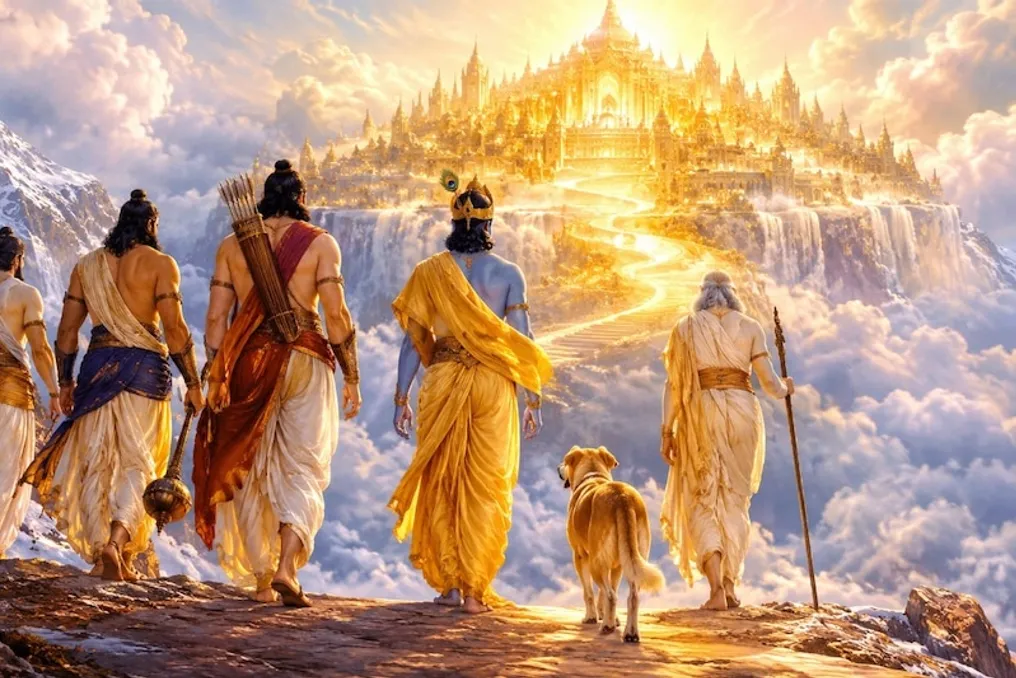
The Pandavas were heading towards Mount Swargarohini from Badrinath on their final journey. The name Swargarohini itself means the path of ascent to heaven, although this does not imply the existence of physical gates through which a person could enter paradise. This episode from the Mahabharata symbolizes the spiritual path, self-sacrifice, and the victory of Dharma.

According to information, Vaikuntha Chaturdashi falls on November 23rd this year. There is a belief that on this day, Hari-Hara, meaning the gods Vishnu and Shiva, are worshipped. Vaikuntha Chaturdashi is the only day of the year when the path to heaven is believed to open. Among the stories associated with heaven, the episode of Draupadi's and the five Pandavas' last journey is considered extremely mysterious and inspiring.

When the five Pandavas and Draupadi set out on their final journey, leaving behind royal treasures, a dog began to accompany them. While passing through the difficult mountainous regions of the Himalayas, Draupadi and four of the Pandavas began to fall one after another. However, Yudhishthira did not look back. Only this dog remained with him until the end of the journey.

When they reached the gates of heaven, Indra asked Yudhishthira to enter heaven, leaving the dog behind. He refused this offer. It was at this moment that the greatest test of Dharma, compassion, and devotion occurred.

According to Mahaprasthanika Parva, the dog that accompanied the Pandavas during their last journey was actually Dharmadeva (Yamaraja). He took the form of a dog to test Yudhishthira. When Indra invited him to heaven alone and forbade him from taking the dog, Yudhishthira clearly stated that he could not accept the bliss of heaven while leaving the animal that had accompanied him through difficult times. By making such a decision, Yudhishthira pleased Dharmadeva, who appeared in his true form. He informed him that Yudhishthira had once again demonstrated Dharma and compassion. After this, the path to heaven was opened to him.

The last journey of the Pandavas is associated with the inaccessible peaks of the Himalayas, which are visible today in the Gadwal region of Uttarakhand. The Pandavas moved further away from the Badrinath region towards Mount Swargarohini. The name Swargarohini literally means the path of ascent to heaven. Mount Swargarohini is located near the Gangotri region in Uttarkashi district, Uttarakhand, and is part of the high Himalayan ranges. The area around it is very inaccessible, and reaching it is not easy. This area is known for both mountaineering and challenging Himalayan treks.

Swargarohini is considered the site of the Pandavas' last journey. Nevertheless, this does not mean that there is a physical entrance where a person can enter heaven. The episode from the Mahabharata serves as a symbol of the spiritual journey, renunciation, and the triumph of Dharma. Swargarohini is not just a mountain range, but a place connected to faith and mythological history. The difficult geographical conditions here remind man of the limits of life and the greatness of nature. The message of the Pandavas' last journey is that at the end of life, what remains with a person is not wealth, power, and luxury, but their deeds, truth, and Dharma.
Similar stories

Buddha Remains Found in Piperhawa Arrive at Golden Pagoda Arunachal
Read more
www.aajtak.in

Buddha Remains Found in Piperhawa Arrive at Golden Pagoda Arunachal

Sacred relics associated with the Buddha arrived in Arunachal Pradesh, in the Namsai district, on Saturday, November 14. These relics are housed in the Golden Pagoda, and pilgrims can visit until November 20. Afterward, on November 21, the relics will be returned to the National Museum in Delhi.

These artifacts are linked to the Piperhawa area in Siddharthnagar district, Uttar Pradesh. It is believed that the Piperhawa territory is connected to the ancient Kapilavastu and the Shakya clan, to which the Buddha belonged. These relics are highly valued by followers of Buddhism.

The relics first arrived in Arunachal Pradesh on October 31. Initially, they were displayed at a historical monastery in Tawang, where an exhibition took place for seven days, allowing about 31,000 pilgrims and other people to see them. Then, on November 8, they were transported to Bomdila, Paschim Kameng district, where a six-day exhibition was held at the TGL monastery, known as Lower Gompa, from November 8 to 13.

The Deputy Minister of Arunachal Pradesh, Chowna Men, called the arrival of the relics in Namsai an important moment for the state's Buddhist community. He emphasized that these relics are connected to the ancient Shakya clan and the life of the Buddha, holding immense religious and historical significance for Buddhist communities worldwide.

On social media, he wrote that the sacred relics from Piperhawa of the Shakyamuni Buddha clan arrived in Namsai on the occasion of Abhidhamma Day, or Lhabab Duchen. This exhibition provides pilgrims with the opportunity to pray, meditate peacefully, and connect with the Buddha. Abhidhamma Day is a special day in Tibetan Buddhist tradition when the Buddha's return from the heavenly realm to Earth is commemorated.

The history of these relics spans about 128 years. In 1898, British engineer William Clakston Pepp conducted excavations of an ancient Buddhist stupa in Piperhawa, Uttar Pradesh. During these works, stone and crystal boxes containing bone fragments and many valuable items were discovered.

One of the boxes bore an inscription mentioning the role of people from the Shakya clan in preserving the Buddha's remains. This is why these relics are associated with the ancient Shakya clan and the Buddha himself. Piperhawa is considered an area connected to ancient Kapilavastu, the place where the Shakya clan resided and where the Buddha spent the beginning of his life.

These relics, found in Piperhawa, are kept in the National Museum in Delhi. The organization of the exhibition in Arunachal Pradesh was carried out by the Ministry of Culture of the central government in collaboration with the Government of Arunachal Pradesh, the International Buddhist Confederation, and the National Museum.

In addition to the exhibition itself, special exhibitions are being held dedicated to the discovery of the Piperhawa relics and their historical significance to inform people about this story connected to the Buddha. Pilgrims will have the opportunity to see these relics in Namsai until November 20, after which they will be returned to Delhi on November 21.

Popular