
Work-from-home earning opportunities: ways to generate income without visiting an office
Read more
Aaj Tak
www.aajtak.in

Work-from-home earning opportunities: ways to generate income without visiting an office

Some people enjoy working from home, while others prefer office work. Currently, many are focused on achieving a work-life balance and are looking for remote earning opportunities.

It is important to understand that passive income does not mean receiving money without any effort. It implies creating a source that initially requires investment of time, labor, skills, or capital. After proper planning and constant monitoring, this source can become an additional way to earn income.

In the context of changing economic needs, relying solely on one job or salary can become a problem for many. Therefore, preparing alternative sources of income helps increase financial security. For this, it is not necessary to start a large business or build a team; you can find options for supplementary earnings by using your knowledge, skills, and financial planning.

If you want to monetize your knowledge or skills, creating digital products is a good option. If you enjoy writing, graphic design, or explaining complex topics in simple language, you can prepare e-books, design templates, practical worksheets, or online courses. After creating these materials, they can be uploaded to digital platforms where people in need can purchase them.

If you have a good audience on social media or your own blog and website, you can try affiliate marketing. In this case, you share a link to a product from a company or platform. When a person makes a purchase through this link, you receive a commission according to the established terms. However, the income in this case depends on traffic, people's trust, and actual purchases.

Today, small and large businesses strive to reach their customers through social media. Because of this, they need specialists who can manage their accounts. This work may include preparing posts, writing captions, creating content plans, and responding to comments. All of this can be done without leaving home.

If you possess skills such as copywriting, graphic design, video editing, web development, or social media management, freelancing can be an excellent choice. You can work for various clients. To find orders, you can create a profile on platforms such as Fiverr, Upwork, and Freelancer.

Similar stories

Study reveals optimal work mode: how many days a week should be spent in the office
Read more
www.aajtak.in

Study reveals optimal work mode: how many days a week should be spent in the office

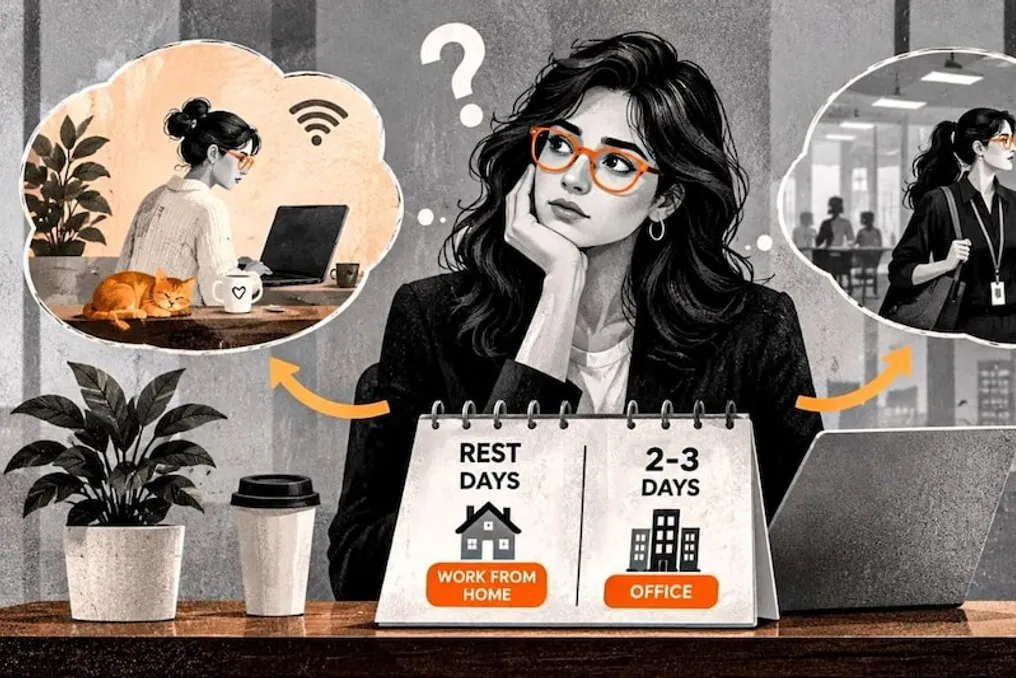
Following the coronavirus pandemic, work methods have undergone significant changes. Many companies have provided employees with the option to work from home, while others have urged them to return to the office. This raises the question for employees about the necessity of daily office attendance or the possibility of achieving better productivity by working from home for part of the week. Various studies present a very specific picture, suggesting that for many employees, the best balance might be working in the office two or three days a week, with the remaining days spent at home.

According to research findings, a hybrid work model combining office and home work can be beneficial for staff. One large online travel company conducted a study involving over 1500 employees. Some of these employees were given the option to work from home two days a week, while others worked permanently in the office.

Analysis of these employees' performance over two years showed that the quality of work for those who worked remotely did not decrease. Moreover, these employees had a lower probability of leaving the company. This effect was particularly noticeable among women and employees who traveled long distances to the office.

In another study, 148 employees were asked to come into the office with varying frequencies. Employees who worked in the office about two days a week reported a better work-life balance, greater job satisfaction, and less loneliness. Their work productivity did not suffer.

These findings indicate that giving employees the option to work from home several days a week, instead of requiring daily presence, can improve their work experience.

Nevertheless, the studies also highlight the advantages of collaborative work in the office. Experiments conducted in five countries showed that the process of generating new and creative ideas can be disrupted when communicating via video calls. Furthermore, an analysis of about 20 million research papers and 4 million patents indicated that the likelihood of a new discovery or major success in remote teams was lower than expected.

This means that for tasks requiring discussion of new ideas, brainstorming, and collaborative problem-solving with a team, physical presence can be useful. At the same time, tasks requiring high concentration can certainly be done from home.

Another aspect identified in the research is this: if companies set a minimum number of days an employee must spend in the office but do not limit the maximum number of days, this can lead to a gradual increase in pressure to attend the office. A study conducted among over 1000 managers in the UK showed that employees working from home might fear being considered less suitable for promotions or salary increases. That is, in some places, office presence can be linked to career growth.

An important takeaway from the research is that the days spent in the office should be consistent for the entire team. A study conducted among approximately 48,000 employees found that in teams where office attendance time was not clearly defined, innovation suffered more severely. This could happen because employees came to the office, but their colleagues were not there. In such cases, they did not benefit from coming to the office and continued to work via video calls.

Based on the research results, three points are considered important for the effective implementation of a hybrid work model:

Firstly, both a minimum and a maximum number of days for office visits per week should be established. Secondly, efforts should be made for the entire team to come to the office on the same day to ensure collaboration. Thirdly, tasks must be distributed according to the nature of the work: tasks like brainstorming, team meetings, and mentoring new employees should take place in the office, while tasks requiring high concentration can be done from home.

Overall, the studies do not claim that one work model suits everyone. However, their results convincingly demonstrate that daily office presence does not guarantee better productivity. Companies should find a balance between office and remote work, taking into account employee needs, the nature of the work, and team interaction.

Horoscope for Libra on November 17, 2026: Controlling Expenses and Improving Well-being
Read more
www.aajtak.in

Horoscope for Libra on November 17, 2026: Controlling Expenses and Improving Well-being

According to the horoscope for Libra on November 17, 2026, it is necessary to focus on work. It is also recommended to make decisions regarding real estate thoughtfully.

Overall, an increase in the level of comfort and amenities is expected. It is important to avoid outbursts of anger while performing work duties. Health will remain in good condition, and business matters will be successful.

Study shows how a colleague's departure affects employees' emotional state in the office
Read more
www.aajtak.in

Study shows how a colleague's departure affects employees' emotional state in the office

In every office, there is usually a colleague who can lighten the burden of Monday. This person might reserve a spot for you during lunch, understand your hints after tiring meetings, share jokes, and know when you need a cup of strong tea or coffee most, even if their name is not listed on your employment record. These are likely the people who are the main reason why one wants to go to work every day.

Friendship in the office is often ignored as a mundane aspect of work, but new research demonstrates that these relationships deeply influence how employees feel about their job, how effectively they work, and whether they want to stay with the company.

The report 'Human Connection: The Crucial Secret to Thriving in the Digital Age' by 'Wily Workplace Intelligence' (2024) presents a number of striking data points. According to the survey, 78 percent of employees reported feeling connected to their colleagues, and 69 percent prefer to build relationships with colleagues in the office. Importantly, 59 percent of workers stated that having friends in the office directly influences their decision to remain with the company.

Similarly, a Gallup study links having a best friend at work to improved engagement, stronger collaboration, and longer employee tenure. Statistics show that where close friends exist, employees are more willing to share their thoughts and opinions.

The true value of these relationships manifests in difficult moments. When there is high work pressure, an awkward conversation with a manager, or a sudden tight deadline, having someone to listen without judgment significantly reduces stress levels. An analysis published in the journal 'Work' in 2024 asserts that friendships in the office strengthen employees' mental health, mutual trust, and emotional support. Simply put, having 'your own' person at work prevents the workplace from feeling lonely or burdensome.

There is another side to workplace friendship. When a close colleague resigns, transfers, or moves to another company, it causes significant personal sadness. Lunch breaks suddenly become quiet, daily conversations disappear, and the workplace starts to feel foreign. Often, it is at this moment that other employees begin to re-evaluate their attitude towards work. This does not mean they will immediately quit, but their emotional attachment to the office certainly weakens.

No, it cannot be forced. No employee wants to be part of a mandatory 'best friend program' or forced team-building sessions. However, companies can create an atmosphere where these relationships arise naturally. Joint projects, benevolent and supportive managers, and an inclusive environment simplify the process of mutual trust for employees. Ultimately, people join companies for salary, position, and career growth. But often, it is the person sitting next to them at the desk who becomes the real reason they stay longer. And when that person leaves, the gleaming office simply becomes a place to fulfill duties.

Popular