College team creates new spring to double drinking water reserves in Unchaun village (Uttarakhand)
Read more
The Better India
thebetterindia.com

College team creates new spring to double drinking water reserves in Unchaun village (Uttarakhand)

In the mountainous settlements of Tehri Garhwal district in Uttarakhand state, the amount of available drinking water for families varies greatly depending on the season. Many households rely on natural sources fed by rainfall and underground water reserves. As summer approaches and the flow from these springs decreases, residents have to cope with increasingly limited supplies.

Residents of Unchaun village in Kirtinagar block faced seasonal water shortages, which is a common problem for several other villages in this region. An annual report for 2023–24 prepared by the Himmattan Society records similar difficulties in Sabli village, also located in Tehri Garhwal. According to a survey conducted in June 2022, all 52 households depended on the local spring during the summer period because the piped water systems were either unreliable or non-existent.

The flow of this spring decreased from 30 liters per minute during the monsoons to only five liters in May and June. Over four summer months, the village faced an estimated water deficit of 14 lakh liters. This data demonstrates how challenging dry months can be for communities dependent on mountain sources.

Now, researchers from the Indian Institute of Technology (IIT) Roorkee have a scientific solution: they developed a new spring in Unchaun using scientific methods to locate and bring groundwater to the surface. According to a Ministry of Education announcement dated November 2, 2026, this intervention increased the daily availability of drinking water from approximately 500 liters to 1000 liters or more during the dry season.

Where does the water in the Himalayan spring come from?

This initiative is part of the IIT Roorkee project titled 'Revitalization of Depleted Springs in the Takoli Gad Watershed of Tehri District, Uttarakhand.' The project is led by Professor Abhayanand Singh Maurya from the Department of Earth Sciences and is based on two studies examining the replenishment processes of Himalayan springs and water movement through underground rocks.

The studies were conducted in the Takoli Gad watershed—an area of 143 square kilometers in the Lesser Himalayas, within the Akland River basin. The first study, published in the 'Hydrological Sciences Journal' in October 2026, analyzed the origin of the spring water and its path underground. Researchers studied precipitation patterns and used measurements of various hydrogen and oxygen isotopes, including radioactive tritium, to track groundwater movement and recharge. Their findings highlighted the critical importance of monsoons for sustaining Himalayan springs.

Approximately 82% of the spring water recharge in the studied watershed occurs due to monsoon rains. Winter precipitation contributes about 10%, and pre-monsoon rains account for the remaining 8%. Simply put, most of the water that eventually emerges from these springs enters the ground during the rainy season. Some of this water remains stored underground, sustaining water sources even months after the monsoons end.

Researchers also studied how long water remains underground before emerging through springs. The second study, published in 'Applied Geochemistry' in 2026, examined the influence of the rocks under the hills on the chemical composition of the spring water. It was found that the interaction of water with carbonate rocks plays an important role, alongside seasonal precipitation, soil carbon dioxide, and human activity.

Together, these studies helped scientists understand the mechanisms of spring recharge, factors affecting water quality, and potential groundwater locations. IIT Roorkee achieved a doubling of water availability in the Himalayan village during the dry season, turning scientific research into a tangible result. Under the guidance of Prof. Abhayanand Singh Maurya, the project combines scientific understanding of spring recharge dynamics, groundwater processes, and geophysical surveys with targeted replenishment measures to address the issue of seasonal water scarcity. With support from 'Namami Gange,' the National Mission for Clean Ganga, Ministry of Water Resources of the Government of India, the project demonstrates the potential of research-based solutions for strengthening rural water security. Based on the two scientific papers published in 'Hydrological Sciences Journal' and 'Applied Geochemistry,' the initiative emphasizes how scientific knowledge can be transformed into effective, locally relevant interventions for Himalayan communities. Professor K.K. Pant, Director of IIT Roorkee, stresses the importance of socially impactful research, reinforcing the Institute's commitment to promoting sustainable solutions for critical environmental and water challenges.

How the team brought groundwater to the surface

The researchers began by studying the rocks under the slope to identify areas capable of retaining and conducting groundwater. After promising aquifers were identified, the team assessed their depth and extent. A trench system was then designed along the upward slope. These trenches help slow down rainwater runoff downwards, allowing more water to seep into the soil and replenish groundwater reserves.

On a suitable aquifer, the researchers created a controlled opening that allowed groundwater to emerge at the surface. This led to the formation of a new spring near the road leading to the Chandrabodhi temple. It is reported that this resulted in an increase of at least 500 liters in the daily volume of drinking water during the dry season, which is a potentially significant improvement for households dependent on local sources.

Can this help other Himalayan villages?

Throughout the Himalayas, springs are a vital source of drinking water, especially in remote villages where other sources may be unreliable. The project in Unchaun offers one way to combat seasonal scarcity: studying how water moves under a specific slope before deciding on an intervention. As explained by Prof. Maurya in the Ministry of Education release, 'Understanding the source, movement, and seasonal behavior of spring water is crucial for solving the water shortage problem.'

The project has shown promising preliminary results, but its long-term success will depend on whether the new spring can continue to supply water across changing seasons. Researchers will need to monitor its flow and water quality over time. For now, this intervention represents a potentially useful approach for other Himalayan villages facing similar shortages, demonstrating how research on such a familiar phenomenon as rainwater can help meet daily water needs.
Similar stories

Asian Development Bank Project Ensures 24/7 Water Supply in Karakalpakstan
Read more
uzdaily.uz

Asian Development Bank Project Ensures 24/7 Water Supply in Karakalpakstan

The Asian Development Bank (ADB) project, valued at 172.3 million US dollars, is expanding access to drinking water pipelines in six rural districts of Karakalpakstan, providing 24-hour water supply to 326,000 residents.

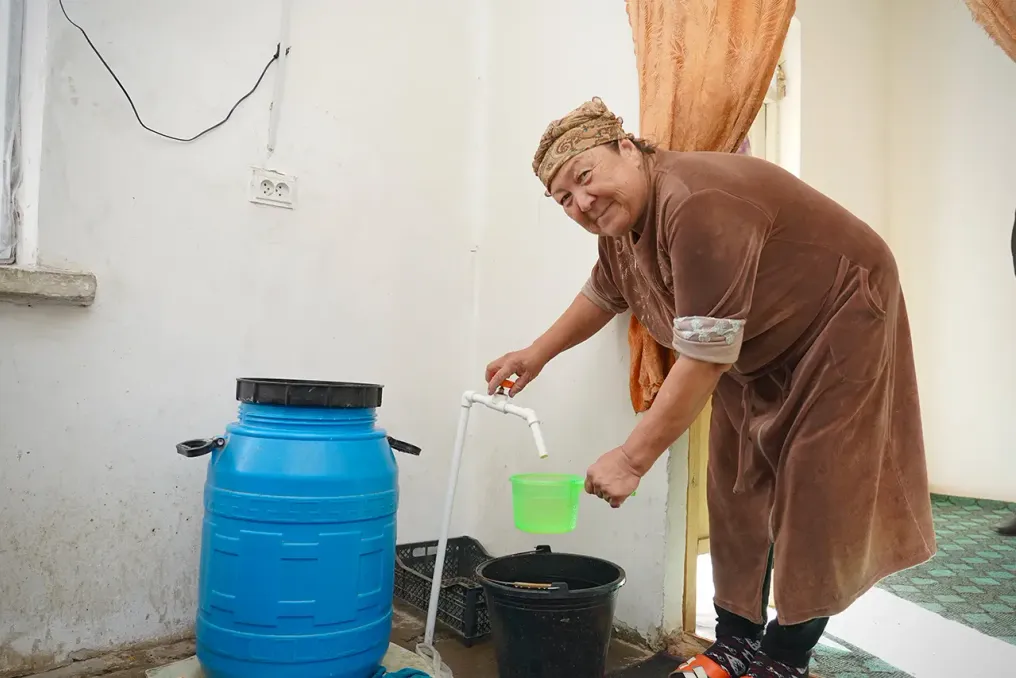
The districts covered by the project include Amudarya, Beruni, Karauzyak, Kungrad, Nukus, and Muynak. For many households, this is the first time they have received piped water in their homes. Previously, residents had to carry water in buckets, transport it in container carts, or pump it manually from wells.

In the village of Kerder, the last settlement connected to the new water supply system in the Nukus district, there live between 4,000 and 5,000 people. Before the project, this village lacked centralized water supply, but now it receives water around the clock.

Azamat Saparov, regional coordinator of the ADB project implementation group in Karakalpakstan, noted: 'Previously, there was no water in Kerder at all. People used to drink water from the canal or from wells using manual pumps. Today, they can use water 24 hours a day.'

Residents previously had to travel long distances by cart to collect drinking water. A project representative emphasized: 'Imagine it's raining, the streets turn into mud, and people have to travel several kilometers daily just to get 30–40 liters of water. Now every household has access to quality drinking water, and that necessity has disappeared.'

At the time of project preparation, only 36.6% of Karakalpakstan's population had access to centralized water supply, with this figure being 12.9% in rural areas. According to ADB, 40% of households received water for less than six hours a week, often under low pressure. Approximately 75% of families complained about the salty and hard composition of the water. Other residents bought expensive delivered water or relied on contaminated sources.

Today, according to Jamoliddin Sagatkaliyev, deputy director of Karakalpakstan Suv Taminoti JSC, 75.1% of the republic's population has access to centralized water supply.

The ADB project includes nine construction contracts: four are completed, and five are in progress. Two new water treatment facilities are being built, and two existing ones are being expanded.

Overall, the project involves the construction or reconstruction of three water treatment facilities, laying about 300 kilometers of main pipelines, creating 28 water distribution centers, and approximately 900 kilometers of distribution networks. Individual household connections include the installation of water meters. The project has also established laboratories to test the quality of water supplied to residents.

Saparov reported that the next phase of cooperation with ADB will focus on sewage systems.

In the Nukus district, a project worth 11.4 million US dollars included laying about 256 kilometers of distribution networks and reconstructing the Madanit, Abadan, and Kerder water distribution centers. The work was carried out by a contractor from Azerbaijan. Six reservoirs were built at the centers, along with laboratory and chlorination equipment.

Water is transported from Nukus through a 400-millimeter pipeline to the district center of Akmangit, and then to Madanit, Abadan, and Kerder. Residents of 35 settlements, totaling 31,100 people, have received centralized drinking water for the first time.

Before the project's implementation, 68.4% of the district's residents had access to centralized water supply; this figure has now reached 89.7%. The remaining villages are located far from the main pipelines. The most remote settlement, Kyzyl Uy in the Kerder civil administration, is included in the state program for 2027. State funding will cover the construction of 3.5 kilometers of pipelines and groundwater desalination units. According to Sagatkaliyev, after completion, coverage in the district should reach 100%.

The Governor of the Nukus district, Ziyauddin Zaitov, stated that the project has positively affected the morale of the residents and expressed hope that improved water access will help prevent diseases and enhance public health.

Imam of the Yuldashbay Utegen village mosque recalled that previously residents depended on a single water intake point with a manual pump. People would gather there and carry water home in buckets. Now, pipelines supply water both to courtyards and homes.

An elderly resident of the village commented: 'Thank God, everything is fine for us now.'

The population of Amudaryo district is 220,000 people, making it the most densely populated district in Karakalpakstan. About half of the residents are connected to the central water supply, while the rest use canals, irrigation ditches, wells, and artesian wells.

Two projects worth a total of 42 million US dollars are being implemented in the district. Upon completion, they are expected to increase water supply coverage to 82%.

Previously, part of the district received water from an old facility in the district center. The water was drawn from the Arnabay canal, underwent sedimentation, and was then chlorinated. Other villages relied on a pipeline from the Gurlan district of Khorezm region. Karakalpakstan Suv Taminoti paid for water from Khorezm, but there were no chlorination stations along the route.

The first project involved the construction of the Mangit water treatment plant, financed by an ADB loan of about 13 million US dollars. The facility has been built and tested. Its capacity is 40,000 cubic meters, or 40 million liters per day, which is sufficient to provide for 200,000 people.

Since the Amudarya carries a large amount of suspended sediment, a natural settling pond covering eight hectares was built next to the plant. The water then undergoes coagulation, passes through four self-cleaning horizontal clarifiers, and is filtered using zeolite from Samarkand and Surkhandarya regions.

Water used for filter washing is returned to the purification cycle instead of being discharged into the river or irrigation canals. Samples are taken in the laboratory on the second floor of the plant and the quality of water supplied to residents is checked according to an approved schedule, which may include hourly checks.

From Mangit, the water flows through a 900-millimeter pipeline. The route covers 16 kilometers to the district center and then continues to the villages of Kylichbay, near the border with Turkmenistan, and Kuykoprik, near the border with Khorezm. Residual chlorine levels are checked at the distribution centers, where additional chlorination is performed if necessary.

The plant was designed by the Uzbek company Uzbekkommunalloyihakurilish and built by the local company Obi Hayot.

The second project, worth 29 million US dollars, involves laying 260 kilometers of pipelines to deliver treated water to residents. It is being implemented by a contractor from Azerbaijan. The work is 75% complete and is scheduled for completion by the end of 2026.

After the networks are connected, the plant should provide for over 180,000 residents. About 70,000 of them will receive centralized water supply for the first time. The old facility, which currently serves 110,000 people, will be closed, and all users will be transferred to the Mangit supply line. The remaining 18% of the district's population is planned to be connected in stages using the state budget and other programs.

Water supply across the republic is managed by the Tuyamyun–Nukus Interregional Water Supply Operation Department. Most of its network was built during the Soviet period and is now heavily worn out, leading to significant water losses.

Unreliable service undermines consumer trust and their willingness to pay. This, in turn, limits tariffs and weakens the financial position of the utility company. As part of sector reforms, more than 40 measures have been introduced to improve corporate governance.

In the Nukus district, the manager, engineer, and customer service department employee previously shared a room in an old, unsafe single-story building. The project provided a new complex.

The ground floor houses the customer service department, where residents submit meter readings and pay water bills. The second floor contains a laboratory. Nearby is a workshop equipped with welding machines and lathes, a garage for emergency vehicles, and a warehouse. The district's water supply service has 41 employees.

Karakalpakstan settlements are located 15–30 kilometers apart. Previously, staff collected water samples in plastic bottles and transported them 20 kilometers to the main office in Nukus for analysis. The new laboratory can conduct on-site analyses within 1–1.5 hours.

The equipment was selected according to ADB requirements with the participation of international consultants and purchased through tender. Staff reported that even the main republican laboratory in the city of Nukus, which is not part of the project, does not yet have similar equipment.

A laboratory employee named Ortik said: 'We didn't have such facilities before.'

According to current standards, water hardness should not exceed 10 milliequivalents per liter. Tests show that the water hardness supplied to the district's residents is 4.5–5 milliequivalents per liter.

The laboratory plans to hire three or four more technicians. The equipment supplier will train them and is contractually obligated to provide a warranty on the equipment.

The project also includes a training center for water supply service specialists, a public complaint handling system, water loss monitoring, a geographic information system, and hydraulic modeling.

Consultations were held with mahallas and local NGOs during the preparation phase. Public organizations educate residents on hygiene and water conservation. The project also includes a gender equality action plan.

Karakalpakstan is located in the Aral Sea region, which is experiencing an ecological crisis. Surface water is scarce, while groundwater is mostly saline and expensive to treat to drinking water standards.

The ADB project description points to a frequent link between water quality and waterborne diseases.

According to the Socio-Economic Development Strategy of Karakalpakstan, presented by ADB regional cooperation specialist Bekhzod Jalilov, about 80% of arable land has been affected by salinization. Only 5% of irrigation canals have concrete lining, while water losses in unlined canals reach 40%.

The exposed seabed of the Aral Sea covers more than 5.5 million hectares. More than 43 million tons of dust and salt rise from it annually.

The strategy predicts that the average annual temperature in Karakalpakstan will increase by 3.2°C by 2041–2070 compared to the 1970–2000 period.

Agriculture accounts for about 90% of total water consumption in Uzbekistan. Approximately 80% of the country's water resources come from the upper reaches of rivers outside its borders.

Jalilov noted: 'We inherited an old Soviet-era canal system designed for cotton farming. This infrastructure has severely deteriorated, and we are losing a lot of water.'

He added that the strategy will also focus on end-users: 'We cannot continue washing cars in garages and wasting scarce water.'

Of the total project cost of 172.3 million US dollars, 145 million dollars is an ADB concessional loan, and 27.3 million dollars is government funding. The entire loan is allocated to Karakalpakstan.

The project was approved in May 2018, and the credit agreement entered into force in May 2019. It covers six districts and 116 rural settlements. About 178,000 people who should benefit are women and children.

As of August 6, 2026, contracts worth 136.2 million US dollars, or 94% of the loan amount, have been awarded. Payments amounted to 84.7 million US dollars, or 58%, according to ADB.

When the project was approved, it was expected to be completed by July 2024. The loan closing date was subsequently postponed from January 31, 2025, to January 31, 2027. The regional project coordinator reported a further extension.

_
Ten ponds are being restored in Rewari (India) to store 120 million liters of water amid declining groundwater levels
Read more
thebetterindia.com

Ten ponds are being restored in Rewari (India) to store 120 million liters of water amid declining groundwater levels

In villages dependent on monsoons, the presence of a pond is critical as it allows rainwater to be retained instead of simply running off. Such water bodies can collect precipitation, support nearby farms, and, depending on soil and water conditions, contribute to replenishing groundwater reserves. However, over time, silt, debris, and lack of attention can reduce the pond's capacity.

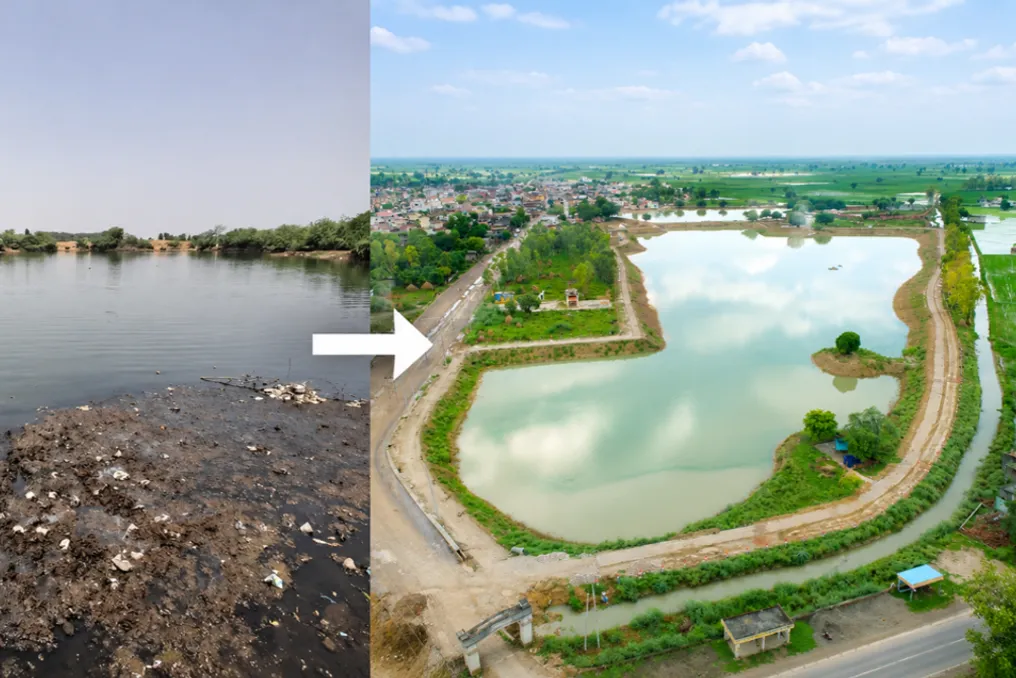
In the Rewari district of Haryana state, where groundwater has been under pressure for many years, a new conservation effort is underway to restore ten village ponds. The Technical and Economic Research Institute (TERI), in collaboration with Nokia India, is working to restore these water bodies over two and a half years, aiming to increase their total capacity to 120 million liters.

The project, announced on November 10, 2026, also includes planting native vegetation, improving public areas around the ponds, and involving residents in the maintenance process. If successfully implemented, approximately 22,000 people will benefit directly, and another 50,000 indirectly.

Reasons for relying on ponds in Rewari

Water resource issues in Rewari are not new. In 2019, an Indian Government report under the Jal Shakti Abhiyan campaign classified the area as water-stressed. It noted a decline in groundwater levels, with the situation being particularly severe in the Khol block, which was deemed over-exploited. This means that water was being extracted from underground faster than it could naturally replenish.

For communities whose daily needs and agriculture depend on groundwater, preserving any possible water source becomes a top priority. Meanwhile, the district administration began mapping existing water resources. Gram Panchayats compiled lists of village ponds and other water management structures, helping officials determine what could be repaired or improved. The main idea was to utilize the existing village systems more effectively.

Traditional ponds play an important role in this picture. With proper care, they can retain rainwater, serve as habitats for small wildlife, and help water seep into the soil under favorable conditions. However, when their inlets become clogged or the space fills with sediment, their effectiveness decreases.

The new project in Rewari builds upon a broader need to protect these familiar yet valuable water bodies.

What will change around the 10 ponds?

TERI and Nokia India signed a Memorandum of Understanding at TERI Gram in Gwal Pahari, Haryana, to launch the Nokia Pond Revitalization Project. The plan involves increasing the aggregate capacity of the ponds to 120,000 cubic meters, equivalent to 120 million liters. This goal must be achieved within the next two years, rather than just accounting for the already conserved volume.

For local residents, the potential benefits are clear: ponds capable of collecting and holding more water can help meet local water needs and contribute to groundwater replenishment. Furthermore, the project aims to improve adjacent lands through the planting of native plants. Plants suitable for the area help stabilize pond banks, slow down rainwater runoff, and trap some soil that might otherwise enter the water.

A review published in the journal Wetlands in 2022 explains that vegetated areas around ponds can reduce the amount of precipitation and pollutants entering them while supporting the surrounding ecosystem. Nevertheless, planting alone is insufficient; the choice of species, their placement, and survival rate will determine their usefulness. TERI's announcement includes planting native species, although the exact number of plants and the species to be used still require clarification.

Alongside ecological work, the initiative proposes installing 100 streetlights, benches, and bins around the ponds. These additions are intended to make the spaces safer and more convenient for use and maintenance by residents.

Who will monitor the ponds after the work is completed?

A restored pond can fall into disrepair if trash accumulates, channels become blocked, or new plants are neglected. This is why the project includes community participation and is not viewed as a one-time construction event. Residents and Gram Panchayats can help identify problems, prevent littering, and raise maintenance issues. Farmers are also interested in protecting water sources that can support agriculture.

At the project presentation, Dr. Dipankar Saharia, CEO of TERI, spoke about 'community-managed conservation' and ensuring water for communities and farms. Local involvement will be crucial after the 24-month project concludes. The ponds will require attention throughout the changing seasons, including periods of low rainfall.

TERI estimates that 22,000 people may benefit directly, and another 50,000 indirectly, based on 2011 census data. These are projected benefits, and actual results will depend on the restoration work and long-term maintenance. The real test will be whether the pond water levels are maintained, whether their banks remain protected, and whether residents have the support to sustain them. For Rewari, the promise of this initiative lies in the fact that the villages have known for generations: a pond is useful when it holds water, and people continue to care for it. If these 10 ponds become healthier and remain so, their value will be felt in the daily lives of surrounding communities long after the last bench is installed and the restoration crews depart.

Rural resident of Rajasthan planted 300 sandalwood trees where there was previously no water
Read more
www.aajtak.in

Rural resident of Rajasthan planted 300 sandalwood trees where there was previously no water

In a village near the Sambhar salt lake in Rajasthan, a farming family demonstrated incredible resilience and perseverance. Where previously they had to order five cisterns monthly for drinking water, the family managed to find a source of fresh water by digging a well on their field.

The residents of the small village, located near the world-famous Sambhar salt lake, depended on cisterns for every drop of fresh water. However, thanks to the strong faith and diligent work of one farming family, they achieved the impossible. Ganesh Kumawat and his family, residing in Pipla Ki Dani (Nagroupa) within the Grampanihata Barauti, not only discovered a source of fresh water on their land but also planted 300 white sandalwood trees on an area of about two bighas, laying the foundation for a unique legacy for future generations and a green innovation project.

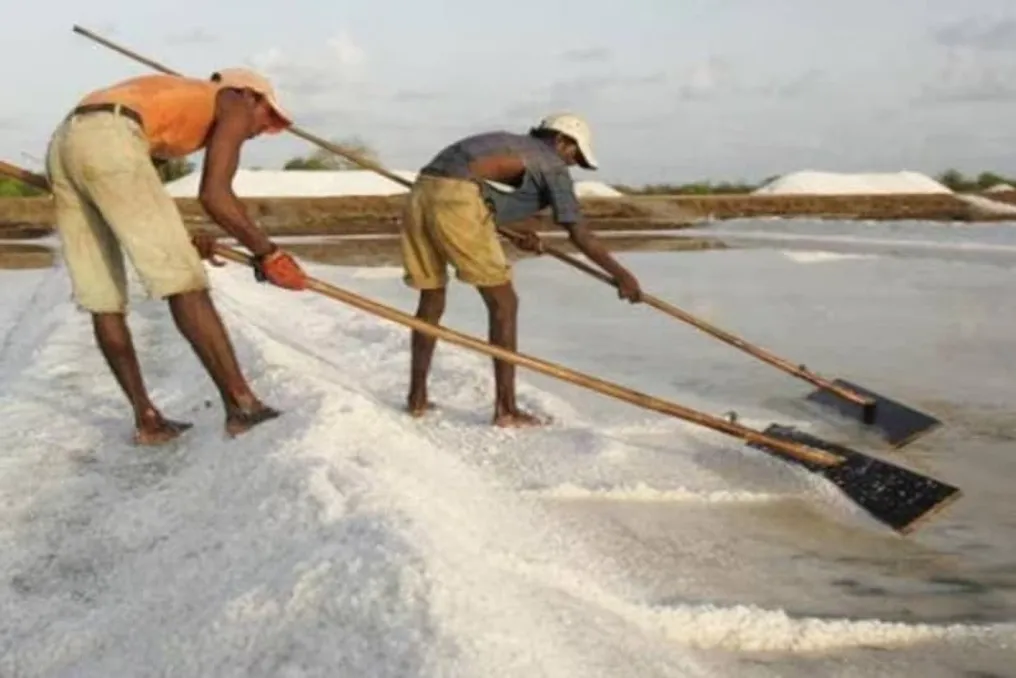
Sambhar Lake contributes about 7.5 percent to global salt production; however, due to groundwater salinization in surrounding areas, rural residents face serious difficulties in obtaining drinking water. Ganesh Kumawat's family also had to order at least five cisterns of water monthly from a location 10 kilometers away. During the coronavirus pandemic quarantine, when daily life slowed down, the father, Bhagirat Kumawat, and mother encouraged all four sons to dig a well on the field. Since the land was salty, the sons doubted that their labor and money would be wasted. Nevertheless, the parents' words—'Try it, who knows, maybe God placed fresh water in our land'—gave them the strength to move forward.

When all four brothers finished digging the well and water started flowing, the entire family was overjoyed because the water in the well was completely fresh. This single step permanently freed the family from dependence on drinking water cisterns. Ganesh Kumawat decided not to limit himself to traditional agriculture but to turn this achievement into a lasting legacy for coming generations. He ordered high-quality white sandalwood saplings from a nursery in Mandan, Tosham village, Bhiwani district, Haryana state, and planted them on approximately two bighas of his field. After about two years of hard work and future planning, there are now about 300 white sandalwood trees growing in this sandalwood grove. Thanks to a modern irrigation system (drip irrigation) and constant care, these plants are growing actively.

According to this incident, Ganesh Kumawat stated: 'For us, this well is not just a source of water made of brick and stone, but a symbol of our parents' unwavering faith. Although the water problem in our village is not yet fully solved, we hope that our small attempt will inspire other farmers. When these sandalwood saplings grow into mighty trees, our future generations will know that their beginning was laid with the blessing of their parents and positive aspiration.'

Popular