The miHoYo research group described the Gamer system—a vision-language-action framework that translates screen observations and instructions into keyboard and mouse commands. Details of this work were presented on their Chinese account on November 21st; a supplementary preprint was first uploaded on November 13th and revised on November 18th.
The core experimental model is based on Qwen3-VL-8B. It utilizes screenshots, task information, observation history, and memory to make action decisions without relying on internal game interfaces. The project views interaction as a general action format covering both standard graphical user interfaces and more complex three-dimensional game environments.
Training is conducted through continued pre-training on game interaction trajectories, instruction tuning, and online reinforcement learning. The authors developed mechanisms for sparse reasoning and memory generalization to maintain task progress when previous interactions leave the active context, rather than constantly processing an infinitely growing dialogue.
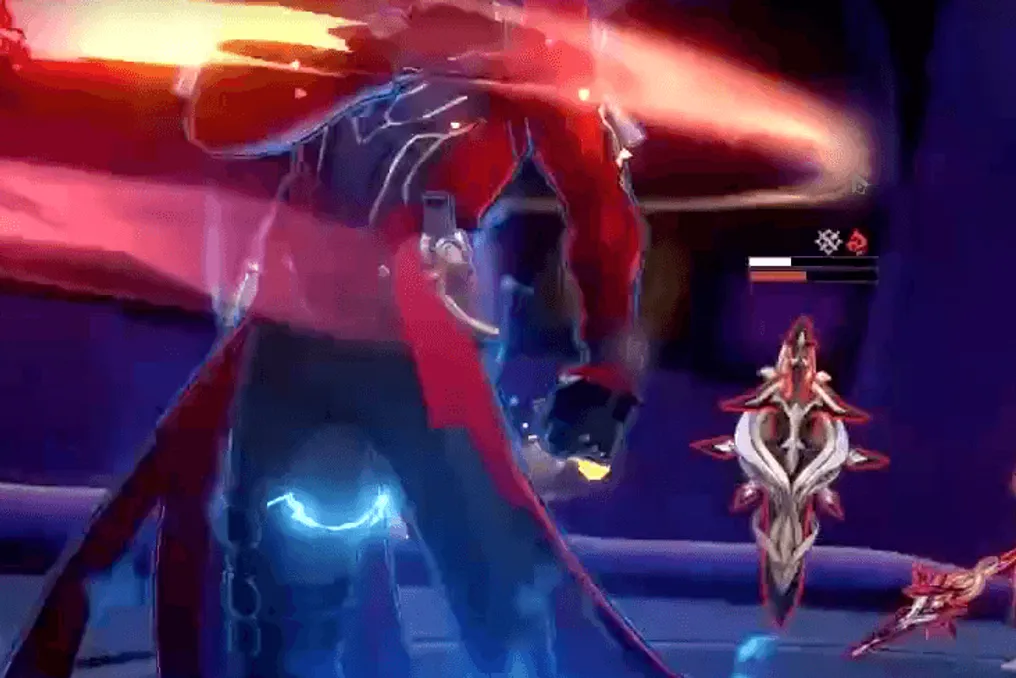
The team reported autonomous operation in over 95% of cases during an evaluation lasting about 50 hours, which covered five chapters of the main story in Honkai: Star Rail. It is important to note that this is the autonomy metric claimed by the authors, not a statement that 95% of all tasks in any game were performed perfectly or that human intervention was completely eliminated.
The paper also evaluates individual side quests in the game with which the model has already encountered. An accuracy of 80.0% and 83.6% was achieved when completing tasks in two such quests. These metrics, based on reaching checkpoints, should not be confused with continuous completion rates from start to finish or transferring the task to an unseen game without prior training.
To ensure real-time interaction, the project describes a cloud-peripheral serving system called Streaming-vLLM, which includes persistent caching and early action dispatching. The goal of this architecture is to support responsiveness across parallel runs and deployments, but it does not guarantee that the entire research system operates locally on a standard gaming PC.
The project page states that checkpoints used in the continued pre-training scaling study have been released, while the Honkai: Star Rail data and checkpoints trained or fine-tuned on this data remain closed for data security reasons. Consequently, publicly available research artifacts should not be considered a complete downloadable version of the demonstrated game system.
It is emphasized that this is a research project, not an announced consumer gaming bot or authorization for automating commercial gaming accounts. Performance metrics remain the authors' estimates, and the cited material does not establish independent reproducibility of these results.