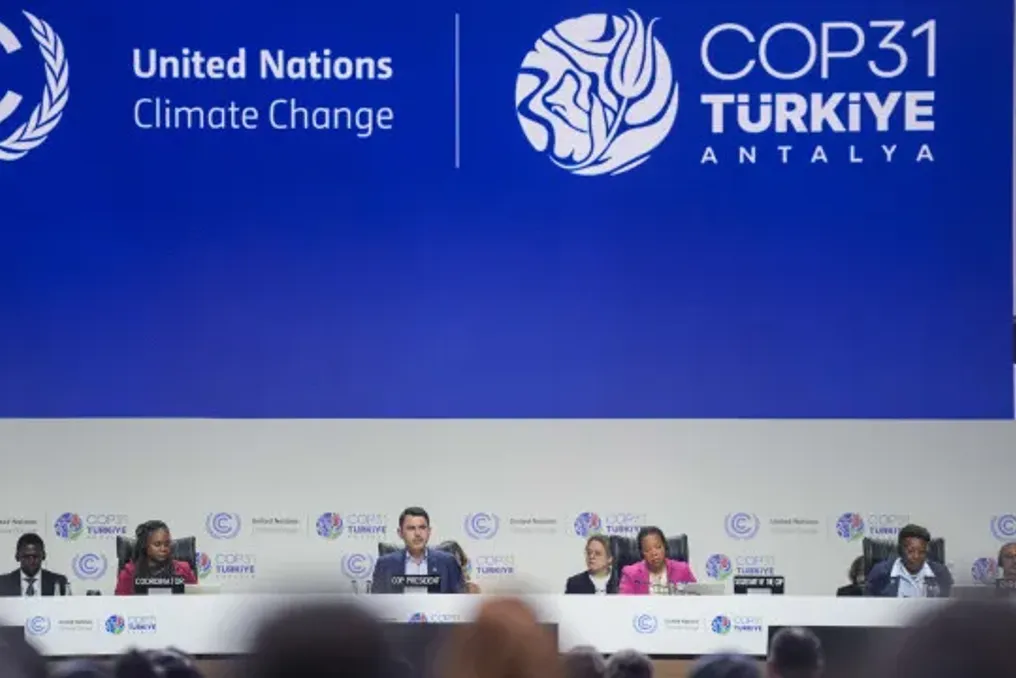
New COP31 resolution draft in Antalia does not mention fossil fuels but calls for electrification
Read more
Noticias ao Minuto
noticiasaominuto.com

New COP31 resolution draft in Antalia does not mention fossil fuels but calls for electrification

The new draft final resolution of COP31 on climate, published on the night from Saturday to Sunday in Antalia, southwestern Turkey, continues to avoid direct mention of fossil fuels, but includes a call for electrification.

This document, prepared by the Turkish and Australian presidencies of the UN conference, also insists on accelerating the use of Carbon Capture, Utilization, and Storage (CCUS) technologies, which are promoted by oil and gas sector companies, causing controversy among some countries.

The text lacks any explicit requirement to abandon coal, oil, or natural gas, whose use is the main cause of climate change. It only refers to the results of COP28 in Dubai, which in 2023 first called on the world's countries to transition with the aim of abandoning these types of energy.

Producer countries, led by Saudi Arabia, oppose any new references in the final text in Antalia. Nevertheless, countries from the Pacific region, Europe, and Latin America demand an explicit mention of these energy sources.

Instead, the resolution draft contains a call, put forward by Turkey, to increase the share of electricity in total final energy consumption to 35% globally by 2035, which is linked to efforts to increase the use of 'clean energy.'

Furthermore, the controversial issue of the publication schedule for the next IPCC reports—the group of scientists working under the auspices of the UN—is discussed. The text emphasizes the 'importance' of these reports for the next 'global assessment' of countries' efforts to limit greenhouse gas emissions, scheduled for 2028. India and Saudi Arabia prefer to postpone the publication of these reports until 2029.

The Turkish COP31 President, Murat Kurum, called on countries to act 'responsibly' and seek an 'agreement' on Saturday. The conference, which gathered nearly 200 countries in Antalia, is a crucial global meeting on climate issues.

This morning, a plenary session is scheduled to attempt to approve a compromise at the major climate conference in Antalia, which has already significantly exceeded its planned completion time of Friday evening. Some ministers have already returned to their countries, and the conference venue is beginning to be dismantled.
Similar stories

COP31 Draft Resolution Highlights Importance of UN Scientific Reports, Including IPCC Work
Read more
noticiasaominuto.com

COP31 Draft Resolution Highlights Importance of UN Scientific Reports, Including IPCC Work

The draft final agreement of the Antalya Climate Summit (COP31) explicitly supports the scientific authority of the Intergovernmental Panel on Climate Change (IPCC) and calls for it to clarify the schedule for the Seventh Assessment Report.

Amid political tensions regarding the pace of future UN scientific reports, this draft agreement will be presented for discussion and approval at the plenary session scheduled for 09:00 local time (06:00 GMT). It emphasizes the 'fundamental' role of 'best available science' and acknowledges that IPCC work provides the 'most reliable and comprehensive assessment of climate science.'

The document also stresses the 'importance' of such assessments for measuring collective progress in climate action and thanks scientists preparing the Seventh Assessment Report (AR7). The timeline for this report is a subject of intense debate to ensure its findings are ready before the second global stocktake of the Paris Agreement, which is due in 2028 during COP33.

The new draft final resolution of COP31 on climate restores the obligation of developed countries to provide financial resources, but the goal of tripling adaptation finance by 2035 remains without a specific target.

The text, put forward by the presidencies of Turkey and Australia, seeks to balance the financial section between the demands of the developing countries bloc—which insisted on firm guarantees from state funds—and the reluctance of industrialized economies to accept new quantitative commitments.

To gain support from the group of developing nations, the proposed agreement again refers to Article 9, paragraph 1, of the Paris Agreement, emphasizing that developed countries 'should provide financial resources' for mitigation and adaptation assistance as a continuation of existing obligations, while noting that other nations may contribute voluntarily.

Nevertheless, the document maintains the goal of tripling adaptation finance by 2035, but without setting a minimum value. This followed the removal of mention of achieving 'at least $120 billion' annually in the second preliminary version on Thursday, which was present in the first version on Monday.

The new draft final resolution continues not to directly mention fossil fuels but includes a call for electrification and urges accelerating the use of carbon capture, utilization, and storage (CCUS) technologies promoted by oil and gas companies, which is controversial for some countries.

The document lacks an explicit call to abandon coal, oil, or gas, whose use is the primary driver of climate change. It is limited to referencing the outcomes of COP28 in Dubai in 2023, where for the first time world nations were called upon to transition away from these energy sources.

Producer countries, led by Saudi Arabia, oppose any new mentions in the final text in Antalya. However, Pacific, European, or Latin American countries demand explicit mention of these energy sources.

The President of Turkey at COP31, Murat Kurum, called on countries to act 'responsibly' and seek 'consensus' on Saturday. The conference, which gathered nearly 200 countries in Antalya, is the most important global meeting on climate issues.

Final COP31 text excludes mention of fossil fuels
Read more
noticiasaominuto.com

Final COP31 text excludes mention of fossil fuels

Fossil fuels, including oil, coal, and gas, have been excluded from the draft final text of the UN climate conference, which was published today. These types of fuels were previously mentioned in an earlier version of the document.

The current version of the text calls for increasing the share of electricity in final energy consumption to 35% globally by 2035. This complements efforts aimed at tripling the world's renewable energy potential.

This latest version of the final text appears on the eve of the scheduled conclusion of the United Nations Climate Conference, which is taking place in Antalya, Turkey.

Global Electrification and Fossil Fuel Phase-out Discussed at COP31
Read more
noticiasaominuto.com

Global Electrification and Fossil Fuel Phase-out Discussed at COP31

The second day of discussions at the 31st United Nations Climate Change Conference (COP31), held in Turkey, concluded with focus on promoting global electrification and phasing out fossil fuels. The working agenda was also approved on this day.

The conference chairman, Turkish Environment Minister Murat Kurum, noted the positive start to negotiations following the adoption of the working agenda, as similar procedures at UN meetings previously led to multi-day deadlocks. Kurum reiterated the call for cooperation to solve this global problem, stating: 'We want this COP to be a COP of implementation and to adopt decisions that change the situation.'

The second day of COP31 centered on energy and transport issues. It was marked by calls to accelerate the transition, which is necessary not only to reduce emissions but also to protect economies from oil and gas price volatility. For instance, UN Secretary-General António Guterres made similar statements.

Simon Stiel, UN Executive Secretary for Climate Change, emphasized that in less than ten years, renewable energy has surpassed coal in global electricity generation. He compared this progress to what was 'unimaginable' at the time the Paris Agreement was signed in 2015.

Fatih Birol, Executive Director of the International Energy Agency (IEA), stated that the current energy crisis has shifted government priorities. He noted that for the first time in a long time, energy security goals and the transition to clean energy are closely linked. Birol also reported that electric vehicle sales outside of China grew by 60% over the last nine months, and the number of nuclear power plants under construction reached 90 gigawatts—the highest level in four decades.

Turkey and Australia, which jointly chair the conference, advocate for increasing the share of electricity in global energy consumption from the current 23% to 35% by 2035. However, this proposal faces resistance from hydrocarbon-producing countries, who object to the electrification goal because it implies the exclusive use of renewable and nuclear energy sources.

Birol added that this commitment could, in any case, send a clear signal to markets that 'electricity is the future.'

The day was also remembered for Brazil's presentation of a roadmap designed to help countries gradually phase out oil, coal, and gas. This initiative aims to translate commitments made in Dubai in 2023 into concrete measures, marking the first time the start of the fossil fuel transition was agreed upon. The document does not set mandatory requirements but provides tools for assessing each country's energy dependence and developing strategies tailored to its realities.

During the presentation, former US Secretary of State John Kerry stated: 'We don't need more promises. We need plans,' a sentiment supported by the UN Secretary-General.

Mobility issues in Antalya, which began with the opening of COP31 on Monday, worsened today due to traffic restrictions imposed before the arrival of heads of state and government. The President of Brazil was among those who arrived at the world leaders' summit today, Wednesday. Turkish authorities suspended classes on Wednesday and Thursday to reduce traffic during the leaders' meeting on those days.

Swedish activist Greta Thunberg participated in the conference, returning to the UN climate summit for the first time since Glasgow (UK) in 2021. She criticized the fact that despite decades of negotiations, emissions continue to rise.

Popular