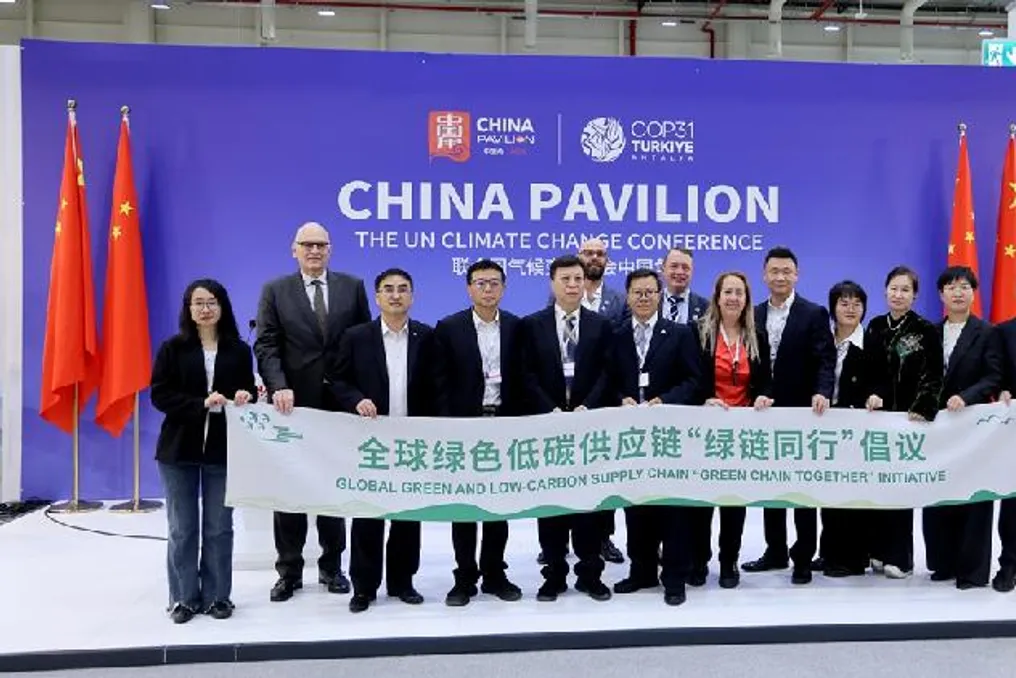
China introduced a global initiative for green and low-carbon supply chains during a side event at the China Pavilion on Thursday, as part of the 31st United Nations Climate Change Conference (COP31) held in Antalya, Turkey.
The initiative, titled 'Green Chain Together,' focuses on several key areas, including life cycle environmental data, rules for assessing green and low-carbon processes, and mutual recognition of certification results. It calls for the creation of a joint global supply chain mechanism based on joint consultation, development, and action to provide an open and shared platform for cooperation in the green transition of global industrial and raw material chains.
According to the Chinese Academy of Environmental Sciences, one of the co-founders, this initiative defines three main priorities. Firstly, it calls for establishing a common life cycle database that includes datasets covering the entire chain—from raw material preparation and production to logistics, consumption, and waste disposal. The goal of this step is to make environmental data more accurate, comparable, and reliable.
Secondly, it proposes jointly developing assessment rules for green and low-carbon processes, including standards for classifying and managing supply chains, as well as transparent mechanisms for continuous supplier evaluation. This will provide clearer guidelines for enterprises, especially small and medium-sized ones, participating in global green competition.
Thirdly, the initiative aims to promote the mutual recognition of certificates and enhance trust in environmental information through a unified data disclosure system and standardized verification channels, which will facilitate cross-border green trade.
This year marks the beginning of a new decade under the Paris Agreement, as global climate governance shifts from negotiating rules to their practical implementation.
Liu Yang, Deputy General Manager of the Department of Climate Change of China's Ministry of Ecology and Environment, noted that green and low-carbon supply chains are an important way to translate climate commitments into industrial action. He emphasized that such an approach can help achieve global climate goals by encouraging leading companies to work with enterprises throughout their supply chains to reduce emissions while improving environmental performance and industrial sustainability.
Liu also pointed out that cross-border supply chains still face challenges such as inconsistencies in environmental data, differences in assessment rules, and difficulties in certificate recognition between countries. China is ready to cooperate with other parties to improve life cycle environmental data systems, coordinate standards, and promote the mutual recognition of certification results, helping to make global industry and supply chains greener and more sustainable.