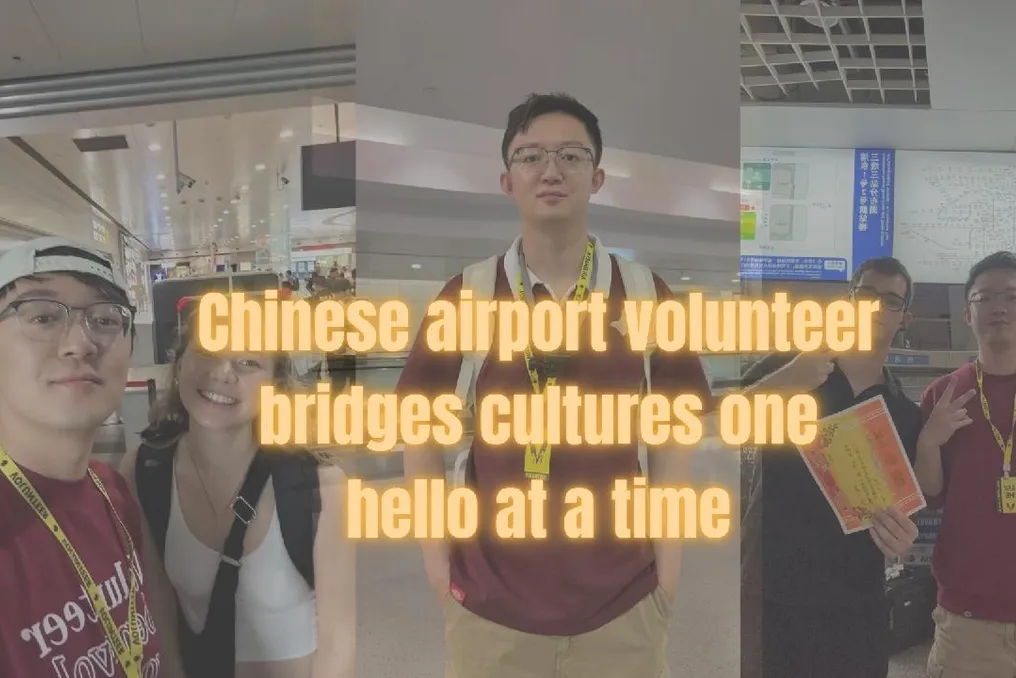
33-year-old Sang Xiangcai, originally from Jinjiang in Shandong province in eastern China, adheres to the old principle: when one door closes, another opens. After moving to Shanghai in 2017, he worked in the internet industry as a product manager and later advanced to senior product manager. However, several years later, he was laid off during a company-wide restructuring.
At the time, he did not realize that this closed door would open opportunities to learn new languages, meet people from all over the world, and gain online popularity. Seeing videos online about volunteering at airports, he decided it was a great chance to meet new people and improve his English skills. Nevertheless, the transition from the corporate sector to volunteering required sacrifices, especially financial ones.
Sang told CGTN that he does not receive a salary as a volunteer. He has to pay for expensive round-trip tickets to the airport himself, and food there is also costly. Initially, he relied on savings from his previous job, but later started earning income through traffic and small commercial sponsorships that brought advertising revenue. This income now covers his living expenses, although he still earns significantly less than when he worked as a product manager.
The turning point was last November when Sang decided to start documenting his volunteer experience online. Now, looking back at his videos published on Chinese social media, it seems that Sang belongs nowhere else. His friendly encounters with strangers are deeply touching and easy to watch. He helps visitors in a foreign country where language is often a barrier: giving directions, helping anxious travelers find lost phones, or simply saying hello.
In the process of these interactions, he is also mastering various languages. He shared that he started learning English when he began volunteering last year, and subsequently mastered Russian, Japanese, Korean, and Spanish. He only knows practical phrases for volunteer work in these languages, enough to help people with basic questions such as directions. His English level, however, is much higher.
Knowing even a few phrases in another language has proven useful because not every international visitor to China speaks English; Sang found many who only know their native language. Knowing additional languages greatly simplifies communication. He hopes to add German, French, Portuguese, Thai, and Arabic to his repertoire, as well as various Chinese dialects and sign language. The exchange is mutual: he teaches visitors simple phrases in Chinese and shares videos of them using what they have learned, helping Chinese people.
Despite these beneficial exchanges, his transition to volunteering was not initially approved by everyone. His family was initially unsupportive, worried about his financial well-being. Sang noted that he only got married last year and is responsible for his family. However, as his content gained popularity and gradually covered some of his living expenses, his family began to understand and support his activities.
He called the online attention an unexpected development. Although his videos receive both positive and negative comments, he feels the overall response has been encouraging. But what drives him to return to the airport is the joy of helping others. He admits that not every encounter goes smoothly, but the happy moments outweigh the difficult ones. Sang explains that helping others releases dopamine and endorphins in his body, which boost his mood, and it is almost addictive, so he looks forward to every trip, and the sincere responses from the people he helps can bring him joy for a long time.
Besides helping cover living expenses, Sang wants his videos to serve as a window into daily life in China. Through ordinary encounters with visitors, he hopes that the international audience will see the warmth and kindness of the Chinese people, as well as the diversity of the country. He strives to show how ordinary Chinese people naturally interact with foreign guests in English, to counter biased videos maligning China, and allow the world to see the real China. For him, this means preserving the authenticity of encounters, demonstrating real China through genuine interaction, rather than staged and rehearsed videos. He also hopes that viewers from China will learn about other cultures and learn English and other languages themselves.
Sang plans to continue studying languages and improving his English, as well as finding more opportunities to bring together people from different cultures. He expressed hope to contribute to the global promotion of China and gain opportunities for meaningful work that promotes intercultural communication.