The Rio de Janeiro Botanical Garden is recognized for its beautiful landscapes, created from collections of flowers and plants that attract both tourists and city residents. In addition to its aesthetics, the garden holds great scientific importance for botany, housing species from diverse origins ideal for research. This site has been designated as a protected heritage by the National Institute of Historic and Artistic Heritage (Iphan) since 1937.
Its historical trajectory dates back to 1808, the year it was established by Prince Dom João VI, granting it the title of the oldest institution of its kind in Latin America. Initially, the purpose was to establish an acclimatization area for spice seedlings from the East, such as cinnamon and nutmeg. Currently, the Botanical Garden is one of the most appreciated attractions in the capital of Rio de Janeiro.
With an area exceeding 540,000 square meters, the park is segmented into multiple thematic spaces filled with world flora. One of the most emblematic points is the Barbosa Rodrigues Avenue, the main avenue of the complex, lined with imperial palms, serving as a classic backdrop for travel photographs.
Japanese Garden
The Japanese Garden, as its name suggests, displays species characteristic of Japan. In this environment, one can find bonsai and cherry trees, as well as an oriental-style bridge spanning a pond with carp, referencing Japanese culture.
The Orchidarium and Bromeliadarium greenhouses cultivate hundreds of varieties of orchids and bromeliads. This section of the park is also highly sought after by visitors due to the beauty and variety of species, including rare specimens.
For visually impaired people, there is the Sensory Garden, designed to provide an intense experience of textures and aromas, allowing visitors to touch and smell all the vegetation present on the site.
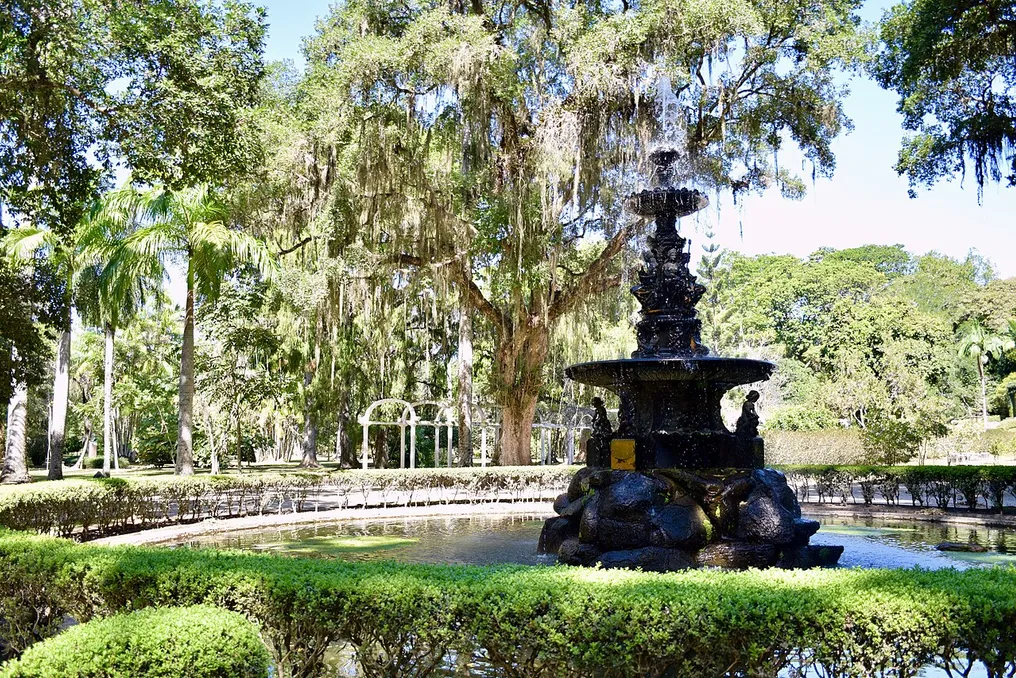
In the center of the park, there is the Fountain of the Muses, another frequently photographed spot. This fountain consists of two basins and is decorated with four sculptures symbolizing science, poetry, art, and music. The work was relocated from Largo da Lapa to its current position in 1905.
The Botanical Garden also houses a cultural center, the Botanical Garden Museum. This space offers art exhibitions and interactive content, in addition to an educational schedule. Its objective is to highlight the work carried out by the park and biologists in developing public policies and strategies for the conservation of local flora over its more than 200 years of existence.
Located at Rua Jardim Botânico, number 1008, access can be made by car, ride-sharing apps, or bus. It is important to note that the location does not have its own parking for private vehicles.
The park operates from Monday to Sunday, from 8 am to 5 pm, except on Wednesdays, when it opens later, at 11 am. The museum is not open on this day. Tickets can be purchased on the official Botanical Garden website, costing R$ 40 for Brazilian citizens and R$ 80 for foreigners.