Voyager 1 probe reaches record distance from Earth; other scientific highlights of the week
Read more
Olhar Digital
olhardigital.com.br

Voyager 1 probe reaches record distance from Earth; other scientific highlights of the week

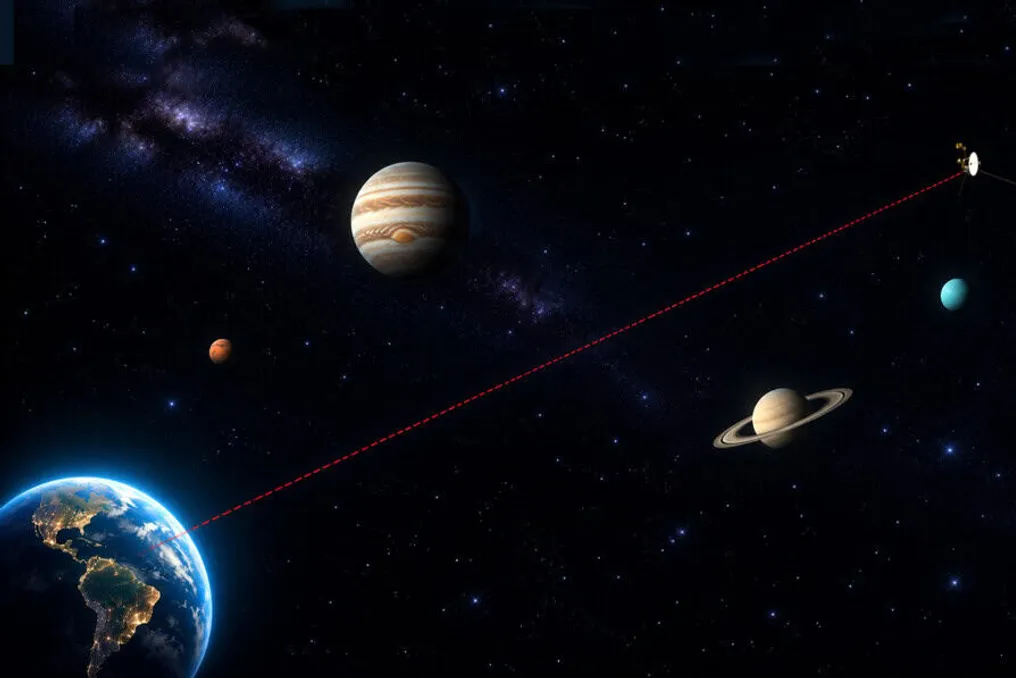
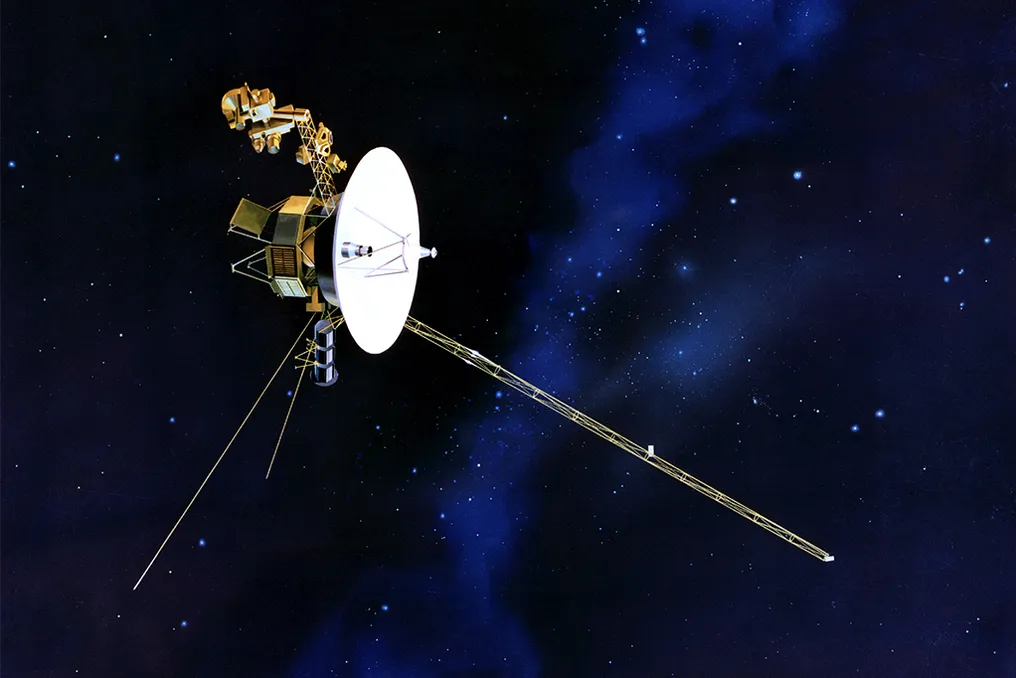
The NASA Voyager 1 probe set a new historical milestone in space exploration by reaching the remarkable distance of 25.9 billion kilometers from Earth last Wednesday, the 18th. This distance is equivalent to one light-day.

Nearly fifty years after its launch, the spacecraft recorded this feat at 7:16:07 AM Brasília time. Considering that light travels about 300 thousand kilometers per second, a signal sent by the probe today will take 24 hours to be received on Earth.

In other news, Elon Musk, CEO of SpaceX, announced plans to make the Starship rocket even larger. He stated that the V4 version of the second stage will have an increase of approximately 40% compared to the current configuration and will carry more than 60% more propellant.

Additionally, the next generation of Starship will undergo propulsion modifications, featuring nine engines, including three extra Raptor-Vacuum units, as reported by Musk.

In the field of astronomy, scientists observed a predicted but never directly seen event: a giant star consuming its companion. This event occurred in the Andromeda galaxy, about 2.5 million light-years from Earth, allowing researchers to reconstruct phases of stellar fusion.

The system, nicknamed Bao, consisted of two stars of different masses. The larger one, named Big Bao, had approximately seven times the mass of the Sun and a radius 350 times greater than that of the Sun. Its partner, Little Bao, presented about 70% of the solar mass.

Another significant advancement was the arrival of the first quantum computers from Latin America in Brazil on Monday, the 16th. Manufactured in China, these devices will be installed in João Pessoa, Paraíba, providing access to the technology for Brazilian researchers.

This initiative covers not only the operation of the machines but also knowledge transfer and training, aiming to enable Brazil to develop its own quantum technology. The equipment will be housed at the International Center for Computing and Quantum Technologies of Paraíba (Ciquanta), located in the former Station of Arts building, with an estimated state investment of R$150 million, projected to boost areas such as medicine, industry, energy, and digital security.

Similar stories

Voyager 1 reaches historic milestone by reaching one light-day distance from Earth
Read more
olhardigital.com.br

Voyager 1 reaches historic milestone by reaching one light-day distance from Earth

The spacecraft Voyager 1 recently reached a significant milestone in its journey through the Cosmos, achieving a distance of one light-day from Earth. This feat represents a distance of approximately 26 billion kilometers, which light takes a full day to travel, and which Voyager 1 took almost 50 years to reach. This measurement was only possible thanks to a study conducted 350 years ago, a period when the speed of light was measured for the first time.

Although previous attempts, such as Galileo Galilei's experiment with lanterns on distant mountains, were made, light was too fast to be captured by the instruments and methods of the time, leading many scientists to believe its speed was infinite.

However, on November 21, 1676, the Danish astronomer Ole Rømer presented the Royal Society of Sciences in Paris with the first scientific proof that light travels at a limited speed. Furthermore, he managed to make the first measurement of this speed, although it was initially imprecise, it revolutionized the way humanity views and understands the Universe.

Rømer based his work on an idea by Galileo, unrelated to the lanterns, but rather on the observation of the movement of moons around Jupiter. The eclipses of these moons occurred at regular intervals, serving as an astronomical clock that could be synchronized globally, which was crucial for determining longitudes on Earth.

By applying this method, Rømer measured the period between the eclipses of Io and noticed that the precision was not constant. Over the months, he observed that the eclipses showed progressive delays relative to the predicted time, followed by decreases in these delays, until the events began to occur earlier than expected.

Investigating the causes, he concluded that the eclipses occurred more quickly when the Earth approached Jupiter and took longer when it moved away. His deduction was that this could only happen if the light from Jupiter and its moons took longer to reach Earth when the planet was farther away, thus proving that the speed of light was not infinite and could be measured.

To illustrate, he compared this to a precise clock: if it were taken to a distance where light took five minutes to arrive, when observed remotely, it would appear delayed; upon returning, it would appear accelerated, correcting the original time. This is the phenomenon Rømer observed, using Galileo's astronomical system as his clock.

In September 1676, Rømer predicted that the next eclipse of Io would occur with about ten minutes of delay, and this prediction was confirmed on November 9. Two weeks later, on November 21, he presented his conclusions to the French Academy, estimating that light took approximately 22 minutes to cross the diameter of Earth's orbit.

At that time, Christiaan Huygens, a colleague of Rømer, had calculated the Earth-Sun distance with high precision. Using this measurement and Rømer's estimate, Huygens calculated the speed of light at 220,000 km/s, a value that, although 27% lower than current estimates, was surprisingly close for a first attempt.

The most relevant point was Rømer's demonstration that light required time to travel long distances. In subsequent centuries, other scientists refined these calculations. In 1849, Hippolyte Fizeau conducted an experiment with a toothed wheel and a distant mirror, and later, Léon Foucault improved the method with rotating mirrors. More advanced experiments led to the current value of 299,792 km/s in a vacuum.

This value has profound implications; for example, sunlight takes just over eight minutes to reach Earth, meaning we never see the Sun as it is in the present moment, but rather as it was eight minutes ago. Observing Jupiter, for instance, reveals its state tens of minutes prior.

This relationship between time and distance resulted in the creation of units such as the light-year, equivalent to about 9.46 trillion kilometers, the distance traveled by light in one year. Thus, when observing stars and galaxies millions of light-years away, we are literally viewing the past of the Universe.

The speed of light also imposes a fundamental limit on communication in space travel, as no information can travel faster than it. This requires rigorous planning in the control of distant spacecraft. In the case of Voyager 1, every exchange of information with Earth requires about two days, one for sending and one for return, even using radio signals that travel at the speed of light.

When observing the eclipses of Io, Ole Rømer probably did not anticipate all the consequences of his discovery. His initial goal was merely to calibrate his clock, but he paved the way for a new understanding of space and time, essential for the theory of relativity centuries later.

350 years ago, Ole Rømer proved that light does not arrive instantaneously. Today, a small human craft is so far away that even a message sent at the speed of light takes a full day to reach it. These are two narratives separated by centuries, but linked by the same discovery. As Voyager 1 advances, carrying a piece of human history beyond the Solar System, light continues to bring news from distant worlds, extinct stars, and galaxies of a young Universe. For when we look into space, we are not just contemplating the vastness of the Cosmos; we are traveling through time, reading the past stories of the Universe that light still tells us.

Voyager 1 approaches Earth's day-light distance; we recall the history of the space mission
Read more
olhardigital.com.br

Voyager 1 approaches Earth's day-light distance; we recall the history of the space mission

Nearly fifty years after leaving Earth, the NASA-developed Voyager 1 probe is about to reach an unprecedented distance for any human equipment.

This Wednesday (18th), Voyager 1 will be located approximately 25.9 billion kilometers from Earth, a distance equivalent to one light-day. Since light travels about 300 thousand kilometers per second, the signal sent from Earth to the spacecraft will take exactly one day to reach it.

This epic journey began in 1977 when NASA launched two identical probes, Voyager 1 and Voyager 2, with the purpose of investigating the gas giants of the Solar System. Since then, both spacecraft have visited distant moons and planets, passed beyond the solar influence zone, and entered interstellar space.

During an episode of the program 'Olhar Espacial' (Space View), host Marcelo Zurita, who is also president of the Paraíba Astronomy Association (APA) and a member of the Brazilian Astronomical Society (SAB), detailed the planning of the Voyager mission. He mentioned that the probes were designed to capitalize on an extremely rare planetary alignment, an event that will only repeat in over a hundred years.

Researchers at NASA's Jet Propulsion Laboratory (JPL) noted in the 1960s that the giant planets would be in a particularly favorable configuration at the end of that decade and during the 70s. Jupiter, Saturn, Uranus, and Neptune would form an arrangement that would allow for the visit to the four celestial bodies in a single mission, using the gravity of each to alter the direction and increase the speed of the spacecraft.

This opportunity, which occurs at intervals of approximately 175 years, gave rise to the Grand Tour project. Initially, the plan contemplated four spacecraft and a route that could include Pluto, but the high cost led NASA to cancel the project in 1971. The following year, the agency approved a more economical version, focused on two probes primarily intended to study Jupiter and Saturn.

On March 7, 1977, the Mariner Jupiter-Saturn project was officially named Voyager. The original expectation was that the spacecraft would operate for about five years, but if they could not complete the journey, the second probe would have a chance to use Saturn's gravity to proceed to Uranus and Neptune.

However, the mission far exceeded its creators' predictions, becoming the longest journey in the history of space exploration.

Voyager 2 was the first to be launched on August 20, 1977, from the Kennedy Space Center (KSC) in Cape Canaveral, Florida, by NASA. Sixteen days later, on September 5, Voyager 1 was launched from the same location.

The reason for the inverted naming, according to the agency, is that Voyager 1 would follow a faster trajectory, reaching Jupiter and Saturn first, while Voyager 2 would take a longer path, allowing it to continue to Uranus and Neptune.

Both spacecraft carried eleven scientific instruments to analyze atmospheres, magnetic fields, particles, radiation, rings, and moons. In addition to the scientific technological advancement, the payload included a unique cultural manifesto: a Golden Record, created under the supervision of astronomer Carl Sagan, containing images, music, natural sounds, and greetings in 55 languages, serving as a time capsule to introduce humanity to possible extraterrestrial civilizations.

On March 5, 1979, Voyager 1 reached Jupiter. Measurements and images revealed a much more dynamic planet than imagined. Among the most notable discoveries was volcanic activity on Io, one of its largest moons, marking the first observation of active volcanoes outside of Earth. The probe also detected a faint ring system around the gas giant.

Four months later, on July 9, Voyager 2 also passed by Jupiter, deepening the observations. The journey continued toward Saturn, where the first probe arrived on November 12, 1980. One of the main focuses during this phase was the study of Titan, a moon characterized by its dense, nitrogen-rich atmosphere.

The passage by Saturn determined distinct paths for the two spacecraft. The planet's gravity propelled Voyager 1 out of the orbital plane of most planets, initiating its trajectory out of the Solar System. Voyager 2, meanwhile, headed toward Uranus, passing Saturn on August 25, 1981.

On January 24, 1986, Voyager 2 became the first spacecraft to visit Uranus, providing details about its atmosphere, rings, and moons. The probe identified ten previously unknown natural satellites and detected a magnetic field with a configuration distinct from Earth's.

Three years later, on August 25, 1989, the encounter with Neptune occurred, again pioneered by Voyager 2. The spacecraft recorded the vast atmospheric structure known as the Great Dark Spot, identified new moons, and analyzed the planet's rings. This was the last visit by a spacecraft to one of the Solar System's giants, and to date, no other mission has returned to Uranus or Neptune.

Thus, Voyager 2 completed a mission far superior to what was planned. Together, the probes explored the four giant planets, dozens of moons, their rings, and magnetic fields, but there remained a historical record before they left the planets—and this entered space memory.

On February 14, 1990, Voyager 1 executed a command to turn its lenses backward, capturing an unprecedented 'family album' of our planetary system from the cosmic vacuum. The most famous image from this sequence is known as the Pale Blue Dot. In this photo, Earth appears as a tiny point of light, about 6 billion kilometers away, seeming insignificant against the vastness of space, despite harboring all known life.

Shortly thereafter, the cameras were turned off to conserve energy during the continuation of the journey. According to science communicator Alexsandro Mota, this image was only possible due to Carl Sagan's persistence with NASA to rotate the camera before the definitive shutdown.

In his 'Olhar Espacial' program, Mota emphasized that the capture was made possible by the accuracy of the technical planning. He stated that 'that bright little dot is our planet, Earth, everything that has ever existed, everyone who has been born, lived, and lives in that grain of sand suspended in a sunbeam, recorded billions of kilometers away.'

For Mota, the meaning of the photograph transcends the scientific sphere, as it exposes human cosmic fragility: 'Carl Sagan thought of everything. He ensured the recording of one of the most important photos in the history of space exploration, revealing the point where our wars happen and where all our problems are concentrated. It is the realization that our existence is only possible because of that fragile point in the cosmos.'

Before Voyager 1, the title of the human-made object farthest from Earth belonged to Pioneer 10. Launched by NASA in 1972, five years before the Voyager probes, its main mission was to study Jupiter. After passing the gas giant, the spacecraft continued its trajectory and crossed Neptune's orbit in 1983, holding the record for fifteen years.

Until, on February 17, 1998, Voyager 1 surpassed Pioneer 10, reaching a greater distance. The two probes followed almost opposite directions away from the Solar System, but Voyager had higher speed. This overtaking occurred at approximately 10.4 billion kilometers from Earth, representing almost 70 times the distance between the planet and the Sun.

The journey gained a new dimension when the probes began to reach the limits of the heliosphere, the vast bubble formed by the solar wind and the Sun's magnetic field. On December 16, 2004, Voyager 1 crossed the termination shock, an area where the solar wind slows down upon encountering the pressure of interstellar matter. Voyager 2 crossed this boundary on August 30, 2007.

The next milestone was crossing the heliopause, the outer limit of the heliosphere. On August 25, 2012, Voyager 1 reached interstellar space, becoming the first human artifact to reach this region. The scientific confirmation of this feat was only released in September 2013, after analyzing data collected by the spacecraft.

On November 5, 2018, Voyager 2 also crossed the heliopause. Thus, two spacecraft began operating simultaneously in interstellar space, providing direct measurements of particles, magnetic fields, and plasma waves in this region.

There are various theories about where the Solar System truly ends. While some argue that the limit is where the planets cease, others suggest that the final boundary lies beyond the Oort Cloud, which marks the limit of solar gravitational attraction, where objects can still be influenced by it. Although Voyager 1 has left the heliosphere, many experts argue that it has not actually left the Solar System.

Mota points to the immense timescale: 'There are calculations that say Voyager 1 will take at least 300 thousand years to reach the outer edge of the Oort Cloud. That is longer than our own species has existed on planet Earth.'

According to NASA, one hypothesis is that the boundary is established where solar gravity ceases to be dominant, a point beyond the Oort Cloud. 'This boundary is roughly halfway to the nearest star, Proxima Centauri. Traveling at speeds exceeding 56 thousand km/h, the Voyager probes will take almost 40 thousand years and will have traveled a distance of about two light-years to reach this somewhat indistinct boundary.'

Even nearly half a century after leaving Earth, the Voyager probes remain active, although the power of their nuclear generators is progressively decreasing. To extend the mission, NASA has proceeded to shut down instruments and equipment, prioritizing those capable of generating relevant scientific data. However, there will come a time when the signals from the spacecraft can no longer be received.

This does not imply the end of the journey. Even without transmitting information, the two probes will continue to traverse interstellar space, carrying the Golden Records with images, music, sounds, and greetings that represent our civilization.

Although they have gained gravitational momentum to advance through the immensity, Zurita emphasizes that the spacecraft do not possess enough speed to overcome the escape velocity of the Milky Way. 'So, they will never leave the galaxy. They will remain trapped with us indefinitely, over billions of years, unless they collide with something by then.'

What started as a mission to explore the giant planets resulted in two spacecraft that traveled far beyond the known limits of the Solar System. Currently, they are navigating interstellar space, carrying records of humanity and a message that, at some point in its history, Earth gazed at the stars and decided to send part of itself into the unknown.

NASA's Voyager 1 probe will reach the unprecedented one-light-day distance from Earth
Read more
super.abril.com.br

NASA's Voyager 1 probe will reach the unprecedented one-light-day distance from Earth

The Voyager 1 probe, launched by NASA on September 5, 1977, has the mission of exploring the most distant planets and moons of the Solar System. Although it is remarkably fast, its speed of 61 thousand km/h is insignificant when compared to the speed of light, which reaches almost 300 thousand kilometers per second.

Initially, the probe reached Jupiter, where it identified two unknown moons at the time. Later, in the 1980s, it began investigating Saturn, discovering five moons and transmitting countless information back to Earth.

Due to the success of the mission, NASA opted to expand it, directing Voyager 1 into interstellar space, the area situated between the stellar systems of the galaxy. In 2012, the probe crossed the heliopause, marking the first human-made object to enter this space.

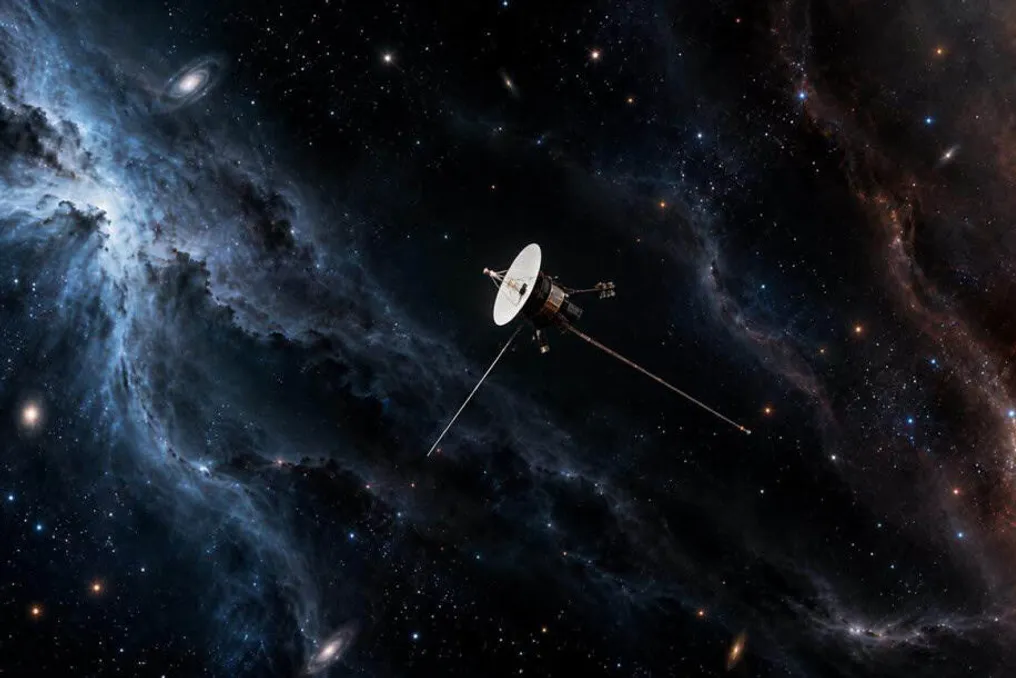
Nearly fifty years after its launch, the spacecraft will continue its journey and achieve a new scientific feat: becoming the farthest object from Earth. Specifically, on November 18th at 7:16 AM (Brasília time), Voyager 1 will reach the unprecedented distance of one light-day, corresponding to approximately 26 billion kilometers, the distance light travels in one day.

After reaching such a distance, communication between NASA and the probe will face new challenges. Signals sent from Earth will take 24 hours to reach the destination, given that transmission occurs at the speed of light, and the probe's response will require another 24 hours, not counting the time needed for information processing.

Despite these logistical difficulties, the spacecraft's operation will not change, and it will continue collecting data, exploring, and maintaining contact with Earth. To celebrate this milestone, NASA will organize an activity on November 17th, allowing people to use their mobile devices to emit the sequence of letters VGR in Morse code, pointing their phones to the sky to create a symbolic wave of golden light around the planet.

Voyager 1 is on a collision course with the star AC +79 3888, also known as Gliese 445, which is more than 17 light-years away from Earth, and is expected to reach it in about 40 thousand years.

Additionally, NASA launched Voyager 2 shortly after the first probe. This reached interstellar space in 2018 and is scheduled to reach the one-light-day mark in 2035, while Voyager 1 headed into interstellar space, Voyager 2 continued investigating Uranus and Neptune.

Both probes contain a gold-plated copper disk, measuring 35 centimeters in diameter. This disk carries messages intended for potential extraterrestrial beings, including inscriptions about Earth's location, greetings in 55 languages, music (from Mozart to Chuck Berry), and recordings of sounds from terrestrial life, such as whale songs and laughter.

Popular