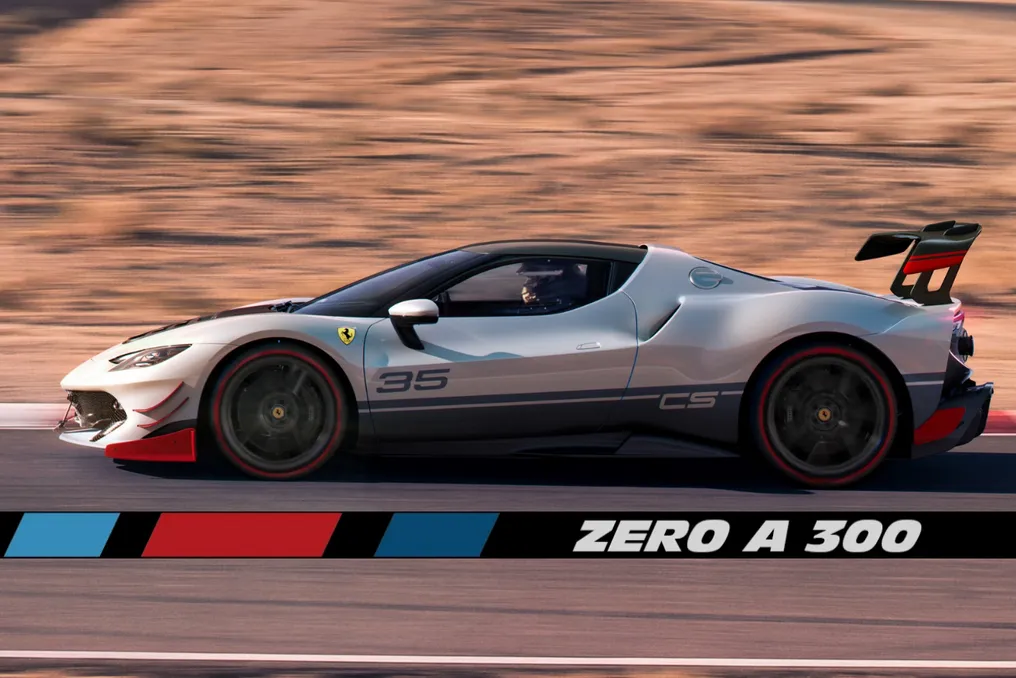
Ferrari has presented the new 296 Challenge Stradale, a model that resumes the brand's track car tradition, but without the aid of the hybrid system. This vehicle is a simplified version of the 296 designed to run faster, and the name 'Challenge Stradale' was previously used only on the 360 from 2003.
This car follows a line of tradition started with the 348 GT Competizione and passing through models such as the 430 Scuderia, 458 Speciale, and 488 Pista. It has been confirmed that the version does not have an electric motor or battery. It is equipped with a 3.0-liter twin-turbo V6 engine, whose turbos are located inside the 120° 'V'. This engine generates 670 hp at 8,000 rpm and 75.5 kgfm at 6,250 rpm, with a cut-off at 8,500 rpm. The turbo and thermal barrier components are inherited from the 296 Challenge track car.
The eight-speed dual-clutch gearbox offers two configurations: in race mode, it operates with quick shifts of about 170 milliseconds; at lower speeds, it uses the smoother calibration of the SF90 XX Stradale.
Technical details and comparison with other models
Some initial expectations did not materialize. August sources indicated a power output of 720 hp, which would surpass the 700 hp of the new 296 Challenge Evo, expected in 2027. There were also rumors of a weight under 1,300 kg. However, the actual weight is 1,330 kg (with weight reduction options), which is 140 kg less than the 296 GTB and 80 kg less than the 296 Speciale.
A notable point is that the Speciale's V6 already delivers 700 hp just with the combustion engine, meaning the Challenge Stradale has 30 hp less in the combustion engine, a fact Ferrari has not yet justified.
Aerodynamics also surprised. Although the prototypes had 'goose-neck' style rear supports, the production version uses lower mounts due to homologation requirements, especially in the United States. The wing alone generates 270 kg of downforce. The car totals 617 kg of downforce at 250 km/h, which is 72% higher than the GTB and 42% higher than the Speciale. This is achieved through a larger splitter, a completely closed floor with vortex generators, and two ducts connecting the underside to the top of the body, preventing aerodynamic drag loss during front braking.
The removal of the hybrid system required significant modifications, including the creation of a mechanical air conditioning compressor, a belt-driven starter generator, and a new transmission with lighter axle and casing. In the suspension, the springs became almost twice as stiff and received an auxiliary spring in series, inspired by the Challenge Evo. The dampers gained two additional extension adjustments to improve comfort on public roads, resulting in a 68% drop in roll compared to the GTB. The vehicle uses Pirelli P Zero R tires (with optional Trofeo RS semi-slick), 398 mm carbon-ceramic discs in the front and 380 mm in the rear, and predictive traction control unprecedented in a street Ferrari.
In terms of performance, the Challenge Stradale matches the Speciale in 0 to 100 km/h acceleration at 2.8 seconds. However, up to 200 km/h, it takes 7.9 seconds, one second slower. The advantage manifests at Fiorano, where it records 1min18s5, half a second faster than the Speciale and 2.5 seconds ahead of the GTB.
F1 confirms return to V8 engines for 2030
Mohammed Ben Sulayem announced in Miami in May that Formula 1 would return to V8 engines, initially scheduled for 2031, but brought forward after agreement from all six manufacturers. During the Las Vegas weekend, the FIA formalized the agreement for the 2030 engine: a 2.1-liter turbocharged V8, powered by sustainable fuel and featuring an electrical component much more modest than the current one.
The engine ended up smaller than planned in May, when a 2.6 to 3.0-liter twin-turbo was considered. The use of a turbo was mandated by manufacturers like Audi and helps maintain acceptable noise levels on urban circuits. The electrical part, according to the FIA document, will be limited to 200 kW (about 272 hp), in contrast to the 350 kW of current units. There will be no screeching sound of the 2.4-liter naturally aspirated engines that spun at 18,000 rpm until 2013.
The FIA document also introduces a more political change: each of the six manufacturers in 2030 may supply engines to only two teams, including their own. This means each manufacturer will have a client. For most, this does not drastically change the scenario; Ferrari will lose Cadillac, as it will start using GM engines in 2030, leaving it only with Haas. Red Bull Powertrains will serve only Red Bull and Racing Bulls, while Honda, Audi, and GM, for now, will only equip their own teams.
Mercedes faces a challenge, as it currently supplies engines to the factory teams, McLaren, Williams, and Alpine. Two of these three teams will need to seek another supplier, and the available spots will be with Honda, Audi, or GM. McLaren, which won the last two constructors' championships with a Mercedes engine, stated through Zak Brown that it does not want 'anything behind the car besides a Mercedes'. Williams also seems keen to remain. The question remains whether Mercedes will continue selling engines to its competitors.
The limitation aims to decrease the political influence of those who equip a large part of the grid, such as Mercedes and Ferrari. The manufacturers did not contest this, given that supplying engines in F1 results in a loss, as the maximum price charged to clients is $18 million per season. With six manufacturers offering two slots each, totaling twelve supplies for eleven teams, the FIA discarded the idea of a 'generic' engine and maintained the old 'obligation to supply,' which allows a manufacturer to be obliged to equip a third team without an engine, a clause that can be used given the competition for Mercedes' spots.
The final decision rests with the FIA World Council, which will meet in Shanghai next month. The return of the V8 is practically assured, but the limit of two teams still needs approval.
Nissan gives clues about the style of the next GT-R
It is almost certain that a new Nissan GT-R will be launched, and recently the responsible parties have begun giving hints about the design, an aspect considered as crucial as performance in any sports car, as it serves as the vehicle's calling card.
The previous GT-R was seen as an exception, whose lasting success (approximately 18 years, from 2007 to 2025) was based on the intrinsic quality of the design, despite its style not being particularly striking.
The next generation project is already under development, according to Nissan CEO Ivan Espinosa, but it is still far from reaching the public. The new model is expected to appear only at the beginning of the next decade, giving the design team time to explore various directions.
The first clue came from Matthew Weaver, Nissan's new global head of design and responsible for the R35's look. In an interview with the Japanese magazine Best Car, he mentioned that, 'if an R36 were produced, it would have round headlights', raising speculation about a possible return to origins, such as the Skyline GT-R C10 (Hakosuka) and its successor, the Kenmeri.
However, Ponz Pandikuthira, Nissan's planning director in North America, clarified in an interview with The Drive during the Los Angeles Auto Show that the intention is not to create a retro car. He explained that the manufacturer has not yet defined a final design, as it would not make sense to establish the appearance of a car that will only reach the market in 2030 or 2031. The executive emphasized that the goal is to blend historical references with a modern identity capable of maintaining appeal for many years, possibly until 2045, suggesting a long commercial life for the R36.