LZ-Space completes ground tests of robotic system ahead of field validation
Read more
Pandaily
pandaily.com

LZ-Space completes ground tests of robotic system ahead of field validation

LZ-Space, the developer of the robotic manipulation system from Ussi using the English name DEXTEROUS HAND, announced the completion of spacecraft installation checks and ground environmental tests. This information was presented at an exhibition in Nanjing.

It is important to note that confirmation of functionality in space is still pending, and current achievements relate to ground tests, not orbital operation.

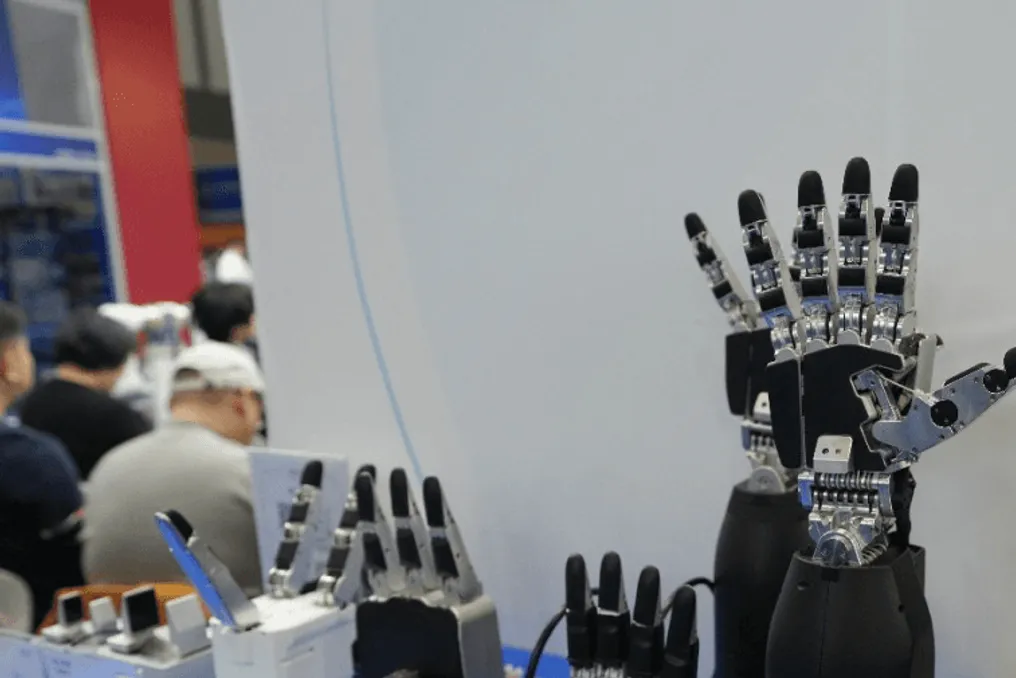
The developer presented nine models of robotic arms at the World Exhibition of Intelligent Manufacturing, which took place from November 19 to 21. The presented line includes designs ranging from two-fingered to five-fingered and is intended for industrial processing, remote control, research, and future space missions.

The space system is a combination of a robotic arm, a five-fingered gripper, and a remote control unit, rather than just an autonomous gripper.

Details of Ground Work Performed

According to information provided by the company via Leiphone, the ground work performed included vibration testing, cyclic vacuum testing with a temperature range from minus 25 to 60 degrees Celsius, as well as testing for total dose and single radiation particles. The spacecraft installation checks should be considered integration work on the ground, not proof of system operation in orbit.

The company identifies potential application areas such as tool usage, inspection and servicing of spacecraft, refueling operations, and conducting space experiments. These tasks remain target directions.

Further flight testing will depend on mission organizational decisions, and the presented report does not establish a fixed launch date or commencement of operational service.

Future Development and Industrial Capabilities

A more autonomous version, named LZ-SpacePro, is under development and is planned for release in early 2027. This company plan is separate from the current status of the system's ground tests and any possible space flight schedule.

Industrial claims require separate consideration. The stated maximum payload capacity of 30 kilograms applies to the heavy industrial LZ-Pro series, demonstrated for material handling, and cannot be automatically applied to LZ-Space or considered a characteristic of all arms presented at the exhibition.

During demonstrations for industry, the movement of containers using two arms and the manipulation of electrical connectors through gripping, insertion, and tightening were shown. The company emphasizes that implementation still requires verification based on client working parts, layout schemes, cycle times, retooling, and failure conditions.

The English name is visible on the exhibitor's own signage in photos taken during the event coverage; fictional English personal names are not used in the materials. The disclosed stages represent engineering progress claimed by the company, not independent qualification results or evidence of completed deployment in space.

Similar stories

NASA investigates technical failures in Perseverance rover and Mars Odyssey probe on Mars
Read more
olhardigital.com.br

NASA investigates technical failures in Perseverance rover and Mars Odyssey probe on Mars

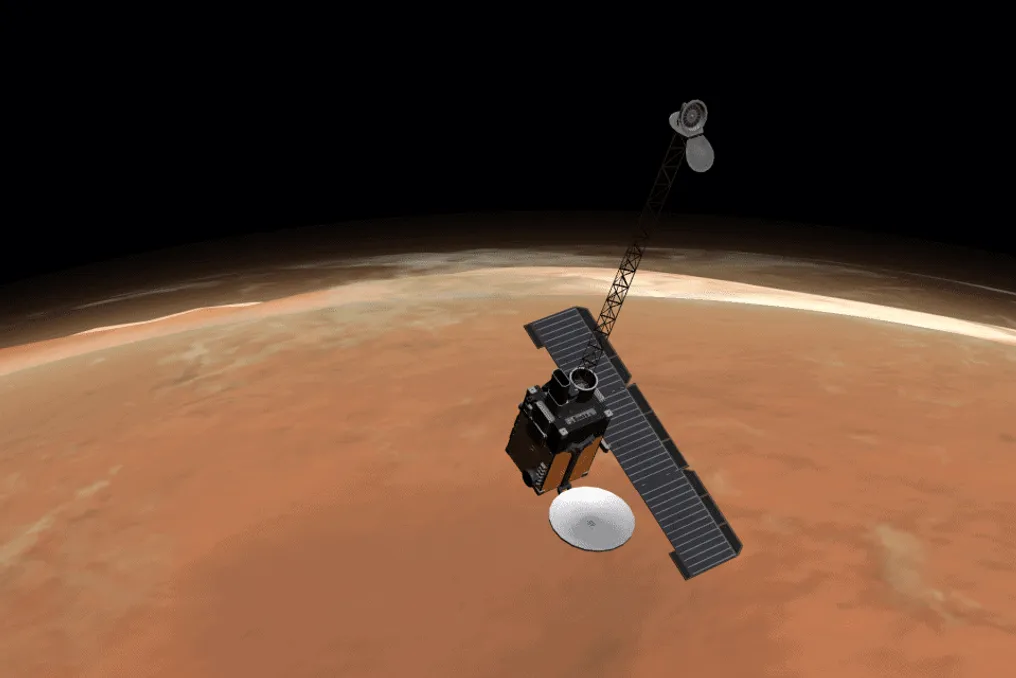
NASA is investigating technical problems that led to the temporary suspension of scientific activities for the Perseverance rover and the Mars Odyssey probe. The failures affected both the communication and orientation systems of both missions.

The work teams are dedicated to restoring the equipment with the expectation of resuming operations as early as November. Perseverance is expected to return to research by the end of the month, while Odyssey should restart its activities in the last week of November.

The incident with Perseverance was detected on October 30, when its main radio stopped emitting the periodic signals necessary to inform the central computer about the equipment's operation. This absence of signals activated the rover's protection system, resulting in the radio shutting down, the backup unit activating, and the vehicle entering safe mode.

According to Steven Lee, project manager at NASA's Jet Propulsion Laboratory (JPL), the computer constantly monitors these signals. In the reported case, 25 missed beats were recorded, corresponding to about 100 seconds without communication.

After taking the rover out of safe mode, engineers discovered a second problem: the backup radio was transmitting with approximately half the expected power. Out of caution, the team suspended the use of both devices while investigating the causes of the failures.

Currently, Perseverance remains stable and maintains contact with Earth through NASA's Deep Space Network, using X-band communication and a high-gain antenna. However, since this connection transmits less data than the usual system, which relies on orbital probes for retransmission, scientific activities have been paused to prioritize diagnostic data. Furthermore, the rover has stopped recording new images, impacting the raw photos available on the mission website.

JPL, which is administered by Caltech, is analyzing the conditions of the backup radio and the chances of recovering it before focusing efforts on the main equipment.

Regarding the Mars Odyssey mission, the problem lies in one of the four reaction wheels used to control the spacecraft's direction. Between November 4 and 6, the probe entered safe mode after one of these parts ceased rotation. It is important to note that another wheel had already shown a failure in 2013.

These components are responsible for adjusting the spacecraft's position during accelerations or decelerations. Since at least three components are required to assist with directional control, Odyssey must resort to hydrazine thrusters when it cannot use the minimum number of operational wheels.

After 25 years in Martian orbit, the team estimates that the remaining fuel will only allow the probe to maintain orientation without the reaction wheels for one or two months, although calculations are still being refined.

Although Odyssey has already exited safe mode, its scientific instruments remain deactivated. Teams from JPL and Lockheed Martin, the company responsible for building and operating the spacecraft, are conducting tests to check the possibility of recovering the wheel. In one assessment, the component resumed movement after receiving a command. The goal set is to resume scientific and retransmission activities in the last week of November.

Launched in April 2001, the probe reached Mars orbit in October of that year. Its initial mission was designed to last just over two and a half years, but since then it has become the longest-operating spacecraft around Mars. Its mappings helped identify landing sites and areas of scientific interest, in addition to revealing water molecules and underground ice deposits. Odyssey is also part of NASA's retransmission network, sending data from missions such as Phoenix, Spirit, Opportunity, and Curiosity.

Lightwheel introduces RoboFinals RL environments for training robots over long time intervals
Read more
pandaily.com

Lightwheel introduces RoboFinals RL environments for training robots over long time intervals

Lightwheel has expanded its robotics evaluation platform by integrating interactive reinforcement learning through its RoboFinals RL Environments. This system was presented at the CoRL 2026 conference, and a detailed report on it was published in November 2026 by QbitAI. The report covers demonstrations in automotive repair, physics calibration, and the separation of training and evaluation processes.

It is important to note that this product is a set of simulation environments for training, not a collection of pre-selected test cases. According to Lightwheel, the RoboFinals RL Environments and the RoboFinals benchmark use common semantic tasks, scene assets, and capability definitions. A Chinese report emphasizes that training tasks, reward tuning, and independent evaluation instances remain separate, so task definition cannot be confused with training on the test cases themselves.

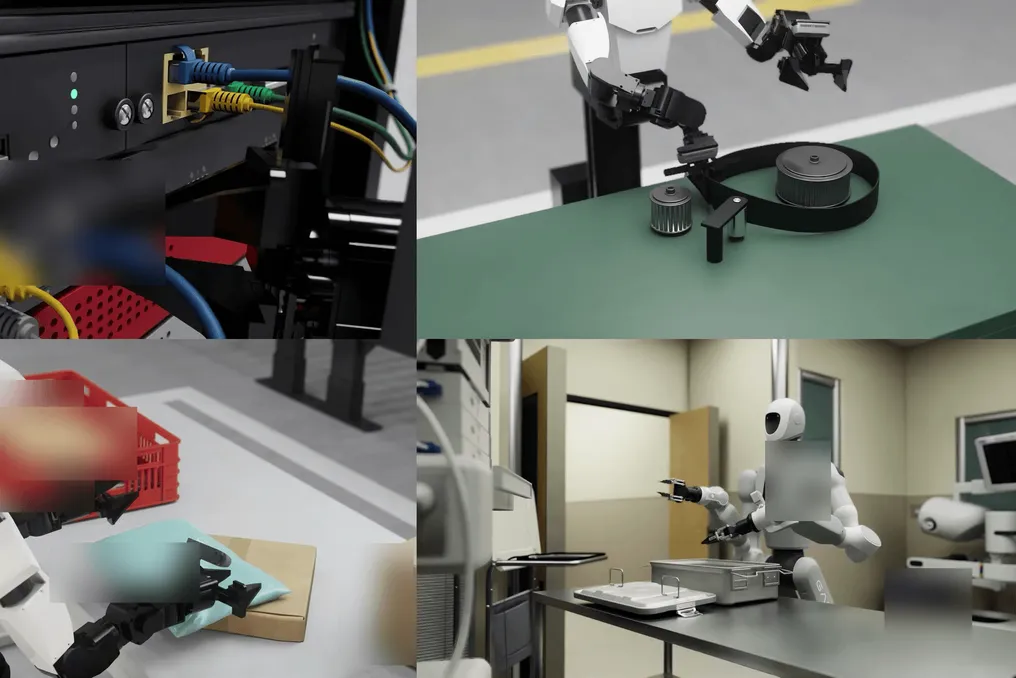
The first demonstration lasts over eight minutes and includes dexterous manipulation, tool usage, multiple work stages, and deformable objects such as cables, hoses, and gaskets. Object positions, contacts, and intermediate states are preserved between stages, requiring the policy to be capable of continuing work based on the results of previous actions. This sequence is a company simulation demonstration, not an independently verified real-world robot deployment.

Lightwheel explains that their workflow begins with first-person recordings of people performing real work using EgoSuite. Agents then define subgoals, objects, and the order of operations, after which scenes are reconstructed as SimReady OpenUSD assets. The company's SimFoundry infrastructure combines physical problem-solving, measurement, and generation, with simulation specialists verifying key steps.

The official product page describes execution based on Newton and coupled rigid, deformable, and granular physics. The company claims that friction, stiffness, and damping are calibrated using engineering checks and measurements. However, these process descriptions do not guarantee a successful transition from simulation to a physical robot.

QbitAI also describes an example of hose calibration using an agent, where candidate material parameters are adjusted, and experts compare simulated movement with real measurements. The report states that the maximum positional deviation was reduced by approximately three millimeters, and unwanted oscillation was decreased. This recorded improvement is within this specific example, not a general accuracy requirement for every environment.

Access to the product is provided via an early access waiting list, not through an open download. Lightwheel plans to provide a more comprehensive benchmark and public leaderboard later. A practical question for external model teams remains open: whether policies trained in these calibrated environments can generalize to independently evaluated tasks and on real hardware; the demonstration itself does not confirm this.

Japanese Space Mission MMX Plans to Collect Samples from Mars' Moon Phobos
Read more
super.abril.com.br

Japanese Space Mission MMX Plans to Collect Samples from Mars' Moon Phobos

The Japanese space mission is heading towards Mars, but its objective is not to land on the planet itself. Instead, the Martian Moons Exploration (MMX) mission will focus on Phobos, the largest of Mars' two small moons.

The satellite was launched on October 19 at 16:41 Brazilian time using the H3 rocket from the Tanegashima Space Center in southern Japan. This marks the beginning of a five-year mission during which the spacecraft will orbit Phobos, explore it, and deploy a module for landing and collecting soil and small rocks. For the first time in history, these samples will be delivered to Earth for laboratory analysis.

MMX is led by the Japan Aerospace Exploration Agency (JAXA) in collaboration with the USA, France, Germany, and the European Space Agency (ESA). The overall scientific goal of the mission is to determine the origin of both Martian moons, including the smaller one named Deimos. Scientists also intend to study the broader evolution of Mars and its local space environment.

There is currently no clear understanding of how the Red Planet acquired its two natural satellites. These natural satellites could have been asteroids that passed by Mars and were captured by its gravity. Another theory suggests they formed as a result of an asteroid impact with Mars, ejecting rocky material into space, which gradually clumped together to form Phobos and Deimos. The chemical composition of Phobos, which the MMX mission will provide, will help determine which of these hypotheses is more likely.

However, collecting samples from Phobos will not be an easy task. Russia attempted this in 2011 with its Phobos Grunt mission. The spacecraft was successfully launched into low Earth orbit but failed to activate its engines to move toward Mars.

Nevertheless, JAXA is well-prepared for success. The Japanese space agency has already demonstrated the ability to deliver asteroid samples through its Hayabusa missions conducted between 2003 and 2010 (Hayabusa) and between 2018 and 2020 (Hayabusa 2).

MMX will test sophisticated sample collection methods specifically designed for Phobos' low gravity. The Martian moon has only about 0.1% of Earth's gravity, meaning a person on Phobos could make a horizontal jump of 1.5 km without much effort.

The mission will also serve as a test of communication between the spacecraft and a newly developed ground station. After the launch of MMX, it will take almost a year to reach Mars, with an expected arrival in August 2027. It will first fly around the Red Planet and then enter orbit around Phobos in about a month.

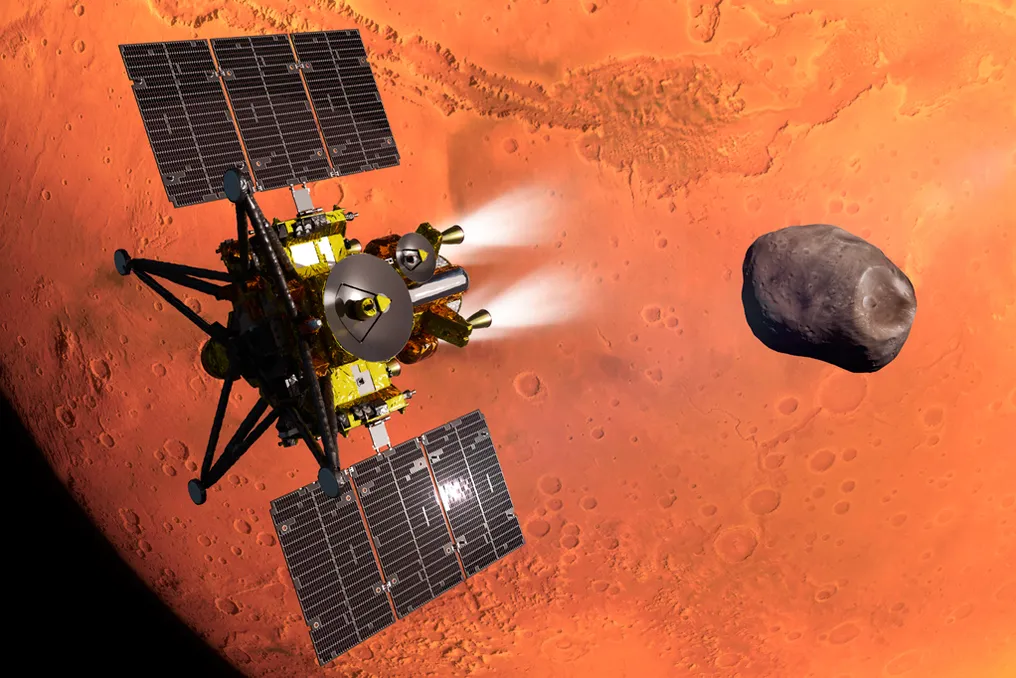
The spacecraft consists of three modules with different functions: a propulsion module to place MMX into orbit around Mars, an exploration module with equipment for landing and sample collection on Phobos, and a return module to deliver the sample to Earth.

The satellite is equipped with 13 scientific instruments to study Phobos. The high-resolution cameras Tengoo and Orochi map the surface of the Martian moon, while a laser altimeter (Lidar) creates an image of its contours using laser pulses to measure the distance between the spacecraft and surface features. The infrared spectrometer MIRS will analyze Phobos' minerals, while the gamma and neutron radiation detector Megane will determine the elemental composition of the moon. At greater distances, MMX will also collect data on Deimos, Mars' smaller moon.

The instruments will transmit data that mission controllers use to make decisions about the landing site and method on Phobos.

In early 2029, the MMX exploration module will release a small microwave oven-sized rover called Idefix, jointly developed by JAXA, the French space agency Cnes, and the German Aerospace Center (DLR). Idefix will descend onto the surface of Phobos from an altitude of 40 to 100 meters. The rover will then straighten up and move across the surface during an operational period expected to last about 100 days. It will use various sensors, including a Raman spectrometer and a radiometer, to finalize the landing site for the exploration module.

In 2030, the exploration module will descend and land on Phobos, remaining on the surface for about 2.5 hours. It will be able to collect samples from the surface once or possibly twice, landing in different locations. The ability to collect samples from multiple points on Phobos is vital for understanding the moon's composition.

The exploration module will use an instrument called C-sampler to drill a core sample or a P-sampler device that emits a jet of nitrogen gas to remove loose soil and gravel from the surface and deliver them to the sample collection chamber. The C-sampler can collect a sample up to 2 cm deep, providing the mission with a sample whose chemical composition has not been altered by solar radiation causing chemical changes on planetary surfaces over time. The P-sampler is a backup option but carries a small risk of the spacecraft falling into weak gravitational fields, such as those of Phobos.

After collecting at least 10 grams of material, the exploration module will leave the Martian moon, detaching from the landing strut. It will then head back to Earth, arriving in 2031. Upon approaching our planet, it will eject its sample capsule, which will then pass through the Earth's atmosphere. It will land via parachute in Australia, from where it will be retrieved and transported to Japan.

An additional potential benefit of the mission is that the Phobos samples may contain Martian material. Phobos orbits very close to the Red Planet, and it is believed to constantly collect Martian soil ejected regularly from the planet's surface due to asteroid impacts.

Thus, MMX can be seen as a simplified version of the Mars Sample Return (MSR) mission. MSR, a joint project of US and European space agencies, was intended to bring rock samples from the surface of Mars back to Earth. However, budget constraints led the US Congress to cancel this program.

If scientists obtain successful samples from MMX, they may receive a good consolation prize.
Popular