Recently, some of the world's most talented young specialists gathered in Dubai to demonstrate how bold ideas can be transformed into practical solutions for everyday problems.
As part of Dubai Future Week, over 100 projects developed by university students and recent graduates from around the world were presented. These projects offered tangible answers to challenges in health, energy, resources, circular systems, and the future of cities.
Among the presented developments was a device capable of extracting gold from obsolete electronics, as well as a wearable device designed to cool workers in extreme heat. The three most notable projects are detailed below.
Old phones, computers, and printed circuit boards accumulate worldwide, and gold is hidden inside them. The main difficulty lies in extracting this metal without using toxic substances such as mercury or cyanide, or without consuming a huge amount of energy.
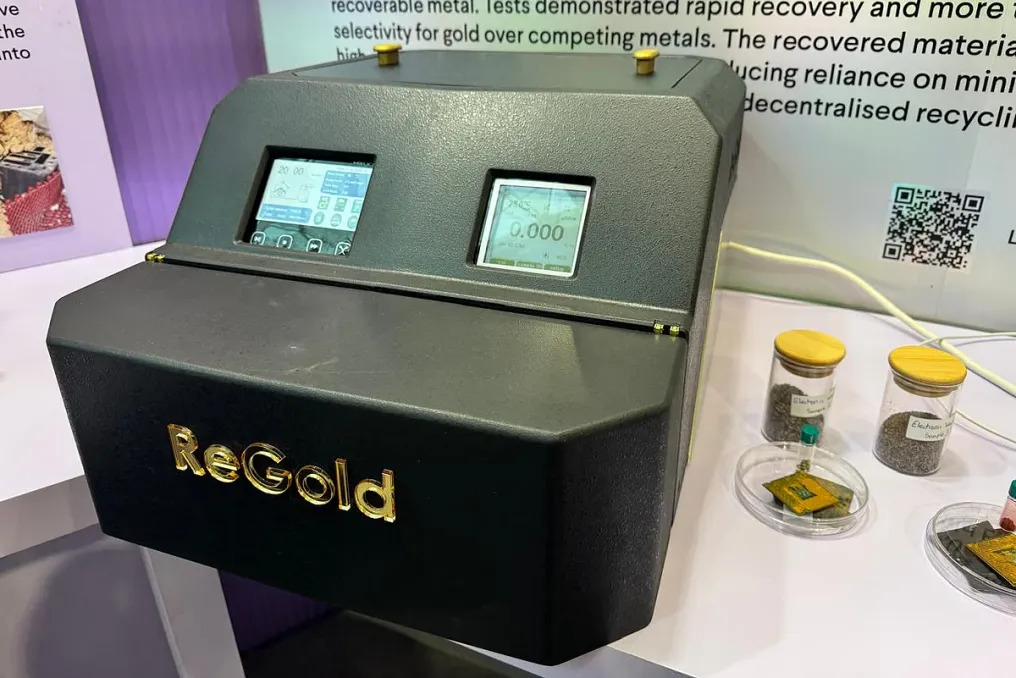
Dr. Najat Aldakka, a lead researcher and technology developer at Khalifa University's Department of Chemistry, spent about two years creating the solution. Her team developed a special porous material that selectively captures gold from the liquid obtained during electronic waste recycling.
She stated: 'At Khalifa University, we have developed a new material, a two-dimensional porous material, that can selectively capture gold from e-waste.'
Dr. Aldakka added that their innovative device can accelerate the efficiency of this capture, allowing for the recovery of 99% of the gold from the solution within one hour.
The results were impressive: 'We achieved the recovery of 5.2 grams of gold in one hour, with a purity of about 21 karats,' she reported. 'Regarding energy consumption, we only require 1 kilowatt per hour per gram of gold.'
The process, named ReGold, also excludes the use of toxic chemicals used in traditional extraction methods. Tests showed selectivity for gold over other metals more than 1000 times, and the recovered material can be reused in high-value electronics, thereby reducing the need for new gold mining.
Currently, Dr. Aldakka is seeking an industrial partner to help move the project from the laboratory to a commercial level. She noted: 'We are currently looking for an industrial partner who can work with us on the industrialization and commercialization of our product.'
Another project, Della Dx, developed by researchers from Georgia Institute of Technology, addresses a problem often encountered during medical examinations. Most people are accustomed to simple tests that provide a definitive answer, similar to COVID-19 or pregnancy tests. However, many conditions require a more detailed analysis: doctors need to know not just the presence of a marker in the blood, but its exact quantity and trend of change.
Speaker Alexandra Patterson explained the essence of the problem: 'When you go to a clinical laboratory, they are often looking not just for the presence or absence of a marker, but actually for its quantity, or a quantitative assessment of the marker in your blood.'
Della Dx uses acellular biological systems—cellular mechanisms functioning outside a living cell—that are programmed to react to specific proteins. Upon detecting the target substance, the test causes a color change indicating its concentration. The design is modular, allowing components to be replaced for different markers in approximately four weeks.
The team's initial focus is on women's health, starting with early pregnancy. Patterson pointed out that 'one in five women will experience a miscarriage, and 80% of these miscarriages occur in the first trimester, but women visit a doctor only once or twice during this period.'
The initial product will track hCG, the pregnancy hormone, which doubles every 48–72 hours in a healthy woman. This project is the result of approximately 12 years of work, including four publications and four patents. Patterson expressed hope for market entry in about five years, pending regulatory approvals.
The third project presented, Mexar Vapour, developed by researchers from the University of Pennsylvania, solves the problem of extreme heat danger for people working outdoors or in factories. It is a wearable active cooling device worn around the neck that lowers skin temperature, helping to reduce thermal stress during physically demanding work.
An accompanying monitoring system provides real-time safety alerts and allows employers to monitor heat exposure on workers. The system was tested on construction workers in hot and humid conditions and demonstrated the ability to reduce the risk of heat-related illnesses while maintaining safer and more productive workplaces.