Growing AI Demand for Electricity Opens New Opportunities for Solar Energy
Read more
CGTN
cgtn.com

Growing AI Demand for Electricity Opens New Opportunities for Solar Energy

As artificial intelligence expands, data centers worldwide are placing increasingly high demands on power supply. The International Energy Agency forecasts that electricity consumption by global data centers will nearly double between 2025 and 2030.

At the Ninth International Conference on Photovoltaic and Storage Energy, held in Chengdu, southwestern China in 2026, international participants highlighted the growing opportunities provided by solar energy and energy storage systems. The role of China's renewable energy industry in meeting growing needs was also discussed.

Similar stories

Guterres: Those who profit from the planet's destruction cannot dictate the future
Read more
noticiasaominuto.com

Guterres: Those who profit from the planet's destruction cannot dictate the future

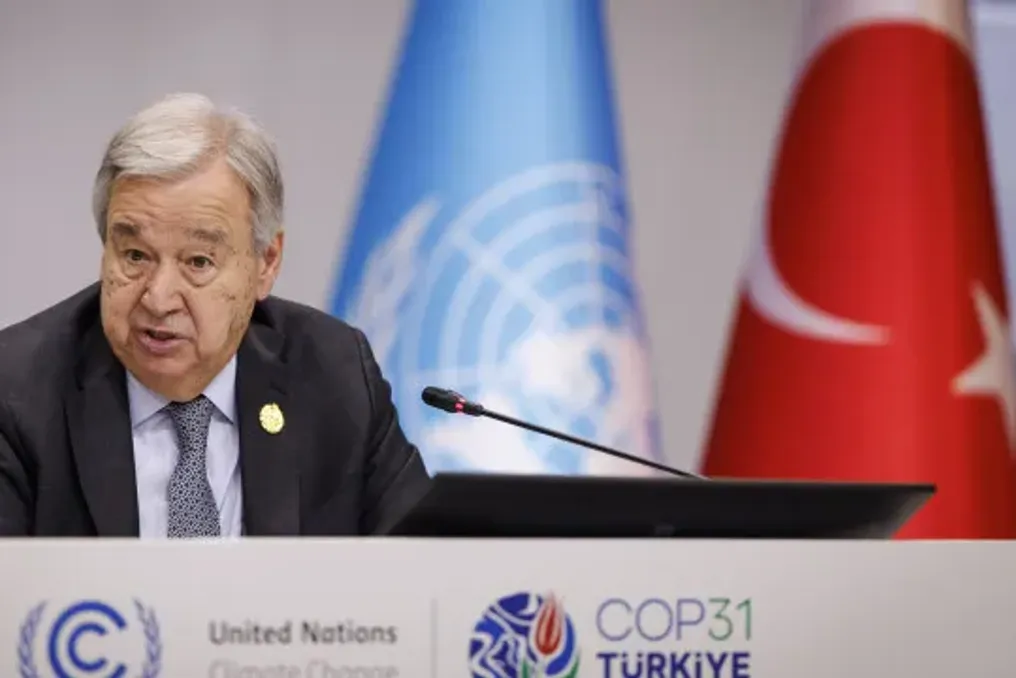
UN Secretary-General António Guterres concluded his participation in climate summits, issuing a warning against the influence of oil interests and calling for resilience against global warming.

In his final speech at COP31 in Antigua, Turkey, Guterres, who will leave office at the end of this year, stated the necessity of countering the disproportionate influence of fossil fuel lobbying. He emphasized that the planet's future should not be determined by those who profit from its destruction.

He argued his position by stating that fossil fuels are the cause of the climate crisis, asserting that achieving climate security is impossible without abandoning them. The former Portuguese statesman summarized nearly ten years of work at the United Nations, saying he always sought to speak the truth about climate change, even when it was uncomfortable or met with negative reactions.

Guterres reminded that global warming exacerbates hunger, population migration, debt burdens, and the struggle for land and water, noting: 'It is impossible to build a world on a burning planet.'

He maintained that climate action must encompass all areas of UN activity—from eradicating poverty to protecting human rights. Guterres condemned the injustice where the least responsible parties suffer the most severe consequences of the problem.

In his farewell address, he called for an accelerated just transition away from fossil fuels for climatic, economic, and security reasons. He pointed out structural injustice: those who pollute the most have failed to create conditions for an adequate response to the needs of those affected.

The Secretary-General added that dependence on oil and gas exposes countries to price fluctuations and geopolitical instability, insisting that reducing dependency, rather than changing suppliers, is the solution to the problem.

Guterres supported the expansion of clean energy but stressed that this growth must lead to a real reduction in the production, consumption, and emissions of fossil fuels. He also endorsed electrification but emphasized that electricity generation must be clean.

He warned that exceeding the 1.5-degree warming threshold is already inevitable and strongly urged limiting this situation as much as possible to subsequently return to a level below this threshold. To achieve this, he demanded immediate emission reductions of around 6% annually in the coming years.

Under current national commitments, he warned that the world is heading toward approximately 2.5 degrees of warming by the end of the century, which he termed a 'recipe for catastrophe.' Faced with these challenges, he called for greater support for vulnerable countries, reminding that even tripling adaptation funding would cover less than 30% of their needs.

Despite the alarming signals, Guterres noted progress in renewable energy sources and stated that a cleaner and safer energy future is achievable, provided the necessary resources are provided.

In 2024, 76.4% of Japan's merchandise exports were directed to APEC economies
Read more
cgtn.com

In 2024, 76.4% of Japan's merchandise exports were directed to APEC economies

According to data published by JETRO, in 2024, about 76.4% of Japan's merchandise exports were sold in countries belonging to APEC. The total amount of this export reached $540.9 billion.

Japanese industry is closely linked to the markets of the Asia-Pacific region, covering a wide range of sectors—from bustling container ports and fishing villages to agricultural producers.

UN Chief warns of the coming era of climate extremes
Read more
cgtn.com

UN Chief warns of the coming era of climate extremes

The Secretary-General of the United Nations, António Guterres, warned that the world is entering a new reality where climate anomalies have become the norm, and called on leaders at the COP31 conference in Turkey to 'take the situation seriously.'

In his statement, the UN Secretary-General noted that 'super strong El Niño is confronting a planet already overheated by anthropogenic climate change,' emphasizing that humanity has entered a new era of climate extremes.

During the gathering of leaders in Antalya for the UN climate summit, Guterres strongly urged them to 'take the issue seriously,' demanding accelerated emissions reductions, support for a just transition away from fossil fuels, as well as financial assistance and protection for vulnerable countries.

These statements came against the backdrop of the publication of a report by the UN World Meteorological Organization (WMO), which showed that in 2026, a series of exceptional global temperatures, ice melt, and sea-level rise continued.

The agency reported that each of the last 12 years was among the 12 hottest on record, and it is expected that the current year will also be included in this list.

WMO Head Celeste Saulo told reporters in Geneva that the observed situation has new significance for expressions 'beyond the charts,' cautioning that the current exceptionally strong El Niño could cause even more heat and extreme weather events over the next year.

She added that preparation should be made for another record year in 2027. According to WMO data, the average global surface temperature from January to September this year was about 1.47 degrees Celsius above pre-industrial levels.

This year's El Niño, which is expected to be the strongest since 1950, is forecast to push this figure higher by the end of the year. Preliminary data shows that 2026 is among the four hottest years in history, and John Kennedy, WMO Climate Information Head, noted that 'with the development of El Niño we may see that we are close to the peak when final figures are obtained.'

Saulo specified that this natural phenomenon releases heat from the ocean, and the waters this year are the warmest ever recorded. El Niño is declared when sea surface temperature exceeds the average by half a degree in the tropical Pacific, but the WMO forecasts that from now until January it could exceed the average temperature by 3.8°C.

Furthermore, the WMO reported record sea levels, freshwater depletion, and the ongoing long-term retreat of glaciers. In 2025, the annual ice loss was enough to fill five Olympic swimming pools every second.

Saulo warned that because 'we are intensifying our weather, and El Niño will be a risk multiplier,' heatwaves, tropical cyclones, and downpours are intensifying faster than historical baselines allowed. Nevertheless, the WMO noted a significant increase in the number of countries with necessary multi-hazard early warning systems, rising from 55 in 2015 to 136 last year.

The organization called on COP31 to ensure more investment in permanent global monitoring, data collection, and forecasting necessary for these systems to function. Saulo concluded: 'We cannot afford to fly blind.'

Popular