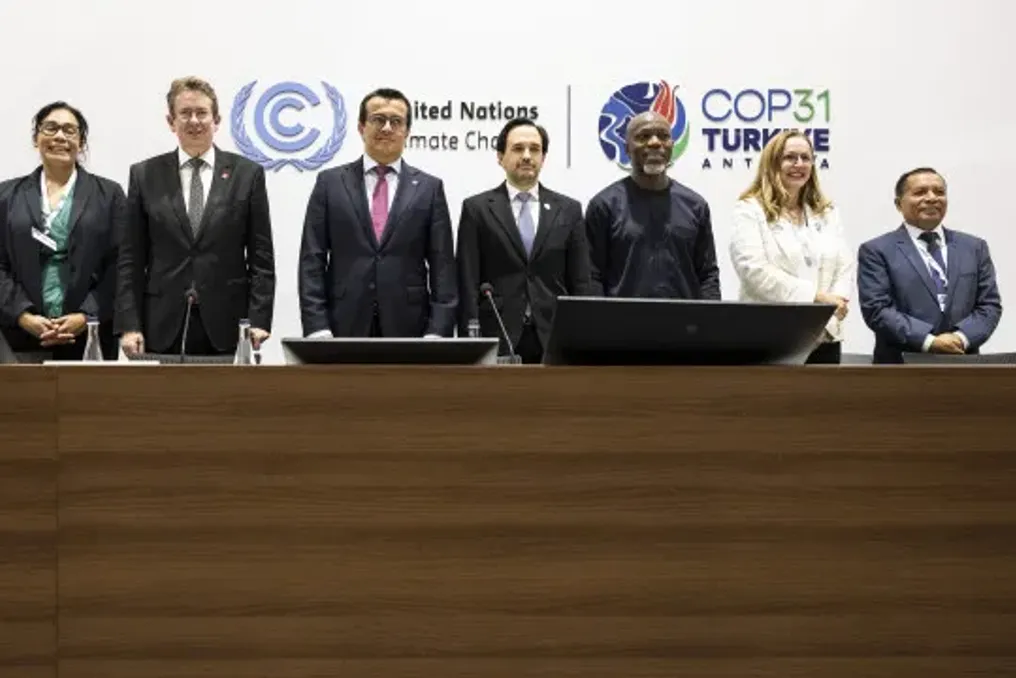
Environmental activists sharply reacted to the draft final document of the global climate summit, calling it the 'worst' in the conference's history. The draft agreement, which defines the main commitments of COP31, taking place in Turkey, lacked any mention of the phased withdrawal from fossil fuels but supported the idea of 'accelerating carbon capture, utilization, and storage' (CCS), which public figures labeled a 'false solution' to the climate change problem.
Hardjit Singh, strategic advisor to the fossil fuel treaty initiative, told Middle East Eye that the document contains 'much weaker wording across the board, and overall, if we look at it, it is regressive, and it will not help developing countries.' He added that instead, it will promote the development of the private sector and the fossil fuel industry, which does not align with the goals of the participants.
This 'summary document' compiles various negotiation outcomes and contains pledges aimed at achieving the goals of the Paris Agreement. The initial draft, released on Monday, underwent significant editing, with many key commitments removed, including the transition away from fossil fuels and the $120 billion target for financing adaptation in developing countries to the climate crisis.
Crucially, the commitment to 'transitioning away from fossil fuels' was replaced in the final text by a pledge for an 'irreversible global transition to low greenhouse gas emissions and climate resilience.' The new draft also focuses on controversial carbon capture technologies, proposing a twenty- or forty-fold increase in their use by 2035. However, CCS technologies are expensive and unreliable, and most projects initiated over the last three decades have failed.
Andreas Sieber, head of political strategy for 350.org, told Middle East Eye that this only gives the fossil fuel industry a reason to continue expanding extraction. He noted that about 80% of CCS projects are linked to new fossil fuel projects and only marginally reduce emissions, rather than neutralizing them, serving as a 'whitewash' for these new ventures.
Climate finance negotiations also yielded similarly weak results: the final text does not mention Article 9.1 of the Paris Agreement, which obliges developed countries to provide financial resources for mitigation and adaptation in developing nations. Furthermore, the reference to tripling climate adaptation by 2035, a goal set in Belém, Brazil, last year, and any mention of the historical responsibility of developed countries were removed from the previous draft.
Saudi Arabia was one of the main players obstructing the inclusion of references to the phased withdrawal from fossil fuels in the final text. The Guardian reported, citing sources familiar with the negotiations, that the kingdom met with the COP presidency and consistently insisted on weakening language regarding fossil fuels while pushing for the inclusion of a carbon capture and storage goal.
However, when it comes to financing, climate activists point to developed countries and the European Union. Singh stated that 'when looking at financing, the European Union, Australia, and Norway are those who exerted strong opposition.' The EU had preemptively excluded new climate finance commitments, declaring them 'deadlocked' before this conference.
Henan Keskes from Greenpeace Mena emphasized that climate finance is a matter of survival in the region. He told MEE that the region is experiencing sea-level rise, fires, droughts, and heatwaves, making adaptation a huge priority. Yet, the entire region receives a tiny fraction of the necessary climate finance for mitigation and adaptation.
Singh argues that the same group of countries hindered progress in operationalizing the just transition mechanism. This framework, designed to support workers and protect communities as countries shift away from fossil fuel-based economies, was agreed upon last year at COP30, but its operationalization was left for COP31. Singh noted that during work on the elements and further defining the mechanism, participants again faced resistance from the same group of countries, who claim such a mechanism is unnecessary and that no new system is required to assist countries aiming to phase out fossil fuels. He concluded that this is unacceptable, which is why they call it the 'worst COP in history,' as the text offers them absolutely no help.