A year after the so-called ceasefire agreement between Israel and Hamas in October 2025, the cinemas of Palestine and Israel are actively working to capture the shifting reality defined by issues more complex than those that arose immediately after the events of October 7th.
The main focus of several films about Gaza released between 2024 and early 2026 was maintaining dignity amidst a sadistic campaign of dehumanization against the civilian population.
However, the autumn season of 2026 raises new questions: the deeply asymmetrical power relations between the aggressor from Israel and Palestinians; the viability of the two-state solution dream; the constant pain of a lost, unattainable homeland; and the recently exposed ugly realities of Gaza's informal economy.
As shown by the colossal success of the film NAZA, Gaza will continue to dominate the narrative of Palestinian cinema in the foreseeable future. Nevertheless, as the harvest of this autumn's films suggests, new facets will gradually become apparent as Palestinian filmmakers continue to grapple with the uncertain situation following October 7th.
Meanwhile, Israeli cinema remains divided, under pressure from political leaders seeking to improve their country's image, and competing with the impulse of leftist filmmakers who are trying to restore the national cinema's lost international prestige, whose motives can only be assessed individually.
Thirteen in Gaza
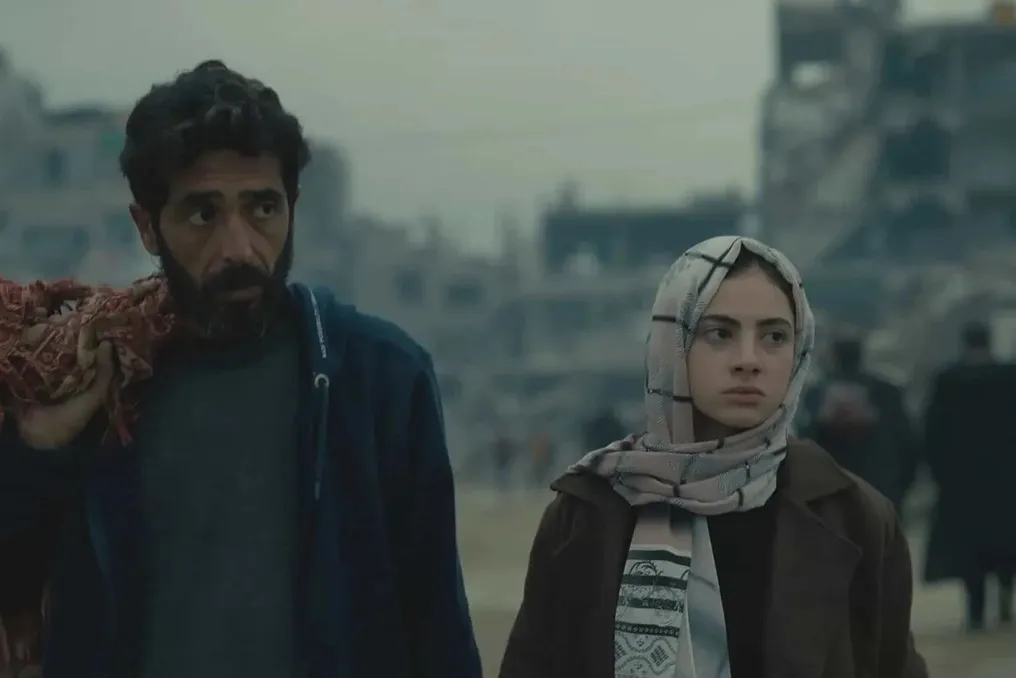
The debut feature film by Palestinian director Hossam Abu Dan is the first fictional work shot by a Palestinian filmmaker inside Gaza after October 7th. It is also the boldest and most controversial Palestinian film of the year: a coming-of-age story that serves as a sharp, unvarnished portrait of Gaza, populated by helpless fathers, war speculators, and sexual predators.
The film is a frank exploration of the inevitable moral compromises affecting part of the male population, whose deviation cannot be separated from the moral decay of the occupation. The action takes place in 2025, and the film features newcomer Mary Ziyara as Raghad, a 13-year-old girl who lost her mother and brothers in an Israeli strike that destroyed her home.
Now
Having moved to a vast, dilapidated camp with her father (Firas Al-Masri), Raghad struggles with the confusion and suffering of puberty in a depleted environment where sanitary pads are considered a luxury. Unemployed and desperately wanting to provide for his daughter, Abu Raghad falls into the web of Khalil (Ghassan Salem), a suspicious trader who controls the trade and distribution of goods within the camp, dealing in the black market of humanitarian aid. Khalil offers Abu Raghad a job while concealing barely restrained sexual desires for his daughter. His proposal for a quick marriage becomes a non-negotiable condition: it is the only way Raghad and her father can continue to survive in the lawless, inevitable purgatory.
Abu Dan portrays another reality of Gaza that cinema has not yet addressed. The director argues that when mere survival ceases to be the primary driving force of existence, the agonizing struggle to restore a semblance of normalcy can be equally destructive.
Raghad is deprived of the ability to cope with the usual pains of adolescence: privacy is absent, sanitation is minimal, and mood swings and insecurities related to body image and self-awareness must be suppressed. Meanwhile, Khalil embodies the unstoppable force of capitalism, an inevitable byproduct of a population immersed in economic chaos. Abu Dan strips the living reality of Gaza of the conventional political coverage that dominates news reports; in this particular Gaza, neither Israel nor Hamas has a tangible presence. It cannot be mistaken: this general tension, paranoia, and suffocating sense of entrapment are inseparable from the war.
Khalil is a monster born of the Israeli occupation. Abu Dan suggests that in this world governed by the law of the jungle, expecting honest behavior from every person is both a fantasy and fundamentally contradicts the primal nature of human survival. There are significant similarities between 'Thirteen in Gaza' and Abdallah Al-Khatib's award-winning film 'Chronicles of Siege' at the Berlin Film Festival. However, Abu Dan's film, which won the Netpac Award at this year's Toronto International Film Festival, is bolder. It is sometimes raw and oppressive, and at times unpleasant. Nevertheless, by confronting an aspect of life in Gaza that Palestinian cinema sought to explore, and refusing to smooth over this uncomfortable dimension of the Palestinian experience, Abu Dan created one of the most authentic chronicles of his hometown.
Citizen Osama
Compared to 'Thirteen in Gaza', 'Citizen Osama' appears as a more traditional depiction of Gaza, although it possesses a refreshing humanism and unexpected warmth. Ahmed Hassoun's second feature documentary, another filmmaker from Gaza, tells the story of Osama Al-Ashy, a photographer who became a war journalist after October 7th, navigating fatherhood, friendship, and the ethical responsibility of documenting daily life in Gaza from within. The film covers approximately the first year of Ashy's child's life, from mid-2024 to mid-2025, and rejects traditional narrative in favor of studying the character of a kind-hearted man who enjoys the small blessings in his life against a backdrop of universal destruction.
Over the course of a year, Ashy and his young family are forced to constantly move from north to south, constantly facing the threat of displacement. Nevertheless, the young father perseveres. In the film's voiceover, he notes: 'Every two days we say goodbye to a colleague.' Hassoun and Ashy illustrate their film with striking footage: a group of journalists joking in dark humor inside a moving vehicle traversing rubble; men running to collect humanitarian aid dropped into the sea; and a heartfelt celebration of the truce by the populace, as people desperately try to find reasons for hope.
If 'Thirteen in Gaza' conveys the bleakness of camp life, 'Citizen Osama' demonstrates the vast, yet often overlooked, importance of urban life, work, and community. Viewed side-by-side, these two films show that forced camps were never a natural or accustomed environment for a people who only desire normalcy. 'Citizen Osama' does not make major cinematic breakthroughs nor offer a particularly revealing portrait of Gaza after October 7th. But Ashy is a convincing and very pleasant protagonist who never seeks to elicit sympathy from his followers or the film's audience. By the end of the film, as Ashy plays with his young son, Hassoun emphasizes a fundamental truth: the struggle of ordinary Palestinians is no longer just about being noticed; they crave something much more basic—a dignified life lived in freedom.
Conversation with the Sea
As a fan of the previous works of Palestinian filmmaker Muayad Alayan, I spent weeks trying to find merit in his latest feature film, but frankly, I failed. 'Conversation with the Sea' is sincere, well-intentioned, and politically significant in highlighting the fragility of Palestinian existence within Israel—an often-overlooked aspect of the Palestinian experience. But, frankly, it is also poorly made, marred by careless production and contrived storytelling.
Veteran actor Kamel El-Basha (The Insult, Mo) plays Kamal, a 60-year-old widowed baker leading a quiet, mostly isolated life in his old house in East Jerusalem. Having distanced himself from his daughter for reasons revealed only at the end of the film, Kamal still mourns the premature death of his young son. His mundane existence is disrupted when he receives a court order from the National Insurance Institute of Israel demanding 75,000 shekels ($23,000 USD) for unpaid social security contributions accumulated in his son's name. Documents show that his death was never recognized for unknown reasons.
Poor Kamal is forced to undertake a mission to prove his son is dead and avoid the confiscation of his home. Initially convinced his son drowned, Kamal begins to doubt when inconsistencies appear in the records, prompting him to travel to find out what truly happened to Wael. The plot is inspired by a real story involving Alayan's wife and mother-in-law. Its surreal premise opens up several fascinating avenues for exploration, both aesthetic and narrative.
Unfortunately, the director chooses the most ordinary, down-to-earth path, weaving a predictable domestic drama whose melodramatic excesses completely overshadow his sharp political themes. The biggest flaw in the narrative is how flawless Kamal is. He is presented as a man in conflict, consumed by guilt. However, his greatest supposed transgression—leaving for the United States in search of a better life—stems from his desire simply to provide for his family. His internal conflict smells of artifice, seemingly imposed by Alayan to give his character greater complexity. Instead, Kamal appears as a victim of circumstances, a double casualty of the American Dream and the Israeli occupation, which deprives men of his type in the Arab world of the financial stability they seek.
Kamal's flatness is reflected in Alayan's disappointingly calculated and absurd portrayal of Israelis. In a widely discussed, lengthy dinner scene that angered numerous critics, Kamal finds himself at a table among a gathering of self-proclaimed liberal Israelis, awaiting the arrival of a woman named Einat. She could have been the last person to see his son before his death. Carelessly unaware of the structural persecution of their Arab neighbors, the dinner guests openly discuss how Palestinian children should be educated to develop a more balanced view of Israel while discarding their supposedly toxic local identity. The rigidly staged, awkwardly written, and provocatively performed dinner scene—the central part of the film—pushes the limits of believability to the breaking point with its sheer bluntness. One can portray Israelis as malicious and smug, however they wish, but must it be so uninspired? So superficial? So obvious? Kamal's journey ends in an artificial reconciliation, but he learns little about himself, his son, or anything else. The film also offers nothing remotely insightful about the dynamics of power between Palestinians and Israelis, which Alayan briefly hints at. The only intrigue remains in the premise itself, which the director never fully develops or utilizes to its full potential. Even a simple legal thriller could have been more gripping and worthwhile.
Alayan is one of the most talented filmmakers of his generation. His first two feature films, 'Love, Theft and Other Adventures' (2015) and 'Reports on Sara and Salim' (2018), were bold, multifaceted genre films that touched upon aspects of the complex Palestinian experience within Israel that many filmmakers avoided. 'Conversation with the Sea' is Alayan's weakest and most compromised work to date—it arrives at a completely different and more complicated moment than his previous work, where the internal critique, biting sarcasm, and satirical humor characteristic of his early films might seem inappropriate in the current thorny political climate. But if filmmakers like Abu Dan can risk their bold and provocative depictions, why can't filmmakers of Alayan's caliber do the same?
Road to Jericho
Last, and undoubtedly the least significant, is the veteran Israeli filmmaker's latest feature film.
[ ]