An elder from Tirunelveli recalls times when he could bend down, gather water in his palms, and drink directly from the Tamiraparani River, noting that the water seemed sweeter back then. He would not do that today.
For researcher Sneha Shah, who dedicated almost five years to studying this river, this memory reflects scientific data indicating changes in the river. She notes that scientific indicators of dissolved oxygen and total dissolved solids (TDS) show increased pollution compared to the past, and she has managed to link these observations.
This raised a question that ultimately shaped the RE-Verse initiative: before beginning river restoration, it is necessary to understand what exactly is being restored, what has changed, and what the river requires.
Currently, Sneha, 29, and her junior colleague Vidhya Vigasini, 24, are trying to answer this question along a 30-kilometer stretch of the Tamiraparani in Tamil Nadu. In July 2026, the Tamiraparani gained legal entity status, becoming the third river in India to receive such recognition. This grants the river a special legal status and includes its rights in discussions about conservation and management.
What if a river has its own rights?
Sneha explains the concept of river personhood, drawing an analogy with human rights violations. She argues that if ink were poured into a person, it would be a violation; the same happens when sewage is dumped into a river—it is a violation of its right to life. Similarly, damaging a person's finger is a human rights violation, and similar damage to a river through diversion or complete restructuring is a violation of its natural essence.
The core idea is recognizing the river as an independent entity possessing rights, rather than merely a resource that can be extracted, diverted, or polluted. This philosophy parallels the beliefs of many indigenous communities who traditionally view rivers, hills, and other natural systems as living entities of sacred significance.
However, legal recognition translates this concept into the sphere of governance. Sneha points to the ongoing pollution of the Ganges and Yamuna, despite their previous legal recognition, as an example of the gap between declaring rights and ensuring them on the ground. She says that the consequences of this recognition for the Tamiraparani have not yet materialized in practical implementation.
The task of the RE-Verse team is to ensure that the concept of river rights transforms into sustainable actions on the ground.
Understand the river before restoring it
The RE-Verse initiative began forming about three years ago. Sneha, who was pursuing a PhD on the Tamiraparani at the Ashoka Foundation for Environmental Research (ATREE), announced a call for interns during her fieldwork. Vidhya, representing the local area, responded to this call. After several months of working together, they realized their skills complemented each other. Together with four other young team members, they formalized their activities into a seven-person team.
Sneha is responsible for research design, scientific assessments, and conducting workshops, while Vidhya handles public engagement and translation, helping bridge the gap between scientists and Tamil-speaking locals. Their work covers three locations: Aladiyur, Cheranamahadevi, and Gopalasamudram.
Instead of starting with a predetermined restoration plan, the team developed a shoreline assessment sheet to document the condition of various sections. They study the physical characteristics of the river, including its width, flow, and floodplain. They also record vegetation along the banks, identifying both native and invasive species. For instance, water hyacinth accumulates where the current slows down or pools form.
Sneha explains that the appearance of invasive vegetation, which should not originally be there, alters the food chain and the structure of the place. Animals and insects that previously did not depend on it begin to rely on it, and gradually the entire structure begins to change.
Another invasive plant they documented is Prosopis juliflora, widely known as mesquite. The team also studies fish populations in the river. Among the species of interest is Dawkinsia tambraparniei, a small endemic barb inhabiting the Tamiraparani. Although these fish are small, they are part of a larger food web, supporting larger fish and indirectly predators like otters.
Another issue is the growing presence of the invasive African catfish. Amateur fishermen have also expressed concern about this species. Some kill the caught catfish, fearing that their increasing numbers may affect the populations of edible fish.
Otters cannot be forgotten either. Locals call them Neer Nai, which literally means 'water dog'. Otters were historically found along the Tamiraparani. Sneha reports that earlier researchers at ATREE documented their presence in the landscape, but current sightings have become rare.
The assessment also records human activities: sand mining, bathing, washing, temples, wastewater treatment infrastructure, and how villages access river water. The goal is to understand the river as an interconnected ecosystem.
The river's memory is written on its banks
One of the unusual aspects of the RE-Verse initiative is the decision to use traditional stone structures as potential public monitoring points. Local residents informed the researchers that some mandapams date back to the Chola dynasty, although the team is still determining their exact history. Mandapams are traditional stone pavilions located along the riverbank. Some of these structures have stood near the Tamiraparani for generations.
During fieldwork, Sneha noticed that people often recognized these structures better than individual stretches of the river. Thus, the mandapams served as landmarks around which communities could organize their relationship with the river. The team maps how many structures still exist, which are dilapidated, and which have become part of the debris along the bank.
Where a structure remains usable without significant restoration, researchers hope to propose it as a monitoring point. The idea is for residents to visit the same mandapam every two weeks or once a month and photograph the river from the same spot. Over time, these photographs can reveal changes in water levels, vegetation, erosion, waste accumulation, and the riverbank itself.
Sneha explains: 'You can come to this specific place every two weeks or once a month and take a picture from the same spot. Then you will see how the river changes over time.' Instead of making the community a passive recipient of the restoration project, the researchers want residents to help create the baseline against which the future of the river will be measured.
When rituals become a source of pollution
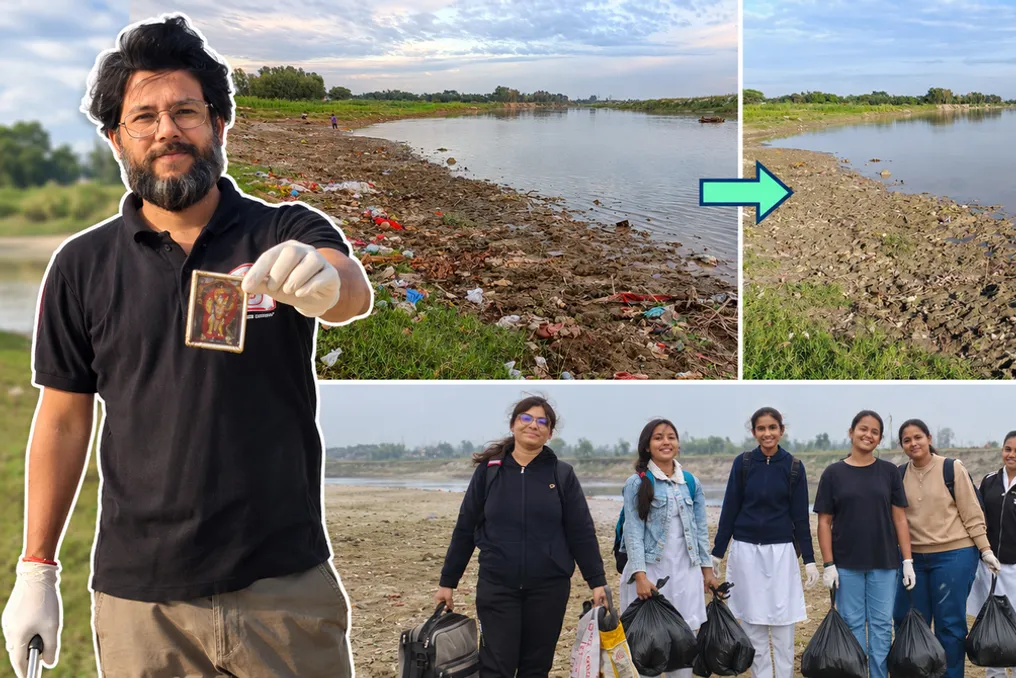
In 2022, when Sneha first came to Tamiraparani for fieldwork for her doctoral dissertation, she encountered an unexpected phenomenon. The river is perennial, meaning it flows year-round. However, in the summer when water levels were low, sections of its banks were covered with discarded clothing. This trash was linked to a ritual that has become increasingly common over the last two decades. At the Papanasam temple, people arriving from different parts of Tamil Nadu began throwing the clothes of deceased family members into the river, believing this practice would help their loved ones reach heaven faster.
Sneha recalls being particularly shocked by where this was happening. The Tamiraparani exits the forest landscape, passes through the Papanasam area, and begins its journey through populated areas. The dumping occurred almost immediately after the river left the dam and entered the human landscape. She notes: 'The river doesn't even get a kilometer of peace before it is just thrown away.'
The situation is complicated by the fact that many local residents themselves do not practice this ritual. Instead, the river receives waste from visiting pilgrims and tourists. For researchers, solving this problem requires delicacy. Sneha emphasizes: 'When people mourn and come here for this ritual relief, it is very delicate to tell them not to throw away clothes. They believe they are doing something for their loved ones, unaware that they are actually polluting someone else's yard.'
There have been administrative interventions. Sneha recalls that the former Tirunelveli Circle Collector, Vishnu Venugopal, installed bins and encouraged visitors to wash and dispose of their clothes properly. Although this practice is reportedly banned, the trash accumulated over approximately two decades still needs to be removed. Sneha believes: 'Cleanup might take longer than the pollution because it is the entire volume of pollution.'
The team also cleaned a one-kilometer section to understand what types of solid waste enter the river. Among their findings were used shampoo, soap, and oil packets. In the region's hot climate, where temperatures can reach 42 degrees Celsius, applying oil before bathing is a traditional practice. Small disposable packets make this convenient, but they also increase the river's plastic burden.
Researchers are now studying ways to reduce this amount of waste. For Sneha, one of the biggest lessons from previous conservation projects was that restoration does not always last long. During her early work in Vadodara, her team cleaned a stream and helped bring crocodiles back to the area. But after she left the city for her doctorate, she returned several years later and found that the stream had deteriorated again. This experience changed her approach to the Tamiraparani.
She says: 'I work with people who belong to this landscape. So it is essentially their own backyard that they must maintain.' This is where Vidhya plays a central role. As a native of the region, she helps the team interact with residents, translate conversations, and make research accessible to local communities. Vidhya shares: 'The biggest thing I learned is that the river can be 'read,' and everyone reads it differently. Farmers read it through clouds. Fishermen read it through the fish, when it is there and when it is not. Everyone has their own way of knowing the river... they know when something is wrong. No one taught them this in class. It comes from living next to the river every day. That is why it is so important for me to tell stories of rivers and the people who live near them. The river is not just water and data. It is part of people's daily lives, and when we listen, we start to see it as they do.'
Sneha and Vidhya recall how elderly residents sometimes greet young researchers as if they were their granddaughters. 'Communities genuinely want to protect and preserve their river, but they often feel overwhelmed when the conversation turns into graphs, numbers, and technical jargon. We work as a bridge between the community and