Google implements sidebar on homepage to manage AI conversation history
Read more
Tecnoblog
tecnoblog.net

Google implements sidebar on homepage to manage AI conversation history

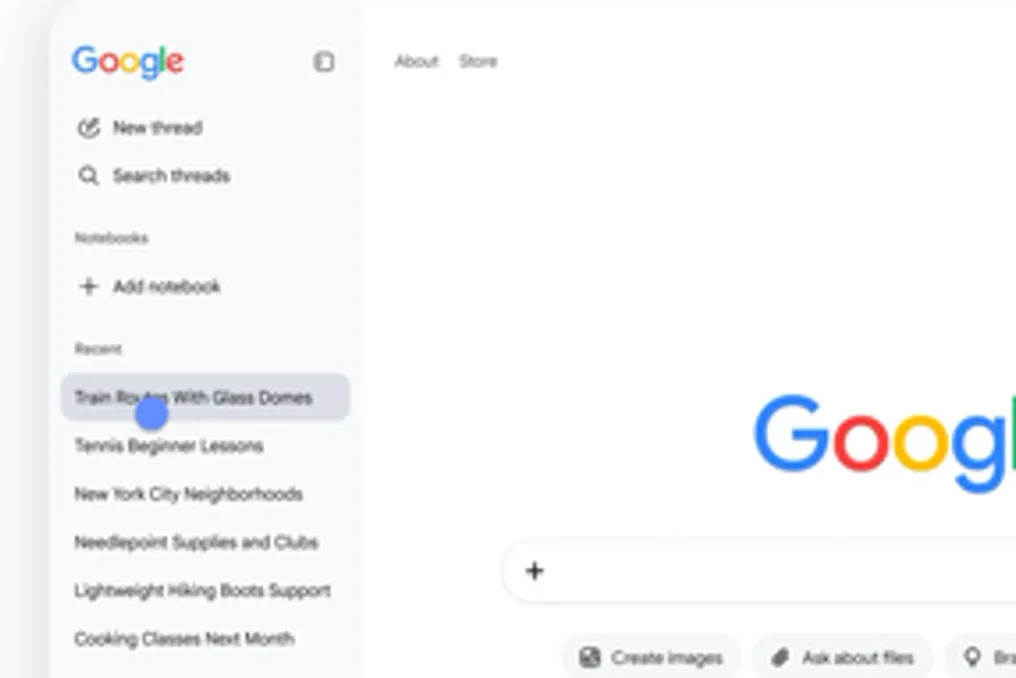
Google has introduced a sidebar on its homepage, designed to give users quick access to past interactions conducted with artificial intelligence. This new feature allows users to resume searches, find previous dialogues, and start new topics using the AI Mode.

The functionality is being rolled out globally and aims to strengthen the integration of AI within the search engine. Google began making this sidebar available to simplify access to previous conversations with artificial intelligence, gathering recent searches made in AI Mode and allowing dialogue continuation without needing to restart every query.

Robby Stein, Vice President of Research, announced this novelty on Thursday (19). He stated that the tool is already globally available in the desktop version and aims to facilitate the continuous maintenance of searches.

By accessing this panel, the user views a list of the most recent conversations generated by AI Mode. Furthermore, the interface provides quick options to start new interactions, search old topics, and link a Gemini Notebook. The sidebar has an option to be minimized to free up space, reverting to the traditional appearance of the search engine.

It is important to note that this feature does not cover the entire Google search history; it serves specifically as a shortcut for conversations conducted in AI Mode, a tool that allows for formulating more elaborate questions. Thus, someone who started an investigation on a specific topic can return to it later, avoiding having to repeat all the initial questions.

This change also brings the main page closer to a typical chatbot experience. Instead of merely functioning as a starting point for web searches, the search engine now offers a dedicated place for organizing and continuing conversations.

This addition is part of a sequence of modifications to the search engine interface. In August, Tecnoblog reported tests with new buttons on the homepage that offered shortcuts to create images, consult documents, and conduct brainstorming sessions with AI support. More recently, the company released the temporary conversations feature, which allows asking questions without the interaction being saved in the history.

With the implementation of this new sidebar, the company bets on providing an experience where the user can start a search, get information, and subsequently return to the discussed subject. Although the global rollout has begun on the desktop environment, Google has not yet specified the timeframe for when the novelty will reach all users.

Similar stories

Artificial intelligence begins to put pressure on Google's core advertising business
Read more
olhardigital.com.br

Artificial intelligence begins to put pressure on Google's core advertising business

Google's strategy of integrating AI-generated answers into the top of search results is beginning to put pressure on its key revenue source—search advertising. Last month, the company reported that this activity accounted for less than 50% of its quarterly revenue of $128 billion USD (equivalent to approximately 729.6 billion Brazilian reais).

Although revenue from search advertising grew by 12%—which was below Wall Street forecasts of 15%—advertisers are noting a decrease in the visibility of their ad campaigns. Thanks to features like AI Overviews, which display AI-generated summaries above traditional results, and AI Mode, which allows users to interact with a chatbot, regular ads are being pushed to lower positions on the page.

During a conference call regarding the results, Google CEO Sundar Pichai stated that the priority is improving the user experience of search before increasing monetization. He emphasized: 'We are focused on creating the best search experience for the user, and then on monetization.' Meanwhile, Thomas Shenfelder noted that AI features have increased the volume of queries, including commercial ones, and that initial ad test results look promising.

In practice, according to The New York Times, this transition is already affecting investors' decisions regarding the platform. Marshall Evans, a marketing specialist from North Carolina who has worked with small businesses for over ten years, has reduced his investments in Google over the past six months. For a client selling trophies, monthly expenses dropped from $2,000 USD (approximately 11.4 thousand reais), which were used about a year ago after the introduction of AI Mode, to $500 (approximately 2.85 thousand reais). Some of these funds were redirected to the streaming service Tubi, the Bing search engine, as well as to the social networks Reddit and Nextdoor.

The problem is also observed among digital companies. Max Anderson, CEO of OnlyFinder, a service that helps users find creators on the OnlyFans platform, claims that advertising costs have likely tripled or quadrupled over the last three years. According to him, the company's ads can disappear from the page or appear below the AI Overviews response. Since Google does not provide a way to guarantee positioning within these summaries, Anderson is gradually reducing spending. He is currently directing about half of the amount he invested in platform advertising in its early years.

Competition for visibility is also linked to changes in how people use search engines. For Valeria Shlosser, a marketing specialist from the global creative agency VML in New York, users are spending more time interacting with chatbots and less time browsing the internet. In her opinion, clients remain interested in Google, but they are also trying alternatives such as ChatGPT and Perplexity.

This transformation represents a strategic challenge for the company itself. According to Tom Monteiro, senior analyst at Investing.com, Google is attempting to replace a business model that demonstrated competitive advantages for a decade with one that has different characteristics. Monteiro stated: 'Google is trying to take a business that was the best in the world for 10 years and turn it into another that doesn't have the same advantages.' He added: 'This transition is much more complex than Google's management anticipated.'

Google keeps record of Gemini interactions for two months, even with history disabled
Read more
tecnoblog.net

Google keeps record of Gemini interactions for two months, even with history disabled

Even if the user disables Gemini history, Google will start recording the last two months of queries made on the platform. This change is part of the update to the artificial intelligence privacy policies, implemented on Tuesday, November 17th, raising the storage period for interactions from 72 hours to two months.

Users still have the ability to define how long they want their conversations to be saved. The settings offer a default of 18 months, as well as options for three or 36 months, or the possibility of leaving the limit indefinite or completely zeroed out, although the new rule guarantees a minimum of two months of saved messages, regardless of the choice.

According to Google, this modification aims to use interactions to ensure the protection of Google, its users, and the general public. The company also mentioned the assistance of human reviewers when communicating the news, suggesting that real people will have access to the content of questions asked to Gemini.

Access to data exchanged with the AI is not new; experts frequently advise users to avoid sharing sensitive information in these queries, such as credit card numbers or personal documents.

Verification of these messages by humans is already a standard procedure in AIs, stipulated in Google's privacy policy. Companies like Anthropic release periodic reports showing cases of misuse resulting from this type of review. Gemini itself acknowledges that certain interactions are verified by real people, but always without identifying the users.

Message retention is a common practice in the sector. While companies like Anthropic and OpenAI cite 30-day periods, they also state that they can keep interactions saved longer if necessary. Google justifies maintaining these records for security reasons but does not detail how this represents greater user protection.

Even with the mandatory retention imposed by Google, it is possible to delete the history and disable automatic saving. Although conversations remain available internally for AI operation and security purposes, they cannot be accessed by the user in their account. To delete and suspend the saving of these dialogues, a specific procedure must be followed.

Additionally, there is an option to configure the automatic deletion of messages older than three years. This feature is located under 'Delete activity older than…', right below the saving deactivation setting, allowing the user to select the desired period and confirm the action to finalize the process.

Microsoft service issues raise questions about Satya Nadella's AI race strategy
Read more
www.aajtak.in

Microsoft service issues raise questions about Satya Nadella's AI race strategy

Microsoft services, including Outlook, Teams, and Microsoft 365, were inoperable for 16 hours, leading to billions of dollars in losses worldwide. Although the company continues to report that it is working on a swift resolution and that services are functioning for some users, the issue remains relevant.

The outage affected businesses, government institutions, and individual users. However, following this failure, questions are arising not only about server malfunctions. Experts and users on social media and Reddit are questioning the strategy of Microsoft CEO Satya Nadella. They argue that the company has focused excessively on launching new features and products in the artificial intelligence (AI) race, while the value of experienced engineers maintaining legacy systems has been sidelined.

One post on X stated that many senior engineers who understand the company's older systems no longer work there. It was also suggested that after layoffs and employee departures, it has become harder for remaining engineers to fix bugs in outdated systems. The post's author further claimed that Microsoft's internal incident management tool, IcM, failed to load during the outage.

These claims have not yet been independently verified, and Microsoft has not stated that a shortage of experienced engineers caused the outage. Nevertheless, discussions surrounding the company's AI strategy, layoffs, and the reliability of old systems raise a serious question: is Microsoft paying enough attention to strengthening existing systems by investing in the future of AI?

According to an official update from Microsoft services, some servers were not undergoing automatic health checks, causing them to stop functioning, and their traffic was rerouted to other servers, causing overload. Later, the company clarified that the main procedure for establishing secure connections on the affected servers was under excessive strain, leading to the cessation of server responses to user requests. Microsoft performed a server restart, rerouted traffic via alternative paths, and checked certain configurations.

This impacted several other services, such as Outlook, Exchange Online, Teams, SharePoint, Copilot, and Microsoft 365. Until November 13, some users continued to experience intermittent problems. The company reported that it found no signs of cyberattacks or malicious activity.

Under Satya Nadella's leadership, Microsoft made AI a core business priority. The company integrated Copilot into Windows, Microsoft 365, Teams, and other products, and accelerated AI infrastructure development through partnerships with OpenAI and investments in large data centers.

Parallel to this strategy, major decisions regarding staffing levels and costs were made within the company. In July 2026, Microsoft announced the layoff of approximately 4,800 employees, citing changes in the commercial and Xbox business and resource reallocation according to priorities. Previously, in 2025, the company had also conducted workforce reductions: in May 2025, about 6,000 employees were laid off, and in July 2025, another approximately 9,000 people were dismissed.

In October 2026, Microsoft also presented a financial support plan for the voluntary departure of around 60,000 employees, which exceeded a quarter of the company's total workforce. However, this should not be viewed as mass layoffs. These decisions have now become a subject of discussion on social media following the recent outage. The question arises: has the company weakened the teams responsible for its old and critical systems in the pursuit of cost reduction and increased investment in AI?

It is not enough to simply write code for a large software system to function. Engineers working with legacy systems know how different components are interconnected, what changes were made previously, and what is a safe way to resolve failures. This is known as institutional knowledge in technical terminology. When experienced staff leave the company, and their expertise is not properly transferred to other engineers, resolving a serious problem can take longer.

Some developers on Reddit report that the rollback process, which used to take about 45 minutes, now takes five hours. They also claim that after engineers knowledgeable about old systems left, current teams have to work overtime to resolve issues.

Microsoft's investments in AI have become a significant part of its business decisions. According to Reuters, this is the case.

Popular