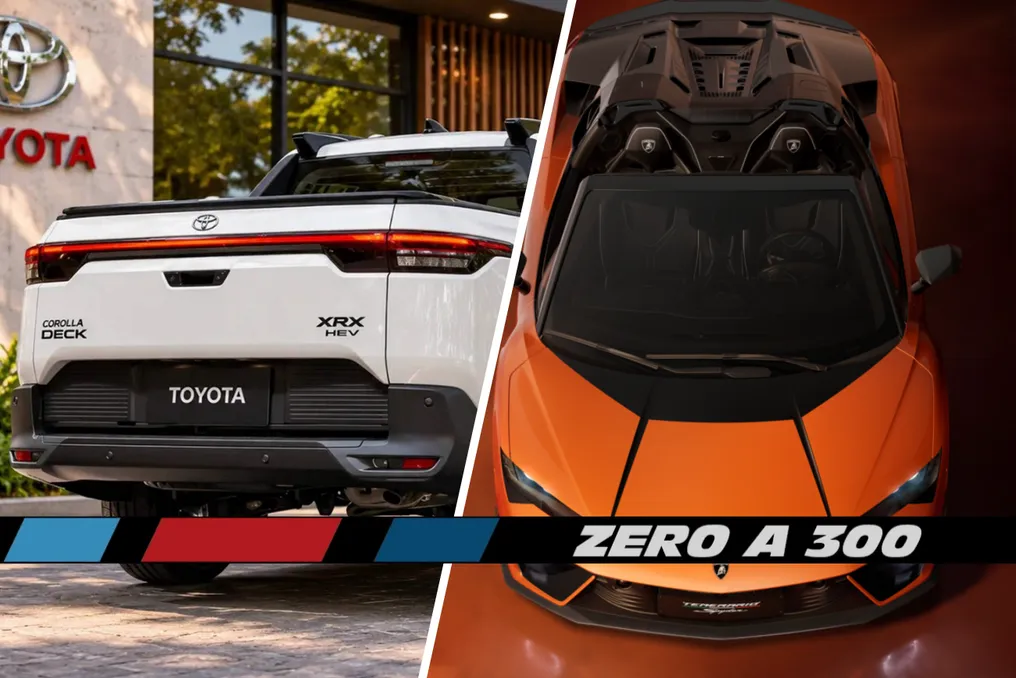
Toyota surprised the market by officially presenting its new intermediate pickup truck, the Corolla Deck. This event took place in the city of Sorocaba, in the state of São Paulo, during the inauguration of a new factory unit. The Corolla Deck was developed to compete with models such as the Fiat Toro, Renault Niagara, Ram Rampage, and future launches from VW Tukan and BYD Mako.
Following the strategy of using an SUV base with a monocoque structure, the pickup is designed to be a passenger vehicle equipped with a bed. It shares the TNGA-C platform with the Corolla Cross, aiming to optimize costs through the sharing of components already well-accepted in the Brazilian market. The Corolla Deck utilizes elements from the Corolla Cross, such as the front suspension, fenders, windshield, pillars, hood, and headlights, but incorporates a new front bumper that gives it a more closed and modern look, reminiscent of electric cars, moving away from the traditionally robust image of pickups.
The rear section of the vehicle, starting from the B-pillar, features exclusive structure and mechanical components, including a torsion beam rear suspension system. Although the interior has not yet been shown, adjustments in finishing and design are expected to differentiate it from the Corolla Cross. Regarding mechanics, there are speculations: the pickup was displayed with the 'HEV' emblem, suggesting a hybrid powertrain. In this scenario, the use of the Corolla sedan hybrid's 1.8 naturally aspirated flex Atkinson cycle engine, assisted by two electric motors to generate 122 hp, is foreseen. Purely combustion versions may use Toyota's 2.0 16v direct injection engine, delivering 176 hp and 21.4 kgfm of torque, managed by a ten-speed simulated CVT gearbox. There are also rumors of a plug-in hybrid version with the 2.0 16v engine and an additional electric motor, capable of reaching about 220 hp.
Toyota shows great confidence in the Corolla Deck, having invested R$ 11.5 billion in its second factory in Sorocaba, named 'Sorocaba II'. This complex has the capacity to manufacture 100,000 vehicles annually, with the potential to double this production upon increased demand. Currently, vehicles are being assembled for final homologation and quality control tests, a process expected to be completed by early 2027, marking the start of Corolla Deck sales in May 2027.
Presentation of the Lamborghini Temerario Spyder
Lamborghini continued the tradition of converting the Temerario model into a convertible, presenting the Lamborghini Temerario Spyder. Unlike previous models that used canvas tops, this version features a retractable hardtop, which is stowed behind the seats by ten electric actuators activated by a button.
The Temerario Spyder has a dry weight of 1,690 kg, reaching close to 1,900 kg in running order. Its hybrid system combines a 4.0 biturbo V8 with three electric motors, generating impressive 907 hp and 800 Nm of torque, with the combustion engine reaching speeds of up to 10,250 rpm. Despite the added weight, performance was not significantly affected; the Spyder accelerates from 0 to 100 km/h in 2.8 seconds and from 0 to 200 km/h in 7.3 seconds, maintaining a top speed of 343 km/h.
A notable addition is the option to install an Akrapovič titanium exhaust system, available for both the coupe and the Spyder. This system is 12% lighter than the original and promises to further enhance the characteristic sound of the V8.
Jetour takes over former Land Rover factory in Brazil
Jetour signed an agreement to take over the former Jaguar Land Rover plant located in Itatiaia, Rio de Janeiro, resolving uncertainty about the unit's future. The British manufacturer's production had been halted in June 2026, after a decade of operation at the site, where it assembled SUVs such as the Range Rover Evoque and Discovery Sport, more recently under SKD regime.
Jetour's new operation will begin in 2027, focusing on assembling its T1 and T2 SUVs, using imported kits under the CKD regime. The plan also includes the production of the unprecedented T0, an entry-level SUV that will offer fully electric and plug-in hybrid versions. Although the exact address has not been disclosed, the state government of Rio de Janeiro confirmed the pact, and Jetour promises to provide more details in the first quarter of 2027.
To enable this industrial activity, the company announced an additional investment of R$ 400 million, adding to the R$ 400 million previously announced for its entry into Brazil, totaling an investment of R$ 800 million. Of this amount, R$ 150 million were directed to research and development. Jetour also guaranteed the development of flex engines for the Brazilian market, without specifying which models will benefit.
Currently, Jetour sells the S06, S08, T1, and T2 SUVs (in 4x2 and 4x4 versions), as well as the G700 in Brazil. All these vehicles are part of the Chinese manufacturer's plug-in hybrid line and registered sales of 8,000 units in the first year of operation.
GM confirms flex hybrid for 2027 — and the Sonic might be the first
GM set a date for the launch of its first flex hybrid, a historic milestone for the brand. During a meeting with Brazilian journalists in Detroit on the 11th, Fábio Rua, Vice President of GM South America, confirmed that the electrification of the national lineup will begin in 2027. The main question is which model will be the pioneer.
The system in question is a 48-volt mild hybrid, designed for the 1.0 and 1.2 turbo three-cylinder engines of the GEM family, used in Onix, Tracker, Montana, and Sonic. Initially, it was expected that the launch would occur in the Tracker or Montana. However, information from GM Authority indicates a change in order, suggesting that the Sonic, equipped with the 1.0 turbo engine and six-speed automatic transmission as the only option, will be the first, with a debut scheduled for early 2027. This change would be attributed to the change in management at GM South America, taken over by Thomas Owsianski at the beginning of the year. Other sources maintain the original forecast of Tracker and Montana in 2027, and Sonic only in 2028, but GM has not confirmed any of these possibilities.
The adoption of 48 volts is necessary to take advantage of the Mover program benefits. A mild hybrid generally does not drive the vehicle alone but uses a motor-generator connected to the combustion engine to assist in acceleration and recover energy during braking, allowing the engine to shut down more frequently. The difference lies in the voltage: while 12-volt systems (like the one used by Stellantis in Pulse and Fastback) offer little energy for a smooth start-stop, 48 volts provide four times more power with the same current, enabling a more powerful electric motor and greater energy recovery. In a three-cylinder turbo engine, this is useful for supplying power before the turbine reaches its full efficiency, which is a weakness of this type of engine.
Currently, the Sonic has 115 hp and 18.9 kgfm. There is no confirmation about the exact power gain the system will bring; GM Authority mentions a small increase, while other sources state that the figures will remain the same, with the benefit concentrated on fuel consumption and emissions. The price has also not been defined. It is relevant to note that the idea of a Sonic with 48 volts is not new, as it appeared last December as an alternative to the Pulse's 12-volt system.
BMW reveals elongated Series 7 that remained hidden for 21 years
BMW Classic exhibited a prototype of the Series 7 that never reached dealerships, after revealing the M7 prototype based on the E38. This model, named L7, was developed from the 760Li of the E65 generation and remained out of public reach for two decades. The car was shown in a video from the Retro Garage profile, supported by BMW Classic itself, and it is a functional prototype equipped with the 6.0-liter V12 engine of the 760Li, the N73, which generates 445 hp and 61.2 kgfm.
The basis of this project is the revamped E65, placing the concept around 2005. Like the previous L7, the body was elongated at the B-pillar, dedicating all the extra length to the rear seats, resulting in approximately 5.53 meters in length, which represents 35 cm more than the 760Li, which already had a long wheelbase, approaching the size of a Rolls-Royce Ghost.
Internally, the vehicle features cream leather seats, wood trim throughout the cabin, a second sunroof exclusively for rear passengers, and a refrigerator in the center console, in addition to a compartment for keeping bottles upright. The legroom is ample, allowing occupants to stretch almost completely.
BMW had previously carried out a similar project between 1997 and 2001, producing 899 units of the L7 based on the E38, a 750iL with a 5.4-liter V12, also elongated at the B-pillar by about 25 cm compared to the standard long version. This model was marketed in Europe, the Middle East, and Southeast Asia but never reached the United States, despite them receiving an L7 in the E23 generation, which was just a top-of-the-line Series 7 with all options, but without the additional elongation.
Although BMW did not explain why the E65 L7 remained only a prototype, the context suggests that in 2002, Mercedes-Benz revived Maybach as its own brand, and the L7 seemed to be the ideal answer for it. However, BMW already had its own luxury brand superior to the Series 7, Rolls-Royce, whose Phantom had been launched in Goodwood since 2003. A five-and-a-half-meter BMW limousine could potentially divert customers from the Phantom instead of the Maybach, which, moreover, was discontinued as an independent brand less than a decade later. The ambition to create a superior Series 7 persisted, culminating in the launch, in 2027, of a more luxurious version of the sedan under the newly created BMW Alpina brand, positioned between the Series 7 and Rolls-Royce, although without the wheelbase elongation.