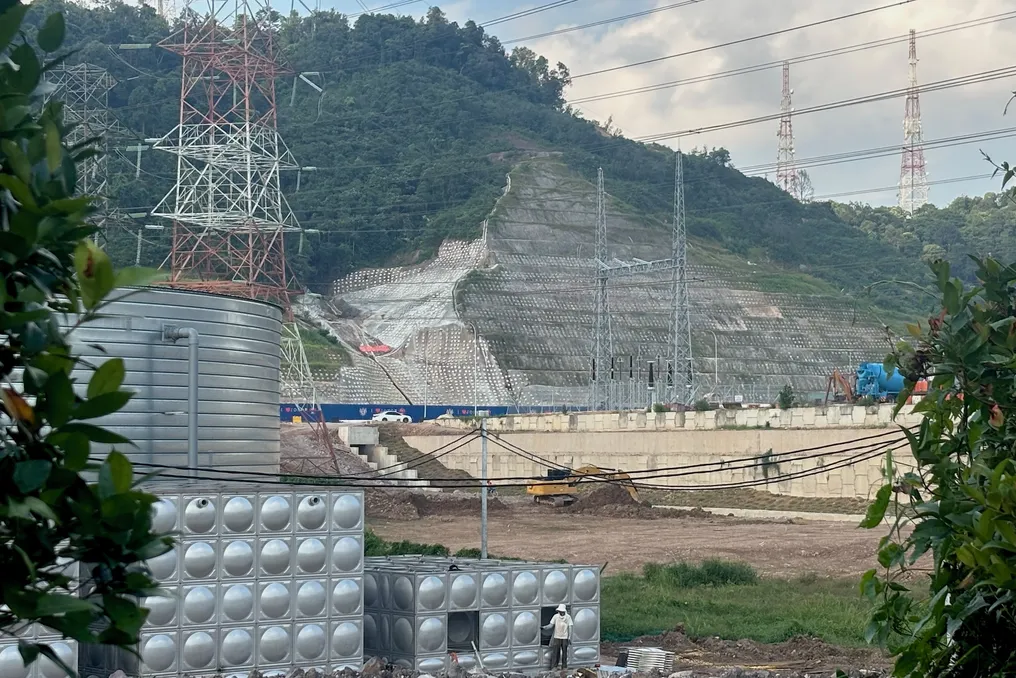
The rapid growth of artificial intelligence infrastructure in the state of Johor, Malaysia, has transformed the once quiet town of Gelang Patah into a major hub for Southeast Asia's AI infrastructure. However, this economic boom is causing serious concern among local residents and threatening rare wildlife species.
Ulaganathan Krishnan, whose residence is only 400 meters from the construction of a hyperscale data center, expressed concerns, stating: 'I am not against economic development, but it must be for the people. We have lost our way of life because of a data center that does not benefit our community.'
On Bukit Resam hill, overlooking the residential area, part of a 43-hectare campus for two international companies is under construction. The Chinese firm ZData will occupy 15.6 hectares of land acquired by its Malaysian subsidiary from developer Tropicana Firstwide. Meanwhile, Japanese NTT Data plans the first phase of its center on the remaining 27.7 hectares.
As of April, at least 17 data center parks are operating or under construction in the wider Iskandar Puteri area. According to research company Baxtel, over 70 such projects have been approved or are in development in Johor.
Residents living near these facilities are feeling rapid changes. Krishnan reportedly organized the first public protest against a data center in Malaysia. In February, about 50 residents from neighboring housing complexes camped near the construction site, demanding an end to dust pollution and compensation for potential health issues.
Locals note that they have to clean their homes more often and use air purifiers due to dust. Following protests and a series of public hearings, Tropicana Firstwide paid 80,000 Malaysian Ringgit (nearly US$20,000) to four resident associations to cover medical expenses and increased electricity and water bills.
Later, a Johor deputy admitted at a press conference with ZData that data centers should not be built 'too close to residential areas,' calling the campus near Krishnan's home a 'lesson' for the state government.
During a walk through the residential areas of Gelang Patah, the publication Dialogue Earth spoke with residents about the arrival of one of the world's most resource-intensive digital infrastructures in their vicinity. One frequently raised issue was the problem of heat.
Johor has already experienced prolonged hot and dry conditions this year, exacerbated by the influence of super El Niño, intensifying concerns about extreme heat and water availability. Residents claim that deforestation and construction work around the hill have made the environment even hotter.
A local farmer, who wished to remain unnamed, reported that his chicks began hatching at an unusual time after the forest clearing for the facility. He noted that the hatching day used to always fall on the 21st, and the high temperatures over the past seven months might have affected the incubation period.
Meanwhile, Krishnan purchased two air conditioners to ensure a more comfortable sleep for his family. Studies have shown that operational data centers raise ground surface temperatures by an average of 2°C, with some sites recording increases up to 9°C, and higher temperatures being felt within a 10 km radius. Researchers have termed this the 'data island' effect, a microclimate related to thermal emissions from servers and cooling systems.
Although some residents strongly oppose the data center boom in Johor, others have expressed enthusiasm about the potential for attracting investment and jobs, trusting officials' promises that the centers can stimulate economic growth without depleting local resources.
Water supply is a sensitive issue in Johor, as the state supplies water to neighboring Singapore and faces growing demand from households and industry. Residents interviewed by Dialogue Earth expressed concern over water stress, purchasing plastic barrels in case of potential shortages. Some report reduced water pressure at night.
The government responded to the situation by restricting certain types of data center development. In November 2025, the expansion of facilities using evaporative or water-intensive cooling was suspended until mid-2027 due to water supply issues. In the same month, the approval of new Level 1 and 2 data centers, which require up to 50 million liters of water per day, was halted, and a tariff was introduced to encourage water reuse.
ZData informed Dialogue Earth via email that its center in Johor, which will be the company's first site in Southeast Asia, does not use municipal water, relying instead on treated water from a local water treatment plant. The company also plans to purchase 630,000 megawatt-hours of renewable energy annually from two local firms.
ZData stated that it would use cooling systems and building materials designed to reduce local heating. Furthermore, the company noted that its facility is the first data center in Malaysia to receive a preliminary GreenRE Platinum rating, the highest level in the national 'green building' certification scheme. In February, the company rejected criticism regarding dust and water, stating that 'minimal construction activity currently contributes to dust pollution at the ZData site.'
Environmental groups argue that the operators' stated commitments are insufficient. In July, Greenpeace Malaysia and other civil society organizations called for a ban on building data centers near residential areas. A Greenpeace representative stated that operators are not obliged to provide sufficient transparency regarding energy and water consumption, and that using renewable energy or treated water alone does not solve broader climate consequences.
The non-profit organization points to Australia, where its recent report, co-prepared with climatologist Ketan Joshi, found that data center operators are reverting to fossil fuels for power, violating promises of using only clean energy.
The Environmental Impact Assessment (EIA) conducted for the ZData and NTT projects considered the impact on surface water, biodiversity, erosion, sedimentation, air quality, noise, and traffic. However, it was revealed that this assessment overlooked a critically endangered species inhabiting a partially cleared forest.
Residents of Setia Eco Gardens, located directly opposite the data center campus, reported seeing a family of Raffles' banded langurs in the remaining forest. This primate was classified as endangered by the IUCN in 2021. Ganesan Siba, a naturalist and resident of the village, reported documenting the animals for the first time five years ago, and by April, just before excavator work began, the group had grown to seven individuals.
Tropicana stated that a study conducted in December 2021 found only common mammals, such as rats and squirrels, across the entire 64.9-hectare area. The company also noted that the assessment supported the planned development works, including site clearing, and was approved by the Johor Department of Environment office.
However, this contradicts what residents like Siba observed, both then and recently. On July 30, a student from the school opposite the construction site photographed several Raffles' banded langurs near the entrance to Setia Eco Gardens. Experts estimate the population of these primates to be between 300 and 700 individuals, mainly in fragmented forest patches in southern Malaysia.
Primatologists noted that observing langurs near a group of long-tailed macaques is unusual, as these species rarely coexist. Residents also report seeing langurs eating human food, which could be dangerous due to their specialized diet.
An anthropology expert from Oxford University, UK, Vincent Nijman, emphasized that protecting the remaining populations is vital for the species' survival. He also warned that excessive heat from data centers could cause stress to trees and plants upon which the langurs depend.
A more immediate concern for conservationists is the fragmentation of the forest itself. The remaining habitat on Bukit Resam hill is surrounded by ongoing construction, another residential complex, and the North-South Expressway connecting Malaysia and Singapore. The only visible path for the monkeys runs through a palm oil plantation, and the nearest reserve, Gunung Pulai, is dozens of kilometers away.
}} , 3.