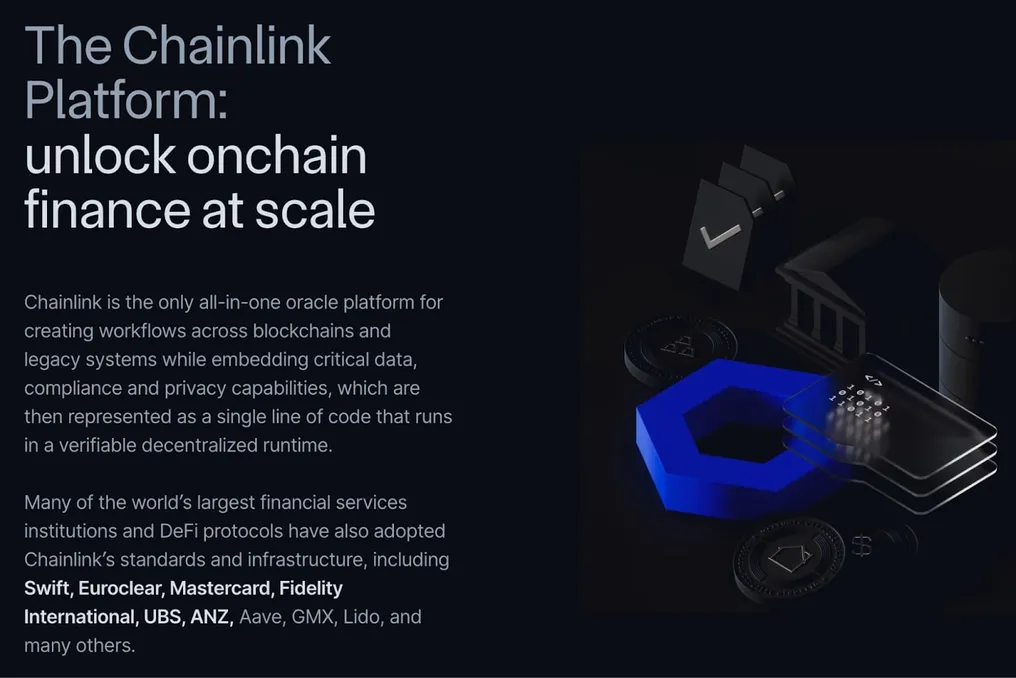
Chainlink (LINK) has established itself as a fundamental element of the Web3 ecosystem, ensuring reliable data transmission between blockchains and the real world. As a leading decentralized oracle network, it supports applications in DeFi, gaming, and the corporate sector across more than 60 blockchains.
Key products of the Chainlink platform include price feed channels for trusted asset data, the Cross-Chain Interoperability Protocol (CCIP) for seamless communication between blockchains, and a Proof-of-Reserve mechanism for transparent asset verification. The network, supporting over 60 blockchains and collaborating with major partners such as Mastercard, Fidelity, Aave, and GMX, plays a critical role in linking Web3 with traditional systems.
Through the LINK token, the network rewards node operators for providing accurate and secure data. In 2025, the Total Value Secured exceeded $93 billion, confirming Chainlink's status as a cornerstone of Web3 and one of the most important infrastructure projects in the crypto industry.
VentureBurn analysts use a combination of fundamental and technical factors to forecast the LINK price. Their predictions are based on historical price trends, statistical data, and various indicators such as RSI, MACD, support and resistance zones, trend lines, Fibonacci corrections, and momentum metrics. To increase accuracy, the team integrates artificial intelligence models with expert manual assessment.
The report also notes that expectations of a potential Federal Reserve rate cut and strengthening risk-on market sentiment contribute to capital inflow into cryptocurrencies, including LINK.
The US economy in August 2026 shows moderate but slowing growth, with Q2 GDP growth falling to 1.5%. Despite resilient consumer spending and a labor market with unemployment around 4.2%, inflation issues persist. The Fed's preferred Consumer Price Index continues to run above the target at 3.7%, creating an uneven economic landscape characterized by moderate growth and stubborn core costs.
Global markets face a complex geopolitical situation marked by energy supply volatility and ongoing trade tensions. Although recent diplomatic efforts have temporarily eased the conflict in the Middle East and stabilized vital maritime trade routes, structural tensions remain. Monetary policy remains tight, as the Federal Reserve holds benchmark interest rates between 3.50% and 3.75%. Internal disagreements have arisen within the FOMC, with pessimistically inclined members advocating for rate hikes to curb persistent inflation. Lowering forward guidance increases market volatility, subjecting broad financial markets to prolonged monetary tightening and high borrowing costs.
The asset is in a prolonged downtrend macro trend following a sharp drop from the previous significant high of around $14. This structural break has established a sequence of higher lows, indicating that sellers maintain primary control over the overall trend. After finding a temporary bottom around $7.00, an attempt to rebound to the $9.00 area was quickly halted by intense overhead supply, returning the market to a phase of local correction.
When investing in Chainlink, it is important to monitor the platform's expanding role in the DeFi ecosystem, as growing demand for decentralized oracle services directly impacts the value of LINK. Key network metrics, such as Total Value Secured (TVS) and node participation, must be tracked as they reflect real usage and the overall health of the network. Partnerships are also a strong signal—collaboration with financial institutions and blockchain projects often accelerates adoption and enhances token utility.
From a technical perspective, attention should be paid to support and resistance zones, as these levels often serve as key decision points for traders and can indicate shifts in market sentiment. Finally, it is important to track regulatory changes and upcoming innovations, such as the Chainlink Cross-Chain Interoperability Protocol (CCIP). These developments will play a crucial role in shaping Chainlink's long-term position and competitiveness in the decentralized oracle market.
In the current late 2026 market environment, where geopolitical tensions and uncertainty regarding Federal Reserve rates continue to influence investor sentiment, Chainlink (LINK) is consolidating around $10, forming a solid base supported by strong fundamentals and key demand around $9. The platform's expanding ecosystem and increasing network interaction underscore sustained institutional confidence despite a broader macroeconomic downturn.
Despite cautious macroeconomic conditions noted by persistent inflation and tight Fed policy, market sentiment may improve as systemic risks stabilize. Chainlink's momentum is further reinforced by major real-world adoption achievements, including its live integration with S&P Global to provide Stablecoin Stability Assessments (SSA) on the blockchain, as well as the Chainlink Reserve programmatic mechanism, which systematically converts protocol revenues into open-market buybacks of LINK.
If global trade uncertainty subsides and investors restore appetite for risk assets, Chainlink is strategically positioned to begin the next bull phase, testing key upper resistance and expanding its influence in Real World Assets (RWA), DeFi, and cross-chain infrastructure.
Based on technical analysis and market outlook, Chainlink (LINK) is expected to trade around $19 by the end of 2030, with potential highs up to $22 if ecosystem growth and positive market conditions continue. Reaching the $100 mark is possible in the long term, but this would require sustained network growth, mass adoption of decentralized oracles, and favorable market dynamics.
Chainlink possesses strong long-term potential due to its vital role as a decentralized oracle network connecting smart contracts with real-world data. The growing ecosystem, integrations across multiple blockchains, and partnerships with major firms like Coinbase strengthen its leadership in both DeFi and traditional finance.
Innovations such as the Cross-Chain Interoperability Protocol (CCIP) enhance Chainlink's value by enabling seamless connectivity between blockchains. As the demand for secure and transparent data channels grows—especially in sectors like gaming, insurance, and capital markets—Chainlink is poised to remain a key player.
Although performance may depend on competition and macro trends, the project's fundamentals support a bullish long-term forecast. LINK's price is determined by a combination of internal developments and external market forces: strong fundamentals and continuous updates support long-term growth, while negative sentiment or technical setbacks may cause temporary volatility.
Despite persistent macroeconomic caution and restrictive Federal Reserve policy, Chainlink stands out as a foundational infrastructure asset for the crypto market. Its core function in connecting smart contracts to real-world data and supporting Real World Assets (RWA) makes it an indispensable utility for both decentralized finance and institutional TradFi adoption.