During a tasting held in October in Bento Gonçalves (RS), the author observed a spectacular service where dozens of waiters distributed the same wine synchronously to about 800 people. This event was part of the 34th edition of the National Wine Evaluation. Annually, producers send samples to the Brazilian Association of Enology (ABE), where one hundred enologists taste the beverages blind to select those that best represent the national harvest across various categories, including dry red, rosé, and sparkling bases.
The wines evaluated came from 558 samples. The identity of the producers is only revealed at the end of the tasting. This year, 14 wines from Rio Grande do Sul, one from Santa Catarina, and one from the Federal District were presented.
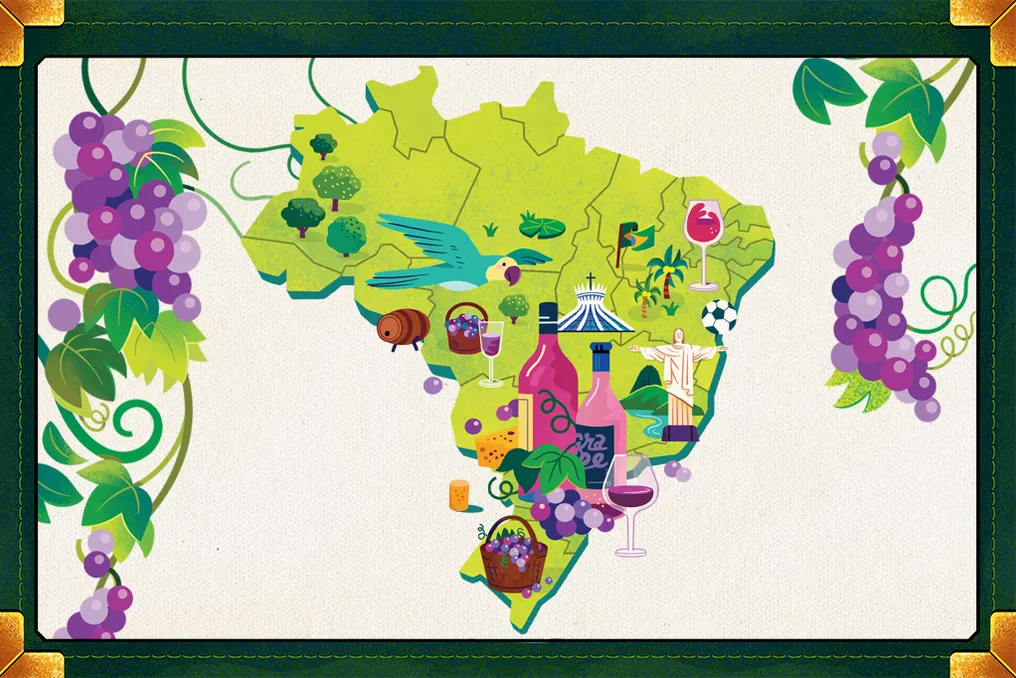
Although the Cerrado may not be the initial image associated with a winery, this fact illustrates the current panorama of Brazilian wine: there has never been so much production in so many distinct regions. In 2025, Brazil counted 965 wineries in 18 states plus the DF, an increase of 41.5% compared to 2020. Lucia Porto, journalist and co-founder of the website Brasil de Vinhos, estimates that the real number could be between 1,000 and 1,200. The diversity of labels has also grown significantly, reaching 16.2 thousand different products, representing an 88.1% increase in the last five years.
The proliferation of wine in a country with multiple climates is possible due to a unique characteristic: Brazil is the only place in the world where grapes are cultivated in three ways. Contrary to the global trend of reducing vineyards and consumption, the opposite is happening in Brazil. In 2025, vineyard area grew by 9.6% compared to 2024, while wine consumption increased by 19.9% above the average of the last five years, totaling 440 million liters.
Despite the Brazilian per capita consumption being about 2 liters annually (compared to triple that of France), Brazil shares with Japan the status of growing demand, with 2025 being the year with the lowest global wine consumption of the century. The wine sector moved R$ 21.1 billion in Brazil in 2025, indicating a heated domestic market, although logistical and distribution challenges for national labels exist.
The Earth
The grape belongs to the genus Vitis, comprising about 80 species. Among them, Vitis vinifera stands out, originating from Europe and Asia. Although thousands of vinifera varieties exist, only a few dozen are commercially cultivated, such as Merlot, Cabernet Sauvignon, Chardonnay, and Pinot Noir.
Many vinifera grapes are not suitable for direct consumption because they are small, have seeds, and astringent skins. However, they are ideal for wine production, as sugar serves as fuel for yeasts during alcoholic fermentation. Acidity and tannins, when well managed, provide freshness, structure, and longevity to the beverage, while hundreds of aromatic compounds are revealed by the fermentation and aging process.
These grapes are extremely sensitive to the environment, which allows the same variety to produce distinct wines depending on the terroir—the combination of climate, soil, and regional management. This delicacy, however, implies greater vulnerability to pests and climate change.
The first vinifera arrived in Brazil in 1532, with the Portuguese purpose of producing wine for masses and personal consumption. Initially, attempts on the São Paulo coast failed. The vines thrived for a few decades after being taken to the mountains but were abandoned due to the focus on gold mining in Minas Gerais.
Vitis vinifera reached the current Rio Grande do Sul in the 17th century, brought by Spanish Jesuits, but production was interrupted by conflicts between missionaries, indigenous people, and bandeirantes. In 1839, the Gaucho diplomat José Marques Lisboa introduced the Isabel grape, a resistant and highly productive hybrid that could be consumed raw, after finding it in the USA.
Lisboa sent Isabel cuttings to Rio Grande. Although the variety was already planted in São Paulo, it was in the South that production took off, driven by the work of immigrants. French and German immigrants settled first on the coast and plains, followed by Italians in 1875, who settled in the Serra Gaúcha, far from Porto Alegre. The inclined terrain of this region proved favorable for the Isabel grape, facilitating water drainage and air circulation.
With the winemaking tradition, production quickly gained momentum, transforming colonies like Bento Gonçalves and Garibaldi into cities. The surplus from home production was marketed by the first wineries, giving rise to old names such as Salton, Peterlongo, and Aurora.
The Wine
Rio Grande do Sul is the main grape producer in Brazil, with 70% of what is planted being American or hybrid grapes, mainly Isabel. These grapes are used to produce juice or table wine, which has a faster and more economical process, representing more than half of the volume consumed in the country, usually in the milder versions.
Historically, table wines formed the basis of national viticulture. However, in recent decades, the fine wine category, made exclusively with Vitis vinifera, has gained prominence. These wines are more expensive and result in beverages of greater complexity, often highlighted in guides and competitions.
Fine wine production began to gain strength in Brazil in the 1970s, a crucial period for global wine. It was then that 'New World' labels began to gain recognition in competitions, equaling the millennia-old European production. This advance intensified after the Great Wine Tasting in Paris in 1976, when Californian wines surpassed French labels in a blind tasting, a phenomenon that spread to Australia, South Africa, Chile, and Argentina.
Foreign companies, such as Chandon and Almadén (now part of the Miolo group), established themselves in Rio Grande do Sul, attracted by the initial economic growth of the military regime and the difficulty of importing into Brazil. These multinationals brought enologists, new technologies, and thousands of European grape cuttings, offering bonuses to farmers who adopted these varieties. During this period, Embrapa Uva e Vinho was also created, a branch of the Brazilian state-owned company that assisted in improving cultivation and production techniques.
In the 1990s, the opening of the national market allowed the entry of imported labels with reduced customs tariffs, leading some foreign companies to leave Brazil. However, their presence left important legacies: the expansion of vineyard area with the reintroduction of Vitis vinifera in the Gaúcha Campaign and the development of fine wines in the São Francisco Valley, in the Northeast. There was also a specialization of labor, leading major Brazilian wineries, previously focused on table wines, to develop their fine lines, and grape growers who supplied vinifera to multinationals to create their own wineries.
At the beginning of the century, Brazilian wines began to be recognized in international awards, with sparkling wines leading this movement. Produced in the Serra Gaúcha since the 1910s and improved with the arrival of multinationals from the 1970s onwards, they gained global prestige. The conditions of the Serra are ideal for sparkling wines, and the quality combined with competitive price results in good cost-benefit, given that more than 85% of sparkling wines consumed in Brazil are from national labels.
The situation of still fine wines is different: more than 80% of national consumption comes from imports, maintaining a constant dispute with foreign products.
The Glass
According to the Ideal BI consultancy, imported wines (of any type) represent one-third of the volume consumed in Brazil but account for 56% of the market revenue. In the previous year, Brazil imported US$ 560.7 million worth of wine, with Chile being the largest supplier, accounting for 38% of this amount. However, this scenario may change with the free trade agreement signed between Mercosur and the European Union for 2026, which foresees a gradual reduction of taxes, potentially lowering European labels by up to 20% over eight years.
This change is positive for connoisseurs of Portuguese, French, and Spanish wines, but it represents a warning for Chilean, Argentine, and Brazilian producers due to increased competition. As an alternative, exports can be explored; in 2025, Brazil reached US$ 13.8 million in exports, a 25% increase compared to 2024, although it remains a niche difficult to exploit.
To diversify the offering, the author experimented with modern drinks in the Serra Gaúcha, such as orange wine, made with white grapes that remain in contact with the skins for longer, and options like denatured wine. Less common varieties in Brazil, such as Alvarinho (Portuguese) and Marselan (French), were also tasted, while research continues to find grapes suitable for the country.
One way to enhance national labels is through Geographical Indications (GIs), government registrations granted to regions renowned for a product or whose characteristics are linked to the territory. The first Brazilian GI was that of the Vale dos Vinhedos, in the Serra Gaúcha, in 2002. Currently, there are hundreds of GIs in the country. For wines, there are 13. Obtaining a GI requires years of study with local producers and partners like Embrapa, and the seal helps standardize production.