StepSecurity raises $20 million to strengthen software supply chain security
Read more
Ventureburn
ventureburn.com

StepSecurity raises $20 million to strengthen software supply chain security

The security startup Step Security announced the closing of a $20 million Series A funding round, which was oversubscribed. The round was led by Elephant, with participation from existing investors: Runtime Ventures, Inner Loop Capital, and SaaS Ventures.

The company's security platform provides numerous control mechanisms for the entire software delivery process. Thanks to this new round, Step Security's total funding has increased to $23 million after receiving an initial investment of $3 million in May 2024.

Step Security was founded in 2021 with the goal of protecting software development environments from supply chain attacks. The platform covers developer workstations, code repositories, package registries, and continuous integration pipelines.

The company was founded by Varun Sharma and Ashish Kurmi, who previously worked in security at Microsoft, Uber, and Plaid. Developers and their tools are increasingly becoming targets for software supply chain attacks. Attackers use malicious packages, compromised credentials, and modified development extensions. Step Security's security platform offers a range of controls throughout the software delivery process.

Recent attacks have highlighted the danger of developer devices and automated software pipelines. They have also demonstrated how the Shai-Hulud attack series was used to inject malicious packages into open-source communities. A more recent example is the malicious Claude Code extension discovered on the Cursor Extension Marketplace, which attempted to establish a persistent SSH backdoor.

The company plans to extend its protection further by including agent sandboxes. This raises the question of whether compromised package dependencies can lead to secret leaks or access to internal systems, requiring awareness from security teams beyond production applications.

The Step Security platform includes developer workstation protection, repository scanning, Secure Registry, and Harden-Runner. Each of these products provides an additional layer of defense, allowing a problem to be caught or blocked if it passes through one layer.

The raised funds will be directed towards supporting three key areas: product development, market expansion, and security research. Step Security intends to increase its engineering staff and improve existing products. These efforts will also enable the creation of protection for other scenarios, such as AI agent sandboxes.

The funding will support security research so that threats are detected earlier and incidents are investigated faster. The resulting findings will be transformed into tangible security improvements.

Step Security plans to scale its commercial operations in response to growing demand. Corporate platform clients include Circle, Dexcom, Kong, Mercari, Chainguard, and XBOW. The company reports that its Annual Recurring Revenue (ARR) grew fivefold in 2024 and asserts that it will exceed this figure fivefold by 2026.

As part of the funding announcement, Step Security introduced a free community tier for Secure Registry. This product combines Secure Registry and Harden-Runner from Step Security. Public repositories using Harden-Runner can now download packages via Secure Registry and enforce policies that prevent the installation of compromised packages. This launch continues the company's initiative to work with open-source maintainers and provides developers with tools to improve their supply chain security.

Elephant partner Matt Tenenblatt noted that this investment underscores the increasing importance of supply chain security. He stated: 'Step Security's proactive strategy blocks malicious packages before they can cause harm.'
Similar stories

Everful raises $48.5 million to scale global AI-powered product search
Read more
ventureburn.com

Everful raises $48.5 million to scale global AI-powered product search

Everful, a startup specializing in global product search using artificial intelligence (AI) technologies, has successfully raised $48.5 million in a Series A funding round. The leaders of this round were Vertex Ventures Southeast Asia & India and January Capital.

The funds raised will be used to expand the company's operations globally and develop its AI-based e-commerce infrastructure. Everful was founded in 2024 by Cici Song and Kevin Han. Previously, Song worked at Alibaba and Bessemer Venture Partners, and Han is an AI project founder.

Everful offers automated product search on factories for retailers and brands. Its software platform allows companies to find necessary products, contact suppliers, and make purchases without needing their own dedicated search staff. Currently, the platform ships over five million units of goods monthly.

The company serves over 60 countries through a network of 30,000 verified factories and maintains a catalog of 20 million products. Everful forecasts achieving annual revenue of $100 million by the end of the current year. Existing investors include Lightspeed and Square Peg.

Traditional wholesale sourcing often creates challenges for many retailers. Small businesses face limitations from intermediaries, minimum order quantity requirements, and slow procurement times. This can lead to doubling working capital expenses before retailers recognize shifts in consumer demand. Furthermore, such difficulties can hinder small firms from finding manufacturers of quality products.

Everful utilizes AI agents to automate sourcing processes. These agents help identify suppliers and consumers, track trends, and organize orders between factories. The platform also handles quality control and logistics, constantly monitoring factory partners through data analysis of inspections and supplier performance metrics. Retailers can purchase goods in bulk, use a dropshipping model, or request custom manufacturing.

Everful integrates search and order fulfillment functions into one platform. Their unique e-commerce model synchronizes consumer demand with factory production capacity. Every order and inspection generates data that is used to improve supplier selection and the procurement process.

The company stated that the fresh funding will help deepen its presence in the US, as this country is Everful's largest market. Additionally, the startup plans to expand into Europe, including markets such as the UK, France, and Italy. Future investments will support their global trade model and AI agents.

The company plans to improve its order fulfillment system and expand product customization capabilities. It also plans to increase integrations with online stores; currently, Everful is integrated with Shopify and plans to connect with other POS systems. The company employs 70 people.

This ecosystem connects engineering skills with commercial processes and business operations. Everful views AI as a way to simplify international procurement, aiming to provide small retailers with opportunities available to large corporations. The company's model combines overseas manufacturing with local retail points, helping to adapt to changes in trade policy and supply chain disruptions. The company also sees potential in product customization and reducing production volumes.

Corma raises $125 million at $1 billion valuation to scale AI in cybersecurity
Read more
ventureburn.com

Corma raises $125 million at $1 billion valuation to scale AI in cybersecurity

Corma, an Israeli cybersecurity startup, announced it has raised $125 million in a Series A funding round with the company valued at one billion dollars. This information was disclosed on November 16, 2026.

The funding was led by NEA, with participation from existing investors including Sequoia Capital, Khosla Ventures, and Coatue. This new capital came after the company previously announced a $60 million seed round in August 2026. Thus, over three months, Corma has raised a total of $185 million.

The company plans to use the funds to develop its foundational models and computing infrastructure. Alon Pluda, CEO and co-founder of Corma, noted that the situation represents a 'battle of wits' as more large organizations demand more advanced protection. In response, the company has increased its server capacity by 24 times.

Corma develops foundational models in defensive cybersecurity. Its artificial intelligence plays a central role in the operations of modern enterprise security teams. It is important to note that the product does not replace existing security products but works alongside them, allowing organizations to maintain their current level of cybersecurity.

The company's models process vast amounts of security data, such as audit logs, security events, and network traffic. They are capable of detecting unusual behavior across various systems and correlating small signals received over long periods, enabling security teams to investigate threats more effectively.

Corma asserts that coding-oriented models are incapable of handling such tasks. Defensive cybersecurity requires continuous analysis and making immutable decisions, as well as working with contradictory sources of information in complex corporate environments.

The company's tools perform security assurance functions. Their models are trained using reinforcement learning on simulated corporate networks. These simulated networks are designed to resemble security tools, telemetry, and operational noise.

There is reported growth in application deployments within companies listed in the Fortune 100 and Fortune 500, as well as interest from companies in the Fortune Global 500. These organizations operate across various industries, including healthcare, financial services, energy, and telecommunications.

Corma's move followed cybersecurity incidents in October, which were dubbed 'Black October.' During this period, numerous errors and breaches affected popular enterprise software, exposing weaknesses in corporate security systems.

Aaron Jacobson, a partner at NEA, stated that Corma successfully combines cutting-edge AI research with cybersecurity expertise. He emphasized that the firm's technology can help organizations prevent devastating cyberattacks, and the new funding round will provide it with sufficient capital to do so.

The Corma team includes scientists from Google DeepMind and cybersecurity experts from Israel's Unit 8200. The company has offices in Tel Aviv and San Francisco, and is led by management with experience in both offensive and defensive security.

The additional capital will help Corma further scale its proprietary models. The company intends to invest in computing infrastructure and hire a new group of researchers and engineers, although hiring plans remain moderate. Corma is developing a direction toward creating autonomous cybersecurity tools.

Other companies focused on autonomous security operations platforms include 7AI, Torq, and Exaforce. All their developments focus on automating security operations using AI agents. Corma's success will depend both on adoption in large enterprises and the availability of computational resources, as it needs to demonstrate effectiveness in various complex security scenarios.

UFORCE raises $700 million at a $6 billion valuation to expand autonomous defense systems
Read more
ventureburn.com

UFORCE raises $700 million at a $6 billion valuation to expand autonomous defense systems

UFORCE, a Ukrainian-founded defense technology startup, has successfully raised Series A funding of $700 million USD. This round values the company at $6 billion.

The joint leaders of this round were Valor Equity Partners and UK National Wealth Fund. Additionally, Menlo Ventures, Xantium, and Hiro Capital participated as investors. Existing investors, including Shield Capital, Ballistic Ventures, Lakestar, and Squadra, also increased their investments.

The raised funds will be used to scale up UFORCE's production across the markets of the USA, Europe, the Asia-Pacific region, and the Middle East. The company, UROBOROS, also aims to facilitate production near key allied defense markets and increase manufacturing in partner countries.

Despite its origins in Ukraine, UFORCE is a London-based company with main operational centers in Kyiv and Washington, D.C. The company provides autonomous aerial, maritime, and ground platforms, as well as artificial intelligence software and control and management systems.

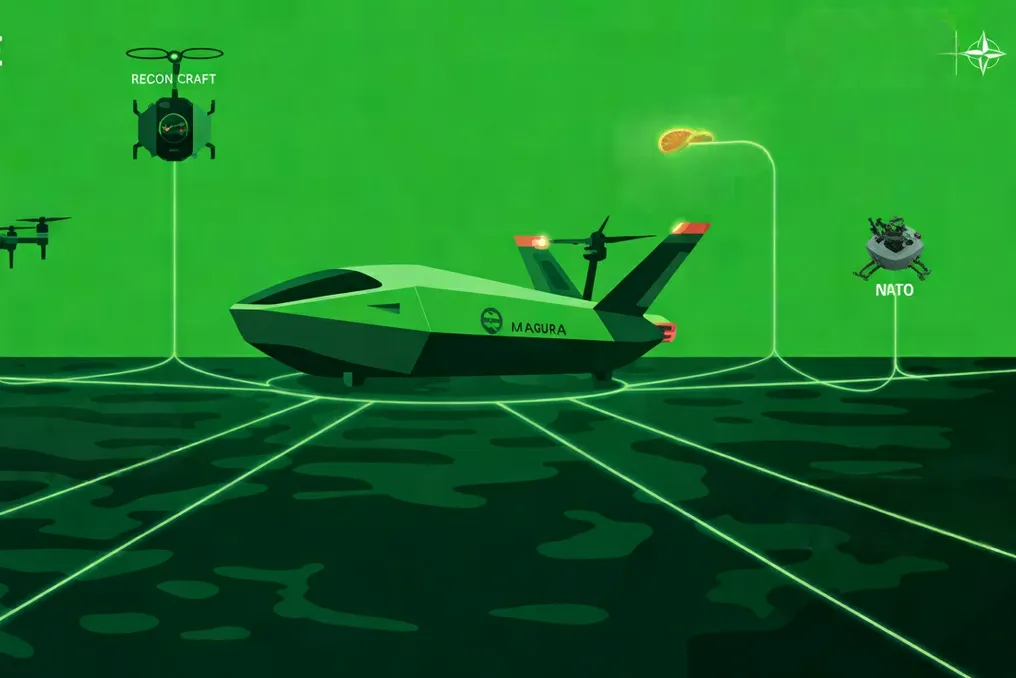
UFORCE produces various autonomous defense systems, such as the MAGURA ground vessels and NEMESIS aerial vehicles. Furthermore, the company releases LIUT ground robotic complexes and PREDATOR drone countermeasures systems. The company's control and management software integrates these platforms, ensuring synchronized operation across different domains.

The company claims that its goal is to significantly reduce the cost of defense compared to the cost of attack. The MAGURA maritime systems are also reportedly involved in sinking more than a dozen Russian warships, as well as shooting down helicopters and fighters. To date, these platforms are deployed in over 100 Ukrainian military units.

The NEMESIS combat platforms have accumulated over 300,000 combat flights. Production facilities will also operate in nearby regions. This approach can help guarantee supplies even if Ukrainian infrastructure is attacked, as the production site should be closer to the launch points.

UFORCE has stated its intention to collaborate with partners to modernize existing industrial facilities for defense production. For example, the company already has a partnership with Recon Craft, which allows for the production of MAGURA maritime systems in the USA.

The company will also deepen its involvement in the EU-Ukraine Drone Alliance, which will include broader interaction with NATO and the NATO force network, as well as with the Joint Expeditionary Force to promote wider industrial and operational cooperation. The attracted funds provide the company with the necessary momentum to realize these plans.

The Ukraine Reconstruction Fund and the US have already invested and will continue to invest in UFORCE's Ukrainian operations. UFORCE's investments will be used for hiring personnel, research and development, and new products. Thus, US investments are linked to the growth of the company and the Ukrainian defense technology sector.

UFORCE CEO Oleg Roginsky stated that this investment not only allows for scaling up production in Ukraine but also supports other alliance countries in achieving the same result. Currently, the firm is working on expanding production capacities and developing its range of technologies.

Popular