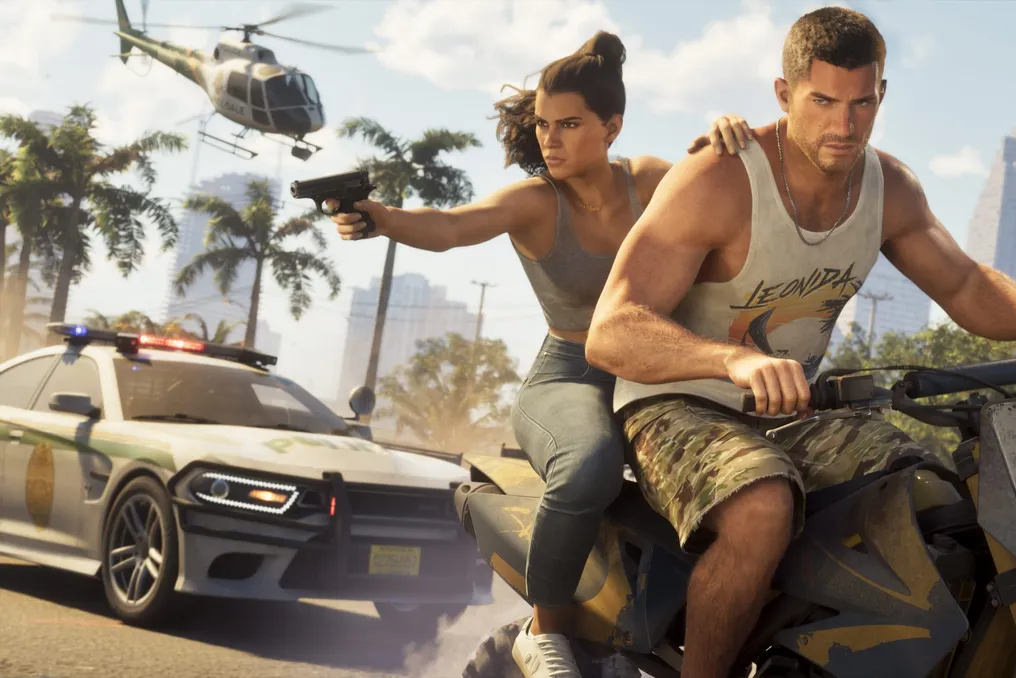
Player analysis assesses whether GTA VI meets the expectations generated by the hype
Read more
FlatOut
flatout.com.br

Player analysis assesses whether GTA VI meets the expectations generated by the hype

The buzz surrounding Grand Theft Auto VI has reached unprecedented levels, with countless memes and AI-generated posts flooding social media. Given this massive enthusiasm, the question arises: does the game truly live up to such high expectations?

The launch is scheduled for November 19th, coinciding with a holiday in Brazil. Those who own a PS5 or Xbox have already pre-downloaded, as have buyers of the physical version, awaiting only activation. Fortunately, specialized press has already had access to the new title, allowing consumers to verify the game's quality.

Metacritic assigned GTA VI an extremely high score of 99 out of 100, equating it to the classic The Legend of Zelda: Ocarina of Time (original from 1998 for Nintendo 64). Since the development of GTA VI took approximately ten years (considering the initial work between 2014 and 2015), such an evaluation was expected. Even without playing, preliminary gameplay videos demonstrate a notable advancement in graphics and environment, refuting the idea that significant visual changes are imperceptible in modern games.

Regardless of whether you purchased GTA VI in advance or plan to invest R$ 450 (Standard version, R$ 550 for Ultimate), it is recommended to consult reviews to get an idea of the new open world. The author compiled impressions from the most important outlets, concluding that yes, GTA VI fulfills all its promises.

Graphics

Reviews converge on the assertion that GTA VI impresses not only through models or lighting, but because Leonida—the fictional version of Florida—possesses a palpable sense of reality. Rockstar didn't just create a larger city; the setting is denser, more varied, and more believable, presenting details that surpass the studio's usual standards.

Wikerson Landim, from Adrenaline, summarizes this difference by stating that 'the map of GTA VI is not just larger, it is also richer.' Although driving through Leonida might take half an hour, size is only one aspect; the environment includes dedicated interiors, vessels, underwater zones, and regions with distinct vegetation and architecture. Canaltech highlights the dynamic climate and animals that seem to follow their own routines, something that has evolved in realism compared to Red Dead Redemption 2, totaling over 170 animal species.

The details go beyond mere screenshot creation. A property can be invaded and looted, and its rooms and objects provide information about its residents. The streets are filled with pedestrians, traffic, and unexpected situations. Omelete points to the ability to interact with almost every element around, while international IGN, after more than 120 hours of gameplay, praises the beauty of the map and the lighting at various times of the day.

Sunrises and sunsets, reflections in flooded areas, and neon signs deserved special attention. This level of care explains why some critics dedicated over one hundred hours to the game without feeling that its content had been exhausted.

However, there is an inevitable technical limitation: on both PS5 and Xbox Series X|S, the game operates at a limit of 30 frames per second. Adrenaline reports that the rate remains stable most of the time, with slight fluctuations and occasional stutters, especially on the entry-level console. Canaltech understands this choice given the vast amount of simultaneous simulations, but does not promote 30 FPS as an advantage, recognizing it as a concession made to maintain world density.

Storyline

If Leonida is the visual highlight, Jason Duval and Lucia Caminos sustain the extended experience. These two characters form a couple of criminals seeking a way out of a difficult life. Rockstar shows less interest in narratives of major crime figures, focusing more on following two people who believe that heists can solve their problems.

Canaltech describes the plot as more realistic compared to GTA V, without neglecting the absurd elements of the series. Jason is portrayed as restrained and practical, while Lucia is ambitious and impulsive, struggling to adjust to legal life after being arrested. Small moments of togetherness help strengthen or distance the couple.

At this point, the sixth title differs from previous protagonists. Unlike GTA V, which followed three characters with converging trajectories, the player must understand the dynamic of a couple who also functions as a criminal partner. Omelete summarizes this choice by stating that the love story prevails over the crime story. Robberies, escapes, and confrontations persist, but they cease to be the final goal, becoming the means Jason and Lucia use to seek some stability.

This change also alters the player's interaction with the game universe. While trying to establish a joint life, acts like running over pedestrians or initiating conflicts with the police can seem less natural than in past titles. Although the game does not prevent such behaviors, the narrative lends a different weight to certain actions. IGN Brazil classifies GTA VI as the most personal game in the franchise, as the experience becomes more dependent on how each player conducts the protagonists' relationship.

Satire continues to target politics, technology, and conspiracy theories, but Omelete observes that the reality amplified by social media is already sufficiently absurd to hinder traditional satire. In this scenario, the trajectory of Jason and Lucia serves as a human counterpoint. The reception suggests this approach was successful: Omelete highlights the emotional weight of the campaign, while Adrenaline praises the protagonists and the ending.

Gameplay

The shift in tone is also perceived in the gameplay. GTA VI remains an action open world, involving robberies, chases, and chaos, but its systems seem less likely to allow the player to act without considering the consequences. This results in a more immersive and demanding experience, which may displease those who expected the almost unlimited freedom of GTA V.

A notable innovation lies in police pursuits. Instead of just accumulating stars and waiting for agents to give up, the player needs to process the information collected by the police: clothing, appearance, vehicle, weapon, presence of a partner, and even security camera footage. Changing clothes, ditching the vehicle used in the crime, or hiding the weapon can integrate the escape plan, a feature Rockstar calls 'Pressure Icons.' This system adds a more technical and realistic layer to something that was previously resolved simply by speeding until the police disappeared from the minimap.

Weapon and vehicle handling follows a similar logic: the arsenal needs to be organized and transported, exposed long guns can attract attention, and stolen cars require specific procedures before being added to the garage. The result approaches a criminal simulation, but without eliminating the inherent chaos of the series.

There are many activities besides the main missions, including fishing, hunting, diving, racing, sports, gym, arcades, and billiards, some of which have depth in themselves rather than just serving to fill the map. Adrenaline highlights the explorable interiors, and Omelete mentions side missions with their own narrative arcs and complete games available on Jason's video game.

The modifications become more evident in the driving experience. Leonida presents significantly more intense traffic than Los Santos, and crossing the state at normal speed takes about 30 minutes. The Adrenaline journalist reported the need to adjust their driving style, observing that 'more aggressive driving will result in more collisions,' and in GTA VI, constantly crashing means incurring repair costs. Impacts can also affect the vehicle's operation, although the review notes that the visual improvement of collisions compared to GTA V was not drastic.

Cars require more attention outside of public roads. Fuel actually runs out, forcing the player to look for a gas station, refuel, and pay for the service. There are even electric cars and charging points marked on the map. Although it is not an excessively punitive mechanic—the fuel indicator only becomes prominent when the tank is running low—it can generate peculiar situations, such as a police chase where the player steals a supercar, only to discover the tank was almost empty.

Mechanical damage must also be monitored: the game features four levels of vehicle condition, and in poor condition, one must visit a garage or a Pay 'n Spray. Furthermore, there is a crucial change in car acquisition and maintenance. It is no longer enough to just steal a vehicle and leave it in the garage; one must remove trackers, deal with alarms and different types of locks, and, depending on the model, make a direct call. To permanently incorporate the car into the collection, Jason and Lucia may need to hire a professional to change its identification or use Pay 'n Spray to regularize the situation. Subsequently, the Scooter Bros app allows locating and requesting delivery of the vehicle at various points in Leonida, including retrieving it if another criminal steals it while they are busy.

All this illustrates how Rockstar seeks to give greater relevance to automobiles without turning GTA VI into a driving simulator. They remain tools for map exploration, participation in races, and police evasion, but now they also represent assets, demand maintenance, and can cause problems if used carelessly. For a franchise whose name literally means car theft, this is a quite appropriate evolution, although it may bother those who are only looking for chaos.

The soundtrack has always been a vital element of the Grand Theft Auto identity, and reviews indicate that the sixth game does not fail in this regard. The catalog of licensed music is vast and diverse, covering electronic, rap, hip-hop, rock, and current tracks. The radio stations offer enough repertoire for the player to keep discovering music after dozens of hours of gameplay, which is important in a title where much of the time is spent driving. The original music by the French duo Justice also receives praise from Omelete, especially for how it intensifies the tension of action scenes and gives identity to the missions.

Not Everything Is Perfect

Despite the highly positive reception, there are critical points, although the reservations do not seem sufficient to compromise the whole. The most evident is the 30 FPS limitation on consoles, given that a large part of the audience expected the 60 frames per second option, especially on the PS5 Pro. Adrenaline reports that...

Similar stories

GTA VI: From initial ban in Brazil to cultural phenomenon and multi-million dollar production
Read more
super.abril.com.br

GTA VI: From initial ban in Brazil to cultural phenomenon and multi-million dollar production

The Grand Theft Auto (GTA) saga began with a ban in Brazil on May 19, 1998. The Consumer Protection and Defense Department (DPDC) considered that the game encouraged behaviors such as robbing vehicles, disregarding rules, assaulting pedestrians, and fleeing the police, concluding that the spirit of the game was that 'CRIME PAYS OFF'. The English distributor BMG proposed limiting sales to those over 18, claiming that the high cost of the computer with a CD-ROM reader would limit access, but the regulatory body rejected this argument.

The regulator pondered the risk of the CD-ROM reaching young people in rehabilitation centers, whose natures were already distorted, and who might adopt the adventures proposed by the game, such as robberies and chases. Brazilian authorities did not judge the content of the game itself, but rather the product's packaging, ending the first phase of GTA's history in the country.

Although the ban was established, the game continued to be sold in pirated versions. This restriction eventually expired with the advancement of the internet, which made the CD-ROM obsolete, as GTA creators began offering the game via download, bypassing local laws.

Over the years, the franchise has evolved significantly. The major breakthrough occurred with Grand Theft Auto III, released in 2001, which introduced three-dimensional graphics and sold 14.5 million copies globally. A decade later, GTA V, in 2013, transcended the gaming industry, becoming a cultural phenomenon by reaching 230 million copies, making it the third best-selling game in history, behind only Tetris and Minecraft.

Finally, GTA VI is set to launch on November 19 for PlayStation and Xbox consoles, representing a decade of work by countless artists and programmers. It is not only the most ambitious game in history but is also considered one of the most expensive cultural artifacts ever produced.

Production and Market Details

The American company Rockstar Games, responsible for its creation, has not disclosed the exact budget, but it is estimated to be around US$1 billion, which would place it above Star Wars: The Force Awakens, the most expensive film of all time in inflation-adjusted values. According to Rockstar, GTA VI has over 600,000 animations—eleven times more than its predecessor and double that of the western Red Dead Redemption II, released in 2018. Its map is colossal, equivalent to the sum of the maps of GTA IV, GTA V, and Red Dead Redemption II.

Despite the impressive scale, the gaming sector faces a market crisis. Since 2022, over 56,000 developers have been laid off, and several companies have closed down. Although the industry is vast (generating US$201 billion last year, compared to US$176 billion from video streaming companies), production costs are high. Creating a high-quality AAA title generally takes at least five years and costs US$300 million, requiring the sale of about 6 million copies just to cover investments, which few manage.

However, GTA VI presents different projections. An analysis by the American investment bank Morgan Stanley predicts that the game will sell 40 million copies in the first three months, considering only the PlayStation and Xbox platforms (the PC version should arrive later, perhaps in 2027). The magnitude of GTA VI is such that other producers have postponed or advanced their releases to avoid conflict with the Rockstar giant. This business originated in Dundee, a Scottish city known for fishing.

From Factory to Streets

David Scott Jones, who was not a watchmaker but an electronics engineer, worked in a multinational Timex factory in Dundee. This factory produced custom computers for the British brand Sinclair since 1983. Jones started as an intern and specialized in the ZX Spectrum, the best-selling computer in England during the 80s.

In 1987, at age 22, the factory faced difficulties, forcing Jones to become unemployed. He used his severance pay to purchase a Commodore Amiga 1000, which had to be imported from the United States and cost the equivalent of US$11,000 at the time. In 2018, he reported in an interview with Games Beat that, although he had discussed future investments with his parents, his real desire was to play the latest games on the device.

Jones utilized the Amiga, which offered advanced graphics for the time, but also used it for work. In 1988, he released his first title, Menace, where the player controlled a spaceship and shot at enemies. The game sold 15,000 copies, generating enough capital to buy a car.

He founded DMA Design with three friends. The second game, Blood Money, followed the same line but without much impact. However, the third, Lemmings, released in 1991, was a huge success. In this game, the objective was to prevent a line of lemmings from falling into cliffs or traps by building bridges and altering the scenery. Lemmings received international awards and sold 2 million copies, with its sequels selling a total of 20 million.

Jones and his partners became millionaires, and DMA consolidated itself as a relevant studio, signing a contract with Nintendo to develop Unirally and Kid Kirby. However, the first game was withdrawn from the market due to similarities with Pixar characters, and the second was never released, leading DMA to a financial crisis.

The Manufactured Controversy

In 1997, DMA, which had about 100 employees, was developing Race’n’Chase, a game focused on car theft and escape. They sought a publisher, striking a deal with BMG, a music industry giant with a gaming division. Brothers Dan and Sam Houser, executives at BMG, made two crucial decisions: first, they renamed the game to Grand Theft Auto, highlighting its criminal nature; second, they hired public relations professional Max Clifford, known for his skill in creating sensationalist stories in the English media.

Clifford began contacting local politicians, warning them about the new 'outrageous' game that glorified car theft. A few weeks before the launch, the topic dominated the English Parliament, and BMG included excerpts of these speeches in its advertisements. English tabloids demanded the ban of GTA. All this attention boosted sales, which reached 500,000 copies in the first few days.

Months later, BMG abandoned the deal and sold its gaming division to Take-Two Interactive. The Houser brothers moved to New York and founded Rockstar Games as a subsidiary of Take-Two. David Jones left the company in 2000, moving to the British studio Rage Software.

The Scottish team continued programming, but the creative influence became American, transforming GTA from a simple robbery game with basic graphics into a complex 3D universe full of cultural references. Budgets and sales soared, and Rockstar achieved global success.

In 2015, two years after the release of GTA V, the company began planning the successor, tentatively named 'Project Americas', as the story would be set in North and South America. Simultaneously, Rockstar was finalizing Red Dead Redemption II, scheduled for May 2017, but released a year and a half later. Rockstar merged the projects and began developing GTA VI. However, stress affected the relationship between the Houser brothers, and Dan, the lead writer, left Rockstar in 2020 to found his own company, Absurd Ventures.

The pandemic delayed the development of GTA VI, and Rockstar opted to focus the narrative only on Miami, abandoning the idea of South America. In 2022, the first primitive video of the game leaked. In 2024, Rockstar banned remote work to prevent leaks, but a hacker infiltrated the systems, stole a complete copy, and began releasing videos online.

Rockstar was also accused of trying to prevent the formation of a union among its employees, firing 34 involved people. The company claims these dismissals occurred due to information leaks, but former employees deny this and are suing Rockstar in Scottish courts, whose decision is expected in mid-November, coinciding with the game's launch period and the internal election of current staff.

Take-Two CEO Strauss Zelnick stated that no artificial intelligence was used in the development of GTA VI, declaring to CNBC that 'creativity cannot exist, by definition, in an AI model, as it is fed by data [that already exists]'. GTA VI may be the last fully artisanal mega-game, a monumental tribute to the artistic supremacy of the human hand.

Neural Rendering

GTA VI attracts attention for its extremely detailed graphics, surpassing current games. This is due to the astronomical budget and the dedication of thousands of professionals for almost a decade. However, in the future, AI technologies may allow games with smaller budgets to achieve a similar level of quality. Neural Rendering technology, developed by Nvidia, makes the look of games nearly photorealistic, adding textures and details in real time, as part of the DLSS 5 package, which works on RTX 5000 graphics cards for PC. Currently, it is available in NBA 2K27, Hogwarts Legacy, and Metro 2033 Redux, with ten other titles in development.

Hype builds ahead of GTA 6 release: The game's influence is felt from the internet to offices
Read more
www.aajtak.in

Hype builds ahead of GTA 6 release: The game's influence is felt from the internet to offices

Despite the planned release of Grand Theft Auto 6 on November 19th, the game's influence is already being felt worldwide. During the pre-load of GTA 6, new records for broadband networks were set in the UK. In the US, internet company Xfinity is offering its customers speeds up to 2 Gbps for 15 days.

Approximately 12.5 million American gamers have reported plans to change their work or study schedules for the game. Logitech has even launched a special 'Game Day' for employees. It is evident that GTA 6 affects not only the video game industry but also areas such as the internet, consoles, sports, tourism, and entertainment.

The game developer, Rockstar Games, provided additional information about the in-game weather, specifying that they tried to incorporate a more realistic depiction of rain, sea fog, strong storms, and changing clouds.

The pre-load for GTA 6 began on November 10th, allowing those who pre-ordered to download the game files onto their PS5 and Xbox Series X|S before the official release. The file size is approximately 212 GB. When thousands and millions of people simultaneously download such a volume of data, the load on internet service provider networks naturally increases.

British internet company Virgin Media O2 reported that on November 10th, its broadband network recorded the highest traffic in its history. Evening traffic exceeded the previous record set by a UEFA Champions League match by 3.8 percent. The total data downloaded throughout the day was 4 percent higher than the previous Fortnite record.

According to the company, in the first hour of the pre-load, broadband traffic increased by 51.6 percent compared to the previous week. This indicated a record demand for downloading the game on the large internet company's network, rather than a complete internet outage.

Another British internet company, YouFibre, also reported speed slowdowns for some customers due to the massive demand for GTA 6 downloads. The company's CEO, Jeremy Chelot, mentioned network congestion in some parts of Yorkshire.

Internet service provider Comcast Xfinity in the US offered eligible customers an increase in download speed up to 2 Gbps for a period of 15 days. The company claims that at this speed, downloading the 212 GB GTA 6 could take about 30 minutes, although the actual time depends on the connection, network, and device.

The scale of demand for the game can also be assessed by the number of pre-orders. Sony named GTA 6 as the game with the most pre-orders in PlayStation Store history. Microsoft also stated that it is the most popular title ever in the Microsoft Store.

According to Sensor Tower estimates from November 11th, there were about 9.69 million digital pre-orders for GTA 6, valued at revenue between 8.8 and 11 billion rupees. The PS5 accounted for about 75 percent of these, with the remaining pre-orders placed on Xbox Series X|S. It should be noted that this figure is a projection by Sensor Tower, not an official sales report from Rockstar Games or its parent company Take-Two Interactive.

The success of GTA 5 is also a significant reason for this hype. The game, released in 2013, has sold over 230 million copies worldwide. Thus, about 13 years after the release of the previous major game, the anticipation for GTA 6 excites both long-time fans and a new generation of gamers.

The anticipation for GTA 6 release is not limited to those sitting in front of gaming consoles. According to a survey conducted by PCMag in collaboration with YouGov, about 8 percent of adult gamers in America plan to take a vacation or adjust their work and study schedules for GTA 6. Applying this statistic to the total gamer population in the US yields an approximate figure of 12.5 million people.

Technology company Logitech initiated a program called 'Logi Game Day' for its employees. Under this initiative, employees can take a day off to play their favorite video games. This opportunity is available not only for GTA 6 but for any game until November 10, 2027. Furthermore, the company plans to stream games from its Miami office on November 19th.

The fictional world of GTA 6, Leonida, is inspired by the state of Florida in the USA. The city of Vice City, featured in the game, resembles Miami. Because of this, business circles and local authorities in Miami are attempting to leverage the game's popularity for their own interests.

Popular