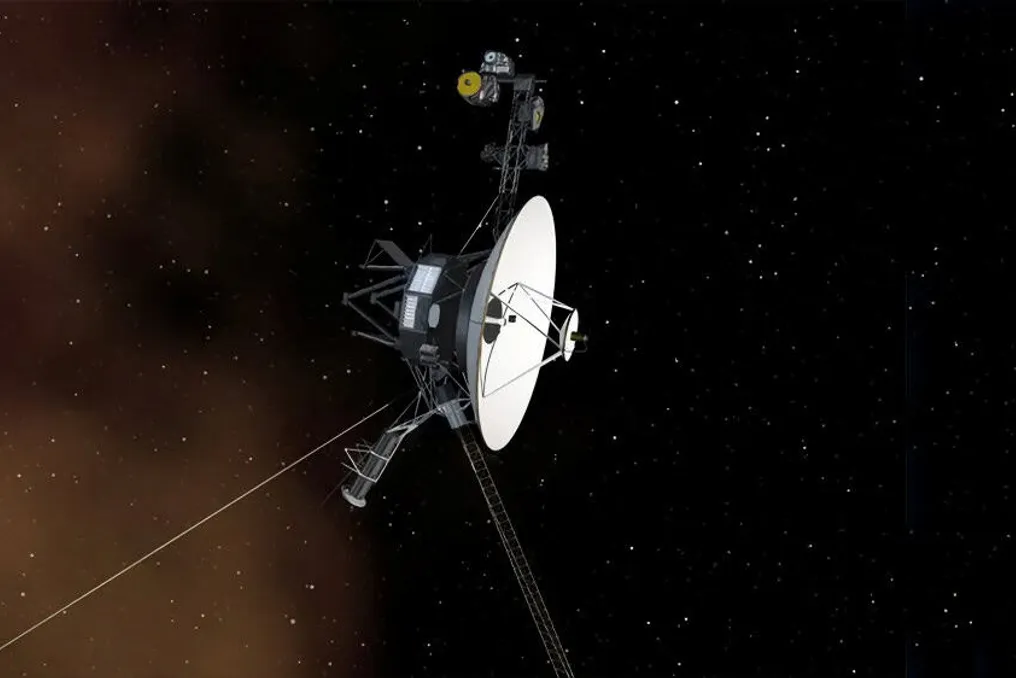
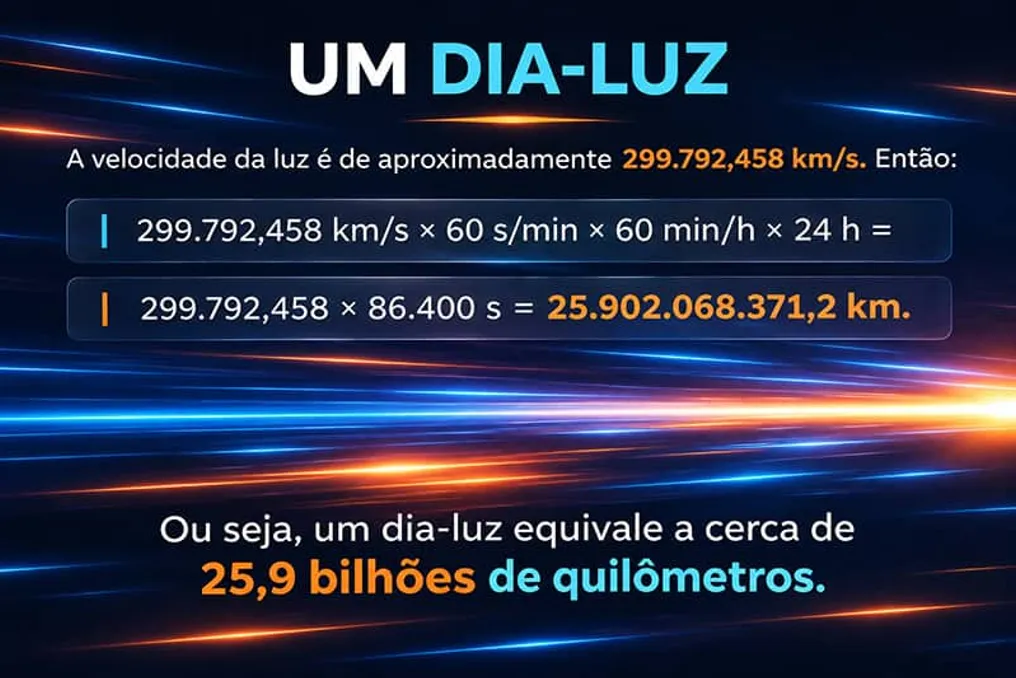
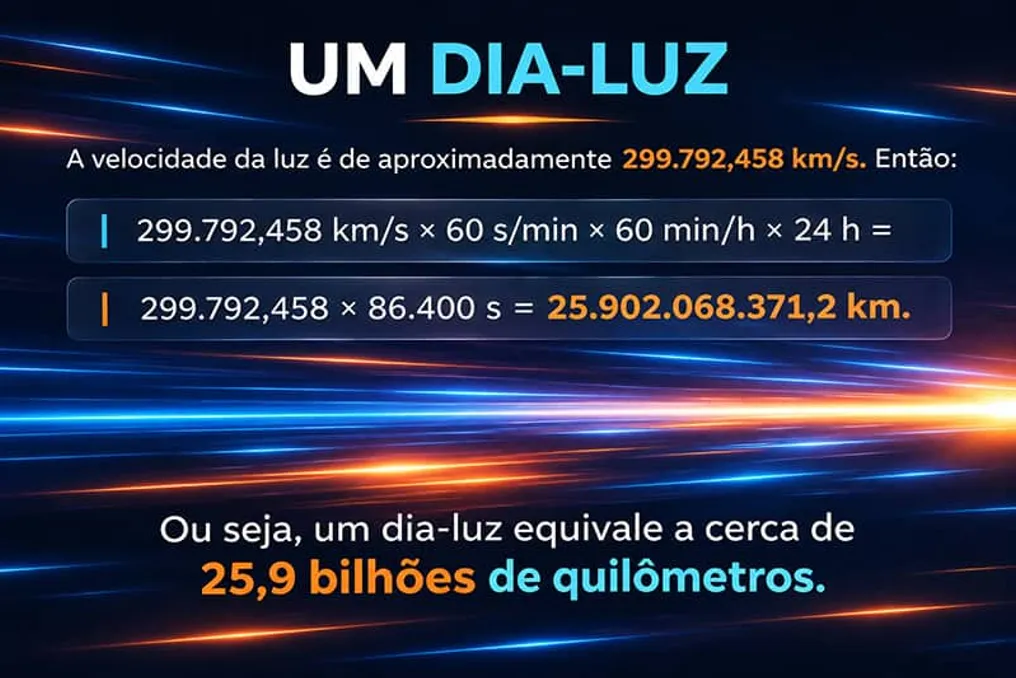
NASA's spacecraft Voyager 1 has reached an unprecedented milestone in space exploration. On Wednesday (the 18th), nearly 50 years after its launch from Earth, the probe covered a distance of 25.9 billion kilometers, which corresponds to the distance of one light-day.
This milestone was achieved at 7 hours, 16 minutes, and 07 seconds Brazilian time. Since light travels at approximately 300 thousand kilometers per second, covering this distance requires 24 hours. Therefore, the signal from the probe received today will reach Earth tomorrow at the same time.
To mark this event, NASA organized a worldwide campaign called 'Shine Bright for Voyager’s Light-Day.' The agency invited people from around the world on Tuesday evening (the 17th) to shine flashlights into the sky and blink the letters VGR—the mission's identifier—in Morse code, which served as a symbolic act of sending a message from humanity to the probe.
Participation could be carried out using a mobile phone flashlight or through the agency's online tool, which turns smartphones and tablets into automatic signaling devices. NASA encouraged participants to photograph or record this tribute and share the recordings on social media.
The twin Voyagers 1 and 2, launched in 1977, were originally intended to study Jupiter and Saturn, utilizing a rare alignment of the giant planets that allowed them to visit several of them in a single mission. After completing this task, the spacecraft continued their journey toward the boundaries of the Solar System.
In the program Olhar Espacial, host Marcelo Zurita, president of the Paranaíba Astronomy Association (APA), member of the Brazilian Astronomical Society (SAB), technical director of the Brazilian Meteor Observation Network (BRAMON), and author of the Olhar Digital column, highlighted the concept of this mission. He noted: 'It is interesting that Voyager was designed to take advantage of an extremely rare alignment of giant planets, which will only happen again in more than 100 years.'
In the 1960s, researchers at NASA's Jet Propulsion Laboratory (JPL) noticed that the giant planets would be in a particularly favorable position at the end of that decade and throughout the 1970s. Jupiter, Saturn, Uranus, and Neptune would form an alignment allowing all four planets to be visited in one flight, using the gravity of each planet to change the spacecraft's direction and increase its speed.
The opportunity, which recurs approximately every 175 years, led to the Grand Tour project. The initial plan involved sending four spacecraft that could visit the four giant planets and even Pluto. However, due to high costs, NASA canceled the project in 1971. The following year, the agency approved a more economical version with two probes, originally intended to study Jupiter and Saturn.
The mission, named Voyager, was christened in March 1977, just a few months before the launches, and was initially called Mariner Jupiter-Saturn. Five years of activity were planned, sufficient time to achieve scientific goals at the two planets. Nevertheless, the probes continued to operate for decades, much longer than the planned duration.
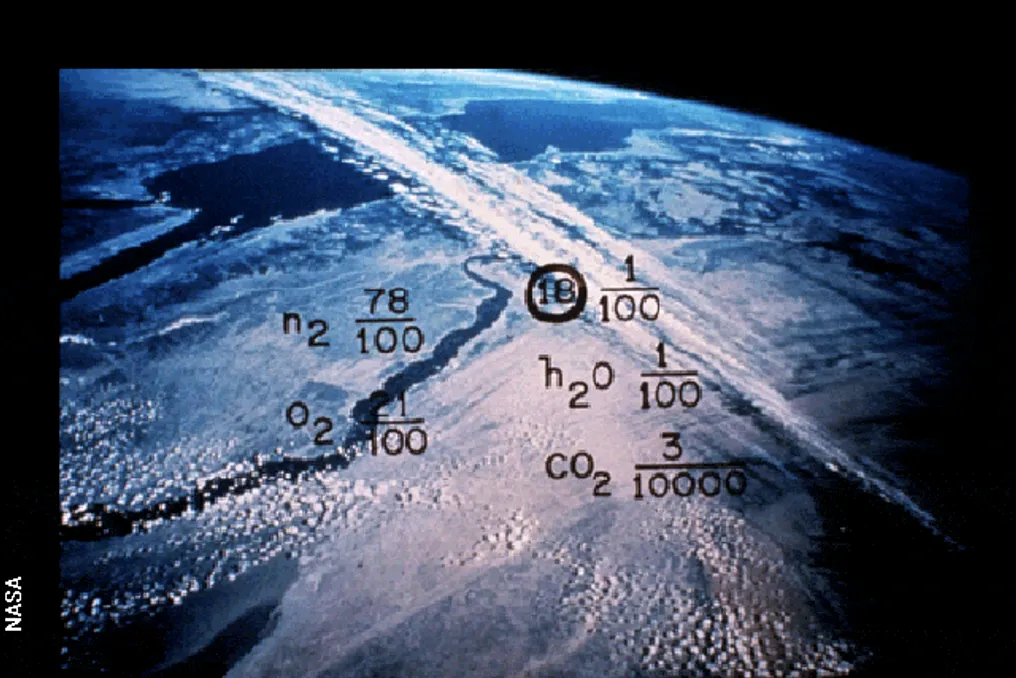
Voyager 2 was launched on August 20, 1977, and Voyager 1 on September 5. Voyager 1 was assigned number 1 because it followed a faster trajectory, according to NASA data. Each probe carried 11 instruments and the Golden Record, designed by Carl Sagan, containing images, music, sounds, and greetings in 55 languages.
In 1979, Voyager 1 reached Jupiter and discovered active volcanoes on Io, which were the first observed outside of Earth. Voyager 2 flew past the planet several months later.
Voyager 1's next target was Saturn in November 1980. After this flyby, the probe was deflected outside the planetary plane. Voyager 2 continued its journey to Uranus, arriving in 1986 and discovering ten unknown moons. Three years later, it reached Neptune and recorded the Great Dark Spot. No other spacecraft has visited these two planets.
On February 14, 1990, before shutting down its cameras, Voyager 1 photographed Earth from a distance of about 6 billion kilometers. This image was named 'Pale Blue Dot' at the insistence of Carl Sagan.
In the Olhar Espacial program, amateur astronomer and science popularizer Alessandro Mota explained the conditions under which the picture was taken. 'The image was captured shortly before the agency announced the camera's decommissioning, at a moment when the equipment needed to be deactivated due to loss of utility and energy. This bright dot is our planet, Earth, everything that has ever existed, everyone who has been born, lived, and lives on this speck suspended in a sunbeam, captured at a distance of billions of kilometers.'
According to Mota, the photograph holds significance beyond science. 'Carl Sagan thought about everything. He ensured the capture of one of the most important photographs in the history of space exploration, revealing the point where our wars occur and all our problems are concentrated. It is the realization that our existence is possible thanks to this fragile point in space. If humanity exists a thousand years from now, this photograph will still be in the history books.'
The title of the object created by humanity farthest from Earth belonged to Pioneer 10 before Voyager 1 claimed it. Launched by NASA in 1972, five years before the Voyager probes, this mission primarily aimed to study Jupiter. After flying past the gas giant, the spacecraft continued its journey and crossed Neptune's orbit in 1983, setting a record that it held for the next 15 years.
However, on February 17, 1998, Voyager 1 reached the distance of Pioneer 10 and surpassed it. Both probes were moving in almost opposite directions beyond the Solar System, but Voyager was moving faster. The overtaking occurred at a distance of about 10.4 billion kilometers from Earth, which is nearly 70 times greater than the distance between our planet and the Sun.
The heliosphere is a vast region around the Sun filled with solar wind—a continuous stream of charged particles emitted by the star—and permeated by its magnetic field. It surrounds the planets and extends far beyond Neptune's orbit, forming a kind of bubble that protects the Solar System from some particles from interstellar space.
Before reaching the boundary of this structure, both Voyagers passed through the so-called termination shock—a region where the solar wind loses speed upon colliding with the pressure of the interstellar medium's gas and magnetic field. Voyager 1 crossed this region in 2004, and Voyager 2 in 2007.
The next step was crossing the heliopause, the outer edge of the heliosphere. On August 25, 2012, Voyager 1 reached this region and entered interstellar space. Scientific confirmation of the passage was published in September 2013. Six years later, in November 2018, Voyager 2 also reached this point.
Exiting the heliosphere, however, does not necessarily mean leaving the Solar System. This is because the gravitational influence of the Sun extends far beyond this boundary. A possible reference for designating the outer limit of the Solar System is the Oort Cloud—a hypothetical region containing billions of icy bodies that are still under the Sun's gravitational influence.
The distance to it demonstrates the scale of the journey that still awaits Voyager 1. Mota emphasizes the scale of this journey: 'There are calculations suggesting that Voyager 1 will require at least 300 thousand years to reach the outer edge of the Oort Cloud. This is longer than the existence of our own species on planet Earth.'
NASA is also considering the point where solar gravity ceases to dominate. 'This boundary is located about halfway to the nearest star, Proxima Centauri. Traveling at speeds above 56 thousand km/h, the Voyager probes will spend almost 40 thousand years and cover a distance of about two light-years to reach this somewhat uncertain boundary.'
Voyager 1 is in the interstellar medium, which extends between stars. Although often associated with emptiness, this space contains matter, albeit in extremely low concentrations. It contains hydrogen and helium atoms, dust particles, cosmic rays, and magnetic fields. These are dispersed elements over vast distances, not forming dense structures like those near the Sun. There are no known planets or large celestial bodies in the immediate vicinity of the probe.
In this medium, Voyager 1 encounters conditions different from those observed inside the heliosphere, especially regarding plasma density and temperature, as well as magnetic field intensity. Its instruments allow for direct measurement of these properties, providing unprecedented data on the interstellar medium and the interaction of solar-ejected matter with the environment between stars.
Both Voyager probes continue to function and still transmit scientific data to Earth via their communication antennas. However, their radioisotope thermoelectric generators, which convert the heat from plutonium-238 radioactive decay into electricity, lose their ability to generate energy over time. To keep the main systems running for as long as possible, NASA is gradually shutting down scientific instruments and other equipment.
When there is no longer enough energy to power the transmitters, the probes will cease communicating with Earth. Nevertheless, they will continue to travel through interstellar space, carrying the Golden Records that collect records of the diversity of life and culture of humanity on Earth.
Zurita notes that they do not have enough speed to leave the Milky Way. 'Thus, they will never leave the galaxy. They will remain tied to us indefinitely, for billions of years, unless they encounter something in the meantime.'
What began as a mission to study giant planets has carried two spacecraft far beyond the known boundaries of the Solar System. Now they are traveling through interstellar space, carrying humanity's records and the message that at some point in its history, Earth looked at the stars and decided to send a part of itself into the unknown.