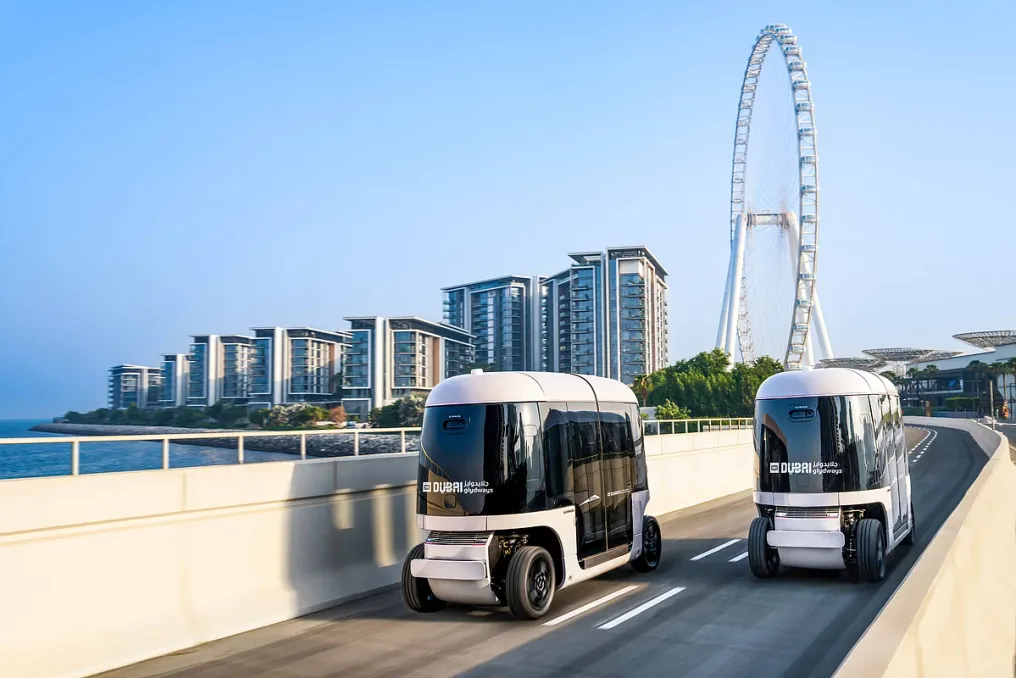
Imagine exiting the Dubai Metro and selecting your destination via a kiosk or app, then boarding a small driverless vehicle that takes you directly to your final point, without needing to share the ride with strangers or wait at intermediate stations.
This experience is being developed by Glydways for Dubai, while the Roads and Transport Authority (RTA) studies potential routes to bridge the gap between metro stations and residential buildings, offices, shops, and attractions.
The company's demonstration at Bluewaters has concluded, but the launch date for the public, fare costs, or the final route have not yet been announced.
Mark Sieger, co-founder and co-CEO of Glydways, noted that the project's goal is to eliminate the part of the public transport journey that often forces people back to using private cars.
Sieger told Khaleej Times: 'A small gap at the beginning or end of a trip can determine whether a person uses public transport at all. If the last leg of the journey involves a long walk in the heat or another lengthy wait, driving might become a more convenient option.'
Within Bluewaters, the RTA is considering a proposed connection spanning 2.8 km from the National Paints Metro Station to the island. However, the final route, station locations, and number of vehicles have not yet been confirmed.
Sieger explained that the proposed system would allow a passenger to transfer from the metro to a climate-controlled Glydcar—the company's autonomous electric vehicle—and continue to the Access Point located near their destination.
He emphasized: 'Our goal is to make this connection simple: exit the metro, get into a climate-controlled Glydcar, and go directly to the Access Point close to where you need to go.'
Unlike buses, shuttles, or metro trains, Glydways stated that its vehicles will not make intermediate stops to pick up other passengers. Each passenger, family, or group of friends will have their own vehicle for the trip.
According to Sieger, 'Passengers will travel directly from their starting Access Point to their chosen destination, without intermediate stops for picking up or dropping off other passengers. Each individual or group of travelers will have their own Glydcar.'
The system is designed to carry four to six passengers, although this depends on cabin layout and the space required for luggage, strollers, or mobility aids. The company asserts that the vehicles and stations are designed to accommodate battery-powered wheelchairs and ensure level boarding.
During the demonstration at Bluewaters, the vehicles traveled at a speed of about 24 km/h. Sieger added that the broader system is designed for speeds up to 50 km/h, though the actual travel time on any Dubai route will depend on the final routing, number of stations, and operational plan.
For the commercial network, Glydways aims for near-immediate boarding in most cases. If a vehicle is not already waiting at an Access Point, the company aims to provide a wait time of about 30–60 seconds, depending on passenger demand and network design.
Sieger concluded: 'The proposed experience is very simple: arrive at the Access Point, select a destination, board a Glydcar, and head there directly.'
Destination selection can be made via a mobile application or a kiosk, allowing users without smartphones to utilize the service. The company reported that its systems can support integration with local payment solutions, although the RTA will decide whether this includes Nol.
Glydways also hopes the service will operate around the clock and offer fares comparable to a metro or bus ticket. Sieger noted: 'Final operating hours and fares will be set by the RTA as part of the commercial plan.'
In conclusion, he reiterated: 'The service is designed to provide each group of travelers with their own Glydcar. You can travel alone, with family, or with friends, directly to your destination, without sharing with strangers.'