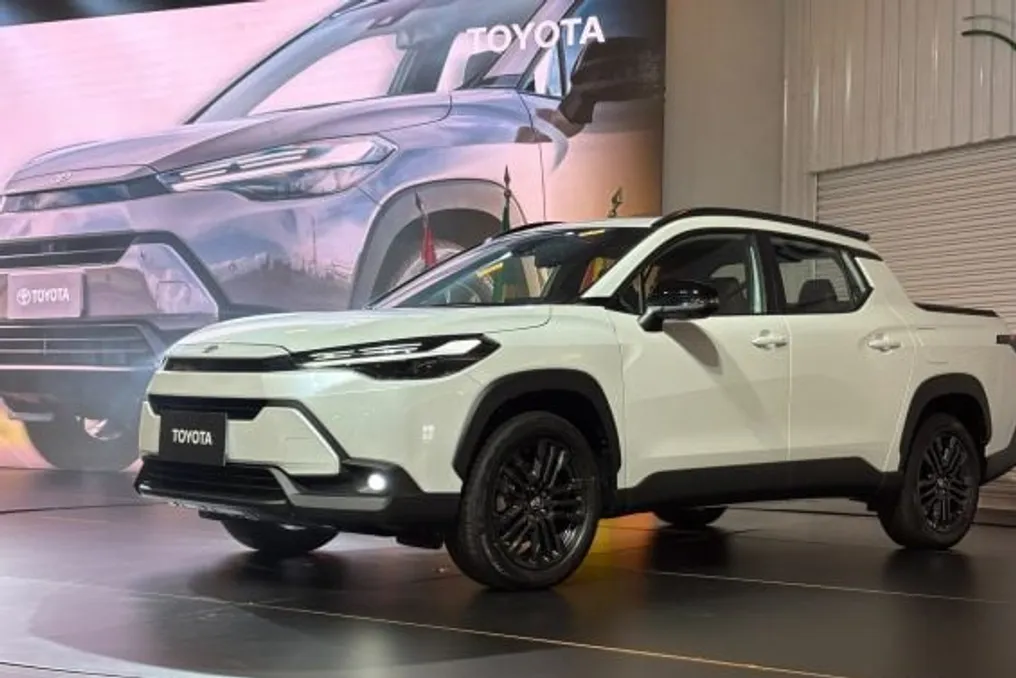
Toyota has introduced its mid-sized pickup truck, named Corolla Deck, aiming to compete in the market currently dominated by the Fiat Toro model. This vehicle is derived from the Corolla Cross and follows a concept established by Renault in 2015 with the Duster Oroch, featuring a double cabin.
The construction of the pickup will be based on the TNGA-C platform, shared with the Corolla Cross, and will feature independent rear suspension. The project seeks to combine the driving qualities and comfort typical of an SUV with the utility of a bed attached to the body.
The front part of the vehicle maintains the recognizable SUV design, while the central and rear sections have received a specific pickup body. Details regarding load capacity and bed volume will only be disclosed when the product is commercially launched. Although other dimensions have not been announced, it is evident that the Corolla Deck is larger than its corresponding SUV, mainly due to its rear overhang. Furthermore, the wheelbase, which measures 2.64 m in the SUV, has been extended in the pickup, as evidenced by the position of the door handles relative to the start of the fenders.
The interior of the Corolla Deck has not yet been revealed, but it is expected to maintain the same layout and equipment packages found in other versions of the Corolla Cross.
The model was initially presented with a flex hybrid engine. The manufacturer has not provided complete specifications for the unit, nor confirmed whether there will be the 1.8L unit with 101 hp coupled with an electric module generating a combined 122 hp. However, the pickup may be offered with a new 2.0L flex hybrid engine or with the already known 2.0 Dynamic Force option, which delivers 175 hp in entry-level versions.
In the monocoque pickup segment, the Corolla Deck will compete directly against models such as the Fiat Toro, Ram Rampage, Renault Niagara, and the future BYD Mako, meeting the needs of urban use, travel, and cargo transport.
The production of the Corolla Deck will take place at the Toyota factory located in Sorocaba, in the state of São Paulo. This facility underwent a modernization process that increased its production capacity to 100,000 vehicles annually, with potential to grow up to 200,000 units per year. The update of the industrial infrastructure also involved modifications to energy consumption and the automation of assembly lines.
Currently, the facility employs 1,700 direct employees, a number projected to reach 2,000 by 2030. The production lines operate with an automation index of 99.5%, reflecting the degree of industrial process robotization. The modernization also included the implementation of biomethane in the manufacturing process and the installation of more efficient equipment, allowing for a 60% reduction in electricity expenditure. These changes are part of Toyota's strategy to expand its production capacity in Brazil, as detailed in the investment cycle announced by the automaker until 2030.