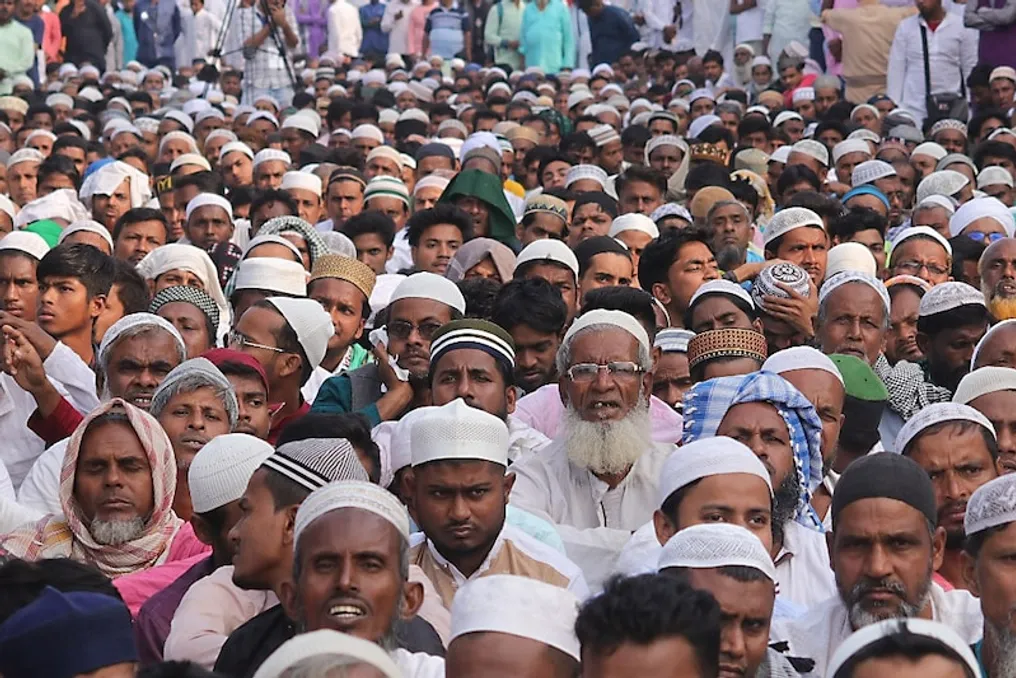
Pew Research Center studies predict Muslims may surpass Christians in population by 2035
Read more
Aaj Tak
www.aajtak.in

Pew Research Center studies predict Muslims may surpass Christians in population by 2035

According to detailed forecasts published by the Pew Research Center on Wednesday, Islam may become the world's largest religion, overtaking Christianity by 2035. It is projected that the number of Muslims will exceed the number of Christians, and this process could take less than ten years.

These changes are expected to see a decrease in the proportion of Hindus and Jews in the global population. Pew Research Center, which has produced reliable reports on religious demographics for the past 25 years, notes that while both Islam and Christianity are growing, the growth rate of Islam is significantly higher.

The main reason for this, according to Pew, is the higher birth rate among Muslims compared to other major religious groups. Pew's senior demographer, Conrad Heikert, emphasized that the fertility factor is far more significant than other methods of religious or religious identity change.

According to Pew, between 2020 and 2025, the birth rate among Muslims was 3.1 children per woman, while for Christians it was 2.5. The average birth rate for all other women was 1.6, which is below the 2.1 level needed to maintain a population without external influx.

Recent Pew estimates show that in 2020, there were 2.27 billion Christians and 2.02 billion Muslims worldwide. According to new forecasts, by 2035, the number of Muslims will reach 2.57 billion, and Christians will be 2.52 billion. If current trends continue, by 2070, the global Muslim population will exceed 3.6 billion, while the Christian population will be slightly less than 3 billion.

These forecasts are part of a large-scale Pew project studying how the sizes of major religious groups' populations might change between 2020 and 2070. The calculations account for recent differences in age structure, birth rates, religious conversion, and migration patterns of religious groups.

One of Pew's key findings is the projection that the Christian group will not retain a majority in the United States over the next 40 years. Currently, Christians make up 62% of the total US population, but this share is expected to fall below 50% by 2065.

Pew also indicated that in neighboring Canada, the share of Christians is likely to drop below 50% by 2030. A significant reason for this decline in both countries is the rise in the number of people who are not affiliated with any religion. Estimates suggest that by 2070, the share of such people in the US population will reach 41%, and in Canada, their number will exceed that of Christians.

According to Pew, the global population is expected to grow by 29% between 2020 and 2070. Among the analyzed religious groups, only Muslims and Christians are expected to grow at this rate or higher; Christians account for an increase of 30%, and Muslims for 80%.

Although the overall numbers of Hindus and Jews continue to grow, Pew believes their share of the world population will decrease. A decline in the number and share of Buddhists is also predicted, partly due to a potential overall population reduction in China, South Korea, and Japan.

According to Pew Research estimates, between 2020 and 2025, Muslim women gave birth to more children than women of any other religion. About 252 million children were born to Muslim mothers, compared to 208 million from Christian mothers. Muslims are the only major religious group whose number of births is expected to increase in the coming decades; other groups are expected to stabilize or see a gradual decline in fertility.

Pew also predicts that if current trends persist, Pakistan will have the largest Muslim population by 2070, followed by India, Nigeria, and Indonesia.


Similar stories

Pew study predicts decline in Hindu share of global population amid growth of other religions
Read more
timesofindia.indiatimes.com

Pew study predicts decline in Hindu share of global population amid growth of other religions

According to new forecasts from the Pew Research Center, the number of Hindus in India is expected to increase by 176 million between 2020 and 2070. However, the proportion of Hindus in the country's total population will decrease because Muslims maintain higher fertility rates.

Despite the expected change in proportions, Hindus are projected to still constitute more than three-quarters of India's population by 2070.

Globally, the Hindu population is expected to grow by 199 million over the same period, reaching nearly 1.4 billion. However, as the rest of the world's population grows faster, the share of Hindus in the world population will decline from 15% in 2020 to 14% in 2070.

These forecasts are part of a broader study by the Pew Research Center analyzing changes in the size and composition of major religious groups between 2020 and 2070. The calculations take into account differences in fertility rates, age structures, religious conversion, and international migration.

Pew notes that although the overall birth rate in India has sharply declined in recent decades, Muslim women continue to have more children on average than Hindu women. Combined with the younger age structure of the Muslim population, this fertility gap will lead to an increase in the Muslim share of the country and a decrease in the Hindu share.

In 2020, 1.1 billion Hindus lived in India, accounting for about 95% of the global Hindu population. Other countries in the top five included Nepal with 24 million Hindus, Bangladesh with 13 million, Pakistan with 5 million, and Indonesia with 4 million.

The rankings are expected to change by 2070: the United States is projected to become the fifth largest country by Hindu population globally. Australia is also expected to enter the top 10, taking ninth place with approximately 3 million Hindus, while the United Arab Emirates is likely to drop out of this list.

The Hindu population in Pakistan is projected to double to 10 million by 2070, although the country is expected to retain fourth place in the global ranking.

Outside of India, most of the projected growth in the Hindu population is expected in Pakistan and the United States. In Pakistan, the growth is likely to be driven by natural population increase, where births exceed deaths, whereas in the US, immigration is expected to be the main driver of growth.

The Asia-Pacific region, home to 99% of the world's Hindus, is forecast to provide most of the community's growth over the next five decades. The Hindu population in this region is expected to increase by 191 million between 2020 and 2070. By 2070, Hindus are projected to make up 28% of the region's population, compared to 26% in 2020.

In North America, the Hindu population is expected to more than double from 4 million in 2020 to 9 million in 2070. Their share of the region's population is projected to rise from 1% to 2%.

Sub-Saharan Africa, Latin America, and the Caribbean are the only regions where the absolute number of Hindus is projected to decline. If current trends persist, Hindus will account for less than 0.1% of the population in each of these regions by 2070.

Pew's forecasts identify fertility, mortality, age structure, international migration, and religious conversion as key factors determining changes in the size of religious groups. The global Hindu population is expected to increase by more than 200 million due to natural increase between 2020 and 2070, with almost all this growth projected in the Asia-Pacific region.

Religious conversion is expected to have a minor impact on the overall Hindu population. Pew explains this by noting that Hindus have a high retention rate: an estimated 99% of people raised in Hinduism continue to identify with the religion in adulthood. Corresponding retention rates are 85% among Christians and 83% among Buddhists. Muslims have a retention rate of 99%, equal to Hindus.

Overall, religious conversion is projected to lead to a reduction in the global Hindu population by about 1 million between 2020 and 2070, with most losses expected in the Asia-Pacific region.

Meanwhile, migration is expected to contribute significantly to the growth of the Hindu population in North America, the Middle East and North Africa, and Europe. Together, these regions are projected to gain over 8 million Hindus through migration by 2070.

Asia and the Pacific region are expected to register the largest losses related to migration. However, the population growth of this region due to natural increase is projected to significantly outweigh the number of Hindus it loses due to emigration.

The Pew report also forecasts that by 2035, Islam will overtake Christianity as the world's largest religion, as the Muslim population continues to grow faster. Both religions are expanding globally, but Pew attributes the faster growth of Islam largely to higher fertility rates among Muslims.

Conrad Hackett, a senior demographer at Pew, explained that 'it's the kids,' emphasizing that fertility rates play a much larger role in the growth of religious populations than conversion and other forms of religious change. Between 2020 and 2025, the fertility rate among Muslim women was 3.1 children per woman compared to 2.5 among Christian women. The average rate for women of all other religious groups was 1.6, which is below the replacement level of 2.1 children per woman needed to replace each generation.

According to the latest Pew estimates, there were 2.27 billion Christians and 2.02 billion Muslims worldwide in 2020. New forecasts show that the Muslim population will reach 2.57 billion by 2035, surpassing the Christian population, which is expected to be 2.52 billion.

If current trends continue, the global Muslim population will exceed 3.6 billion by 2070, while the Christian population is projected to remain just under 3 billion.

The forecasts also point to significant changes in the religious composition of North America. In the United States, where Christians currently make up 62% of the population, a loss of Christian majority is expected by 2065. By 2070, people with no religious affiliation are projected to make up 41% of the US population.

In neighboring Canada, Christians are projected to make up less than half the population by 2030. By 2070, people with no religious affiliation are expected to surpass Christians in the country. The rise in the number of people who do not identify with any religion is a significant factor underlying the projected decline in the Christian population share in both countries.

Popular