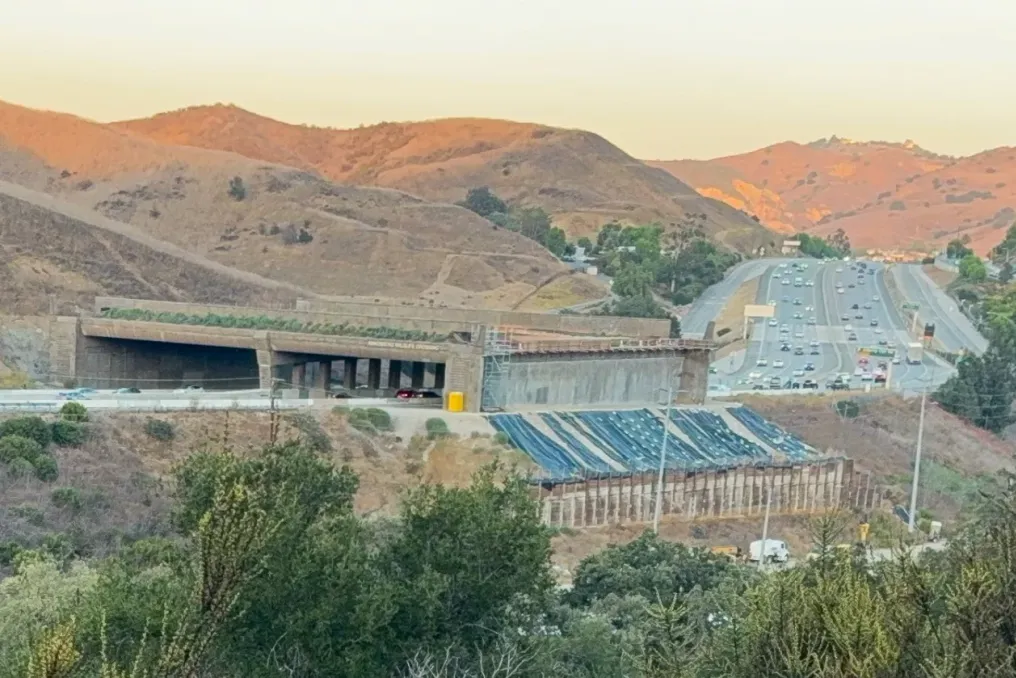
In December of this year, drivers traveling through Agoura Hills near Los Angeles may see a bridge covered with local vegetation. This structure is called the Wallis Annenberg Wildlife Crossing and is scheduled to open to wildlife on December 2, 2026. The bridge crosses ten lanes of Highway 101 in California.
The crossing in Liberty Canyon will restore connectivity between the Santa Monica Mountains habitat and the Simi Hills to the north. From there, a second section will allow animals to cross the adjacent Agoura road. Fencing will guide animals to the crossing, while barriers will protect them from the blinding light of headlights and traffic noise below.
For many Los Angeles residents, the story of wildlife trapped by highways is familiar. Mountain lion P-22, who lived in Griffith Park, was thought to have crossed both the 101 and 405 to get there. He lived in the park for over ten years before dying in 2022, occupying the smallest habitat area ever recorded for an adult male mountain lion.
His journey drew attention to what happens when roads divide habitats. Highway crossings put mountain lions at risk of being hit by vehicles. However, staying on one side can deprive mountain lions of opportunities to find mates. Consequently, isolated populations can become more inbred over generations. A safer route between the hills gives the cats a better chance to reach territory and find mates outside their immediate population.
A camera captured a coyote on the southern slope of the unfinished crossing in late October. Bobcats, gray foxes, and mule deer also use the nearby trail, so researchers will monitor these species after the bridge opens.
In the coming years, scientists will track which animals cross the bridge and whether it helps restore connections between wildlife populations. For motorists, this change may be unnoticed on a familiar stretch of road, but for a young mountain lion searching for territory, it could mean the opportunity to reach the next range of hills without encountering traffic.