While public support for the arts faces difficulties in several countries, Darat al Funun, whose name literally means 'House of Arts,' maintains its commitment to supporting artists. Suha Shoman, its founder, states that 'Artists are witnesses of their time,' adding that art can record changes and point the way, speaking also of beauty, even in difficult or violent contexts.
Located on the hills of Jabal al Luweibdeh, overlooking downtown Amman, Jordan, Darat al Funun possesses an inviting and accessible landscape, with distinct entrances to the south and north. Its cascading terrace design demonstrates the foundation's central principle: art is essential for citizenship and a vehicle for history.
The site functions as a living palimpsest, where architecture accumulates human history through historic residences, contemporary additions, gardens, and archaeological remains. This triad—'Art, Architecture, Archaeology'—is physically expressed on the site. As explained by Suha Shoman, the work aims at both the people who shaped the past and the artists who build the future, creating space for artists to contribute to history and heritage.
Origins and Historical Context
The roots of Darat al Funun are linked to the urban growth of Amman in the late 19th and early 20th centuries, as well as to Suha Shoman's personal trajectory. The areas of Amman, situated on hills, often carry the prefixes Wadi or Jabal, indicating valley or mountain. The city was built with local stone, often reused. With a history spanning the Roman, Byzantine, and Islamic periods, its diverse social fabric evolved into a modern era, driven by Circassians in the late 19th century, who enriched regional carpentry and popularized wheeled transport.
In the 1920s, Amman's growth surpassed its commercial core, with residential neighborhoods establishing themselves on the slopes. Subsequent migration movements intensified this urban and social transformation, as the city served as a shelter for people displaced from Palestine during the 1948 Nakba and in 1967, from Iraq in 1990 and 2003, and from Syria starting in 2011.
Born in 1944 in Jerusalem, Palestine, Suha experienced this displacement from childhood, which influenced her artistic practice and institutional work. Under the guidance of artist Fahrelnissa Zeid, she was introduced to abstraction as a way to express cultural experience. In 1988, she established an artist support program through the Abdul Hameed Shoman Foundation, giving rise to Darat al Funun. Her origins were also tied to the region's political instabilities, making it a meeting point for Palestinian artists after the First Intifada, Iraqis fleeing the Gulf War, and Libanese facing civil war. Thus, Darat al Funun was born as an intellectual refuge and oasis, without avoiding complex themes, recognizing that art is not separate from its political circumstances.
Artists use their works to question the conditions of their time and need a space for critical discourse and, sometimes, cultural resistance. The institution was conceived not as a museum nor a commercial gallery, but rather as a place where this could happen, reflecting an aspiration of hospitality. The interaction between the physical layers of the site and Suha Shoman's artistic concerns offers a complete understanding of the institution.
Architecture as Archive and Artists as Historians
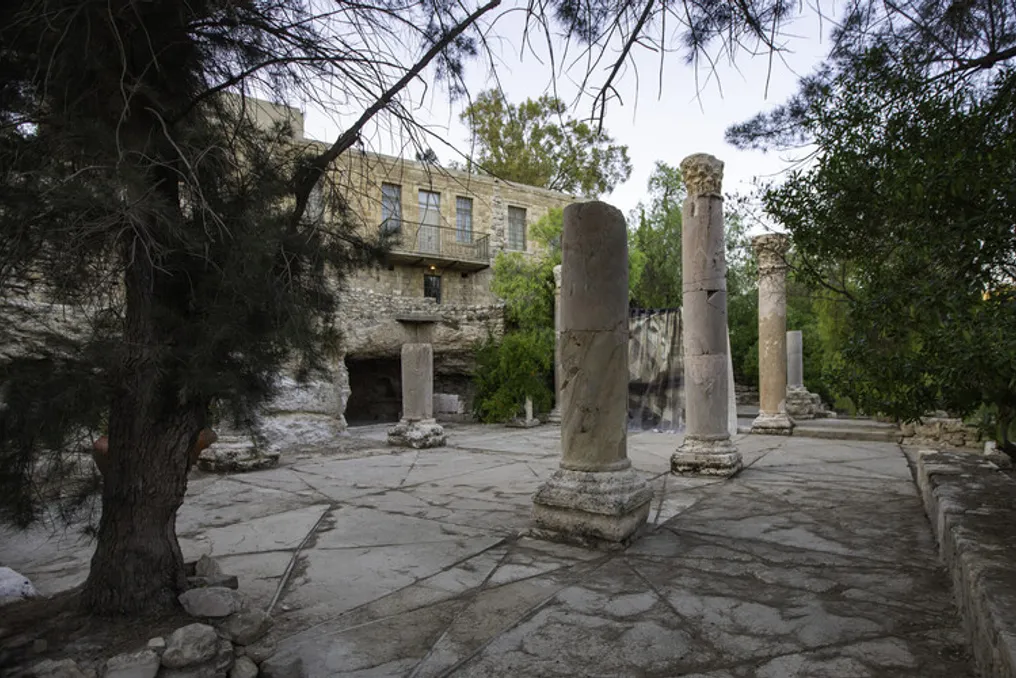
The Main Building of Darat al Funun was inaugurated in 1993, formalizing the foundation's transition into a physical cultural institution. Currently, the complex comprises nine renovated structures—six historic buildings and three sheds—in addition to an archaeological site containing ruins of a 6th-century Byzantine church, possibly dedicated to St. George and built near or on a Roman temple, perhaps that of Hercules. The diverse architectural identity of Darat al Funun is visible in the stones of its restored historic residences, dating from the 1920s and 1930s, where vestiges of different construction and occupation eras persist.
The historic houses were originally built by families from across the Levant (Bilad al-Sham): the Main Building belonged to a Jordanian family; the Headquarters, to a Syrian family; the Blue House and Dar Khalid, to a Palestinian family; and Beit al Beiruti, to a Lebanese family, bringing the architectural legacy of Beirut to Amman. The complex symbolizes the overcoming of imposed borders, welcoming artists from all over the Levant and the world.
The transformation of the site, from ancient ruins to a modern home for the arts—equipped with a research center, scholarships, artist residences, and an open-air theater—illustrates how artists and architects record and create history for future generations. This philosophy was applied by the lead architect, Ammar Khammash, whose restoration interventions in the 1990s prioritized minimal interference, preserving original facades with hammer and chisel marks.
The Main Building, commissioned by the then-mayor of Salt, Nimr Pasha al-Hamoud, exhibits cosmopolitan influences from the initial phase of Amman's urban development. It is a two-story building with a symmetrical Levantine plan of three bays, characterized by a central reception hall flanked by rooms arranged around a covered courtyard, a semi-circular front entrance hall crowned by a terrace with a veranda supported by syncretic columns, and stone window frames. The external limestone walls, 40 to 60 cm thick, were erected using a double-wall masonry system with stone and gravel, a technique used in later expansions.
Subsequent occupants brought an equally complex history to the building, which housed British military officers, including 'Lawrence of Arabia,' government offices, and later, the Arab Girls' School. After being abandoned in 1978, it remained in ruins until it was acquired by the Shoman family. Although the original spatial configuration, scale, atmosphere, and limestone facades were maintained, the rooms were adapted into interconnected exhibition spaces. A juxtaposition occurred with the addition of the triple-vaulted library, a contemporary annex built with concrete blocks to celebrate the plurality of the present, but clad in the same tone to maintain a subtle dialogue with the historic masonry. Artist Fahrelnissa Zeid contributed by donating her collection to enrich the collection.
The Blue House, restored in 1994, adds another layer of identity. Built in the 1920s with Circassian labor from Jordan for the former Palestinian governor Ismail Haqqi Abdo, it stands out today for its blue-Circassian wooden veranda designed by Khammash, along with its wrought iron doors and grilles. Another residence, Dar Khalid, also built for the Abdo family, became known for having hosted the poet of the Great Arab Revolt, Sheikh Fouad al-Khateeb, and was adapted into art studios and residences, being renamed in 2002 in honor of Khalid Shoman.
At Darat al Funun, heritage is not seen as something static, kept in display cases, but rather as something intrinsically linked to its daily and continuous use.
Suha Shoman and the Temporal Dimension
Suha Shoman's artistic practice dialogues deeply with Darat al Funun, as her paintings and video installations explore identity and memory through personal and collective experiences, addressing themes such as displacement, time, light, and the relationship between humans and landscape. Her connection to the Petra slab, seen in her paintings 'Legend of Petra' (1987 and 1992), is particularly influential. Additionally, her video exhibition 'Of Time and Light' (2004) reinforces her interest in time, both as a physical and individual experience and as a medium, and in the mutable nature of light in the face of loss. Thus, there is a mutual interaction between her work and the architecture, lending expressive strength to her vision within Darat al Funun.
The artist's role as a historian involves translating memory into new forms, transforming personal experience into a broader narrative that might otherwise be ignored or silenced. Artists also actively participate in the continuous construction of history. The ruins of the 6th-century Byzantine church integrate into the landscape traversed by the public, who participates in events, including performing arts. Fragments of mosaic flooring in its grotto under the Main Building reveal the foundations upon which a new story is being built.
Recent architectural interventions confirm this: in 2005, the upper boundary wall and entrance were redesigned by architect Sahel al Hiyari with a combination of stone and concrete. This modification was intended to create a transition between the public thoroughfare and the Darat landscape, validating local plurality and contrasts while remaining coherent with the history and function of the space as a home for the arts.
A new expansion occurred in 2011, when the Khalid Shoman Foundation headquarters was installed in a restored 1930s residence that now displays works from the Khalid Shoman Collection.