The author, fascinated by video games since childhood, dedicated time to revisiting classic racing games such as Gran Turismo 2 and Need for Speed: Hot Pursuit 2 from 2002, considering them to represent a valuable period in gaming history, between the mid-1990s and mid-2000s.
These old titles had a distinct appeal, differentiating themselves through driving style and physics realism, in addition to having a strong visual identity in the menus and art direction, which built a certain 'charm' into the gaming experience.
Although current games are extremely fun and have gigantic budgets, the author points out that they have lost some of that previous 'video game feel,' requiring increasingly powerful equipment and consuming a lot of player time.
The evolution of the classic gaming era, marked by the popularization of three-dimensional graphics, allowed not only visual advancements but also the simulation of automotive behavior in 3D environments. While previous games used programmed animations and effects, 3D enabled representing the car in a physical space, calculating its position, speed, and interaction with the asphalt.
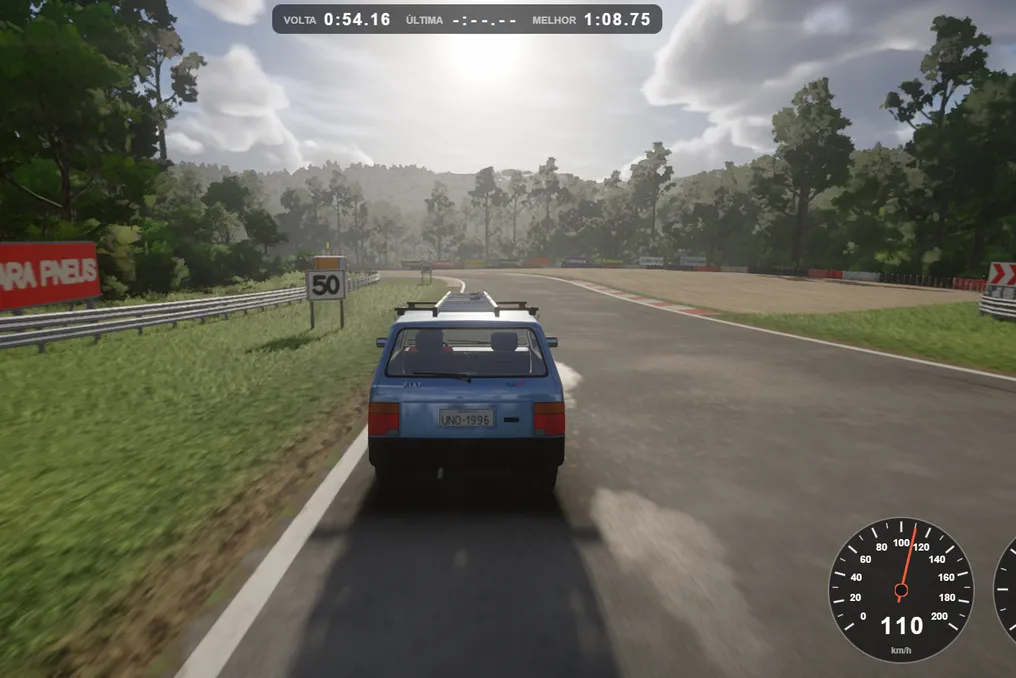
This curiosity led the author to analyze a project published by the Brazilian Viktor Kav on GitHub: a racing game featuring a 1996 Fiat Uno Mille EP with an aluminum ladder on the roof, developed entirely by artificial intelligence.
Viktor Kav employed two Anthropic models, Fable 5.2 and Opus 5.5. Both received the same prompt and generated independent versions of the game, where the AI wrote practically all elements, including the car representation, the circuit, the vegetation, the lighting, visual effects, and the physics system.
The request was complex: a real-time 3D game with visual quality close to a 2026 release, executable directly in the browser. Photos of the Uno were provided as reference, specifying details such as metallic light blue paint, visible interior, headlights, hubcaps, and the roof ladder, while also requiring body movements in curves and braking, and drifting with smoke and tire marks.
A crucial technical point is that neither project uses traditional engines like Unreal Engine or Unity. They were coded to use WebGPU, a technology that allows the browser to access the graphics resources of the video card for direct rendering on the GPU. The result is a standalone HTML file, accessible in browsers like Chrome or Edge without installation.
All content is procedural, meaning the elements are mathematically constructed by the code. There are no pre-imported 3D models, ready textures, or audio recordings; the body, wheels, ladder, trees, and track are formed by geometries calculated by the program, as are the sky, shadows, and reflections.
When creating the tracks, the author did not define a prior layout, allowing each model to create its own circuit. Fable named its circuit Serra da Mata, and Opus created the Circuito da Serra, presenting distinct layouts with straights, varied curves, elevation changes, chevrons, escape areas, guardrails, grandstands, and pits.
Visually, the result is impressive, reminiscent of early 2000s racing games, and in some aspects of lighting and shadow, surpasses Hot Pursuit 2, despite being an unequal comparison. All of this is contained in an HTML file of just over half a megabyte.
However, regarding the car, none of the versions managed to replicate the Uno with total fidelity from all angles, demonstrating that describing an object and providing photos is not enough for the AI to reconstruct it accurately, making the work of a specialized artist irreplaceable.
The most notable aspect was the physics. Even without a specific model, Fable's code implemented a four-wheel vehicle dynamics model with load transfer, front-wheel drive, automatic transmission, brakes, and different adhesion conditions. Parameters are defined for mass, weight distribution, wheelbase, track width, center of gravity height, and rotational inertia.
The system calculates the vertical force on each tire and limits traction and braking according to adhesion. There is even a simplified version of the Pacejka model, a mathematical formula used in automotive engineering to simulate the relationship between tire deformation and forces transmitted to the ground.
In summary, the program continuously calculates forces and movements, updating the vehicle's position and orientation based on the simulation, using a fixed time step of 1/120th of a second for stability.
However, this is not a faithful simulation of the Uno Mille, as the parameters were not measured on the real car; the code defines a torque curve, described by the developer as 'a Mille considerably more responsive than the original.' The physics is a functional approximation to generate convincing behavior.
The audio follows a similar logic: instead of real recordings, the system uses Web Audio to synthesize all sounds in real time, combining oscillations and filters. The engine rotation follows the tachometer, and there are specific effects for drifting, wind, and passing over chevrons or gravel, creating a generic but technically ingenious sound.
In practice, the final product is a simple minigame, which includes a start screen, pause menu, dashboard with speedometer, tachometer, and timer, as well as three distinct cameras to follow the race.