After the rain stopped at the Juan Manuel Fangio Autodrome in Balcarce, the author proceeded to the Museo Fangio, a place he had wanted to visit for many years. During the day, he had accompanied the Crespi Competición cars, but the drizzle forced the collection of the monocoques.
Juan Manuel Fangio is a notable figure in motorsports, having won five Formula 1 world titles with four different manufacturers, an unprecedented feat to date. His admiration was shared by idols such as Ayrton Senna, making a visit to his museum an essential stop for Formula 1 enthusiasts.
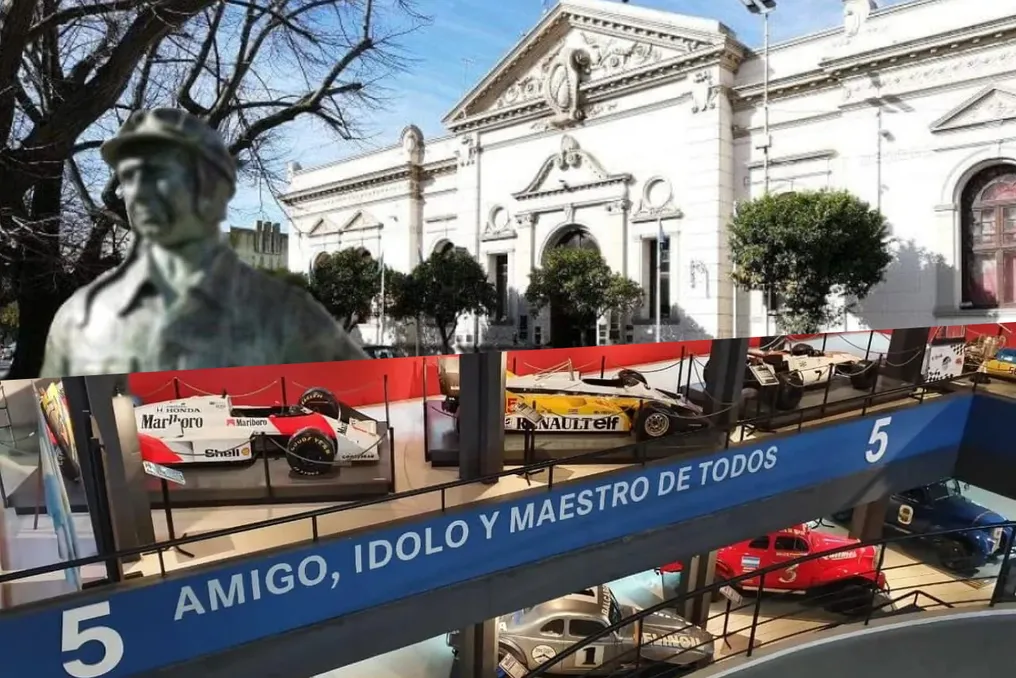
In Plaza Libertad, the weather was cold, with temperatures around six degrees, windy, and drizzling. From the outside, the Museo Fangio appeared to be just another old public building typical of Argentine city centers, as it was built in 1906 and served as the headquarters for the Municipality and Deliberative Council of Balcarce.
Entering the museum was like transitioning from winter to a warm and cozy environment, filled with warm lights and a vast space reminiscent of a cathedral, but substituting saints with automobiles. Monocoques, prototypes, and road cars were displayed in large quantity and proximity, something the author had only seen in photographs.
The internal structure of the museum is revealed by a staircase that descends below street level, connecting floors via a spiral ramp. New vehicles appear in each section of the route, while others remain visible on different levels. The building has a larger space than its facade suggests, encouraging long stays, such as the one the author planned to contemplate Fangio's Mercedes 300S.
The museum's history began in 1979, when residents of Balcarce organized a commission to protect Fangio's sporting heritage. The building, which was abandoned and deteriorated, maintained its original facade, but its interior received a completely new structure, designed by architect Antonio Eduardo Mandiola. This new space was conceived to house cars, trophies, documents, and objects related to the driver and Argentine motorsport.
The construction was the result of a collaboration between the provincial government, companies, and private donors, also involving Fangio. Mercedes-Benz contributed significantly, given its long relationship with Fangio on the tracks and as a dealership. The official inauguration took place on November 22, 1986.
The internal organization of the Museo Fangio shows notable similarities to the current Mercedes-Benz Museum, inaugurated twenty years later in Stuttgart, both using galleries traversed by spiral ramps. The visit was started by a specialist from the Fangio Foundation, who detailed the collection and gave a mini-lecture in each sector.
The exhibition begins in the old 'workshop,' a replica of Fangio's workshop in Balcarce, where he worked before dedicating himself fully to driving. This workspace is recreated with original tools, benches, and equipment from the time, in addition to authentic cars and engines.
An important part of the exhibition is dedicated to Turismo Carretera, a category that required endurance in long public road races, where the ability to repair mid-road was crucial. This includes the Chevrolets used by Fangio in the 1930s and 1940s, alongside the 1939 Chevrolet Coupe, one of the two 'carreteras' established by the Foundation based on original cars from that era.
As the museum was not busy, the group began exploring the galleries autonomously, focusing on the vehicles of greatest interest and analyzing their details without the rush of a guided tour.
The author already suspected that part of the collection consisted of recreations, but assured that this was not disappointing. The original cars are rare racing machines produced in very small quantities, often worth tens of millions of dollars today. The Mercedes-Benz W196 Stromlinienwagen, for example, is represented by a mockup provided by Mercedes-Benz itself, motivated by financial issues, considering the insurance cost of a vehicle that, in February 2025, was sold for 51.155 million euros and became the second most expensive car auctioned.
Not all reproductions are merely aesthetic; some are complete reconstructions, using techniques, materials, and parts from the era, and may even be functional. Argentina has a recognized tradition in this field, with names like Pur Sang and Néstor Salerno. The Lancia D50, for example, was only identified as a replica after a lower inspection, upon finding a conventional driveshaft, different from the original.
The Maserati 450S by Salerno, into which entry was permitted, illustrates this. Although it is not the exact car driven by Fangio, the replica allowed the author to experience the driving position, the interior space, the steering wheel, and the clutch, providing a much more realistic notion of the driving experience.
Salerno is also responsible for the Maserati 300S and the Ferrari 166 Formula 2, the latter being identified as a replica by the type of chassis weld. With the Ferrari 166 FL, Fangio won a race in Interlagos in January 1952; the original specimen is housed in the collection of the Automóvil Club Argentino in Buenos Aires.
At the apex of the collection is the Maserati 250F, also a replica, but whose identification is complex because it was built with original Maserati tooling and parts. The Balcarce specimen is the third of twelve made and was acquired by Fangio in the 1970s due to its extreme fidelity. This acquisition was vital, as it was with the 250F that Fangio won his fifth and final world title in 1957, winning at the Nürburgring after a remarkable recovery race at age 46.
The replica, homologated by the FIA as historic F1, faithfully demonstrates the construction of the monocoque: front engine, wire wheels, narrow tires, drum brakes, and an almost exposed driver posture, making Fangio's achievement even more impressive to those familiar with modern F1.
The museum also houses cars that actually competed. A highlight is the 1938 Alfa Romeo 308, chassis 50017, one of the four built by Alfa Romeo, which competed against the Silberpfeile during the interwar period. This car arrived in South America before World War II, raced in Argentina, and was kept by Fangio disassembled until the 1980s.
This same Alfa Romeo was accessible, allowing the author to examine the cockpit, the engine, the cylinder head, the mechanical injection system, and the proportions up close, evoking the feeling of meeting an admired person after a long time.
Another original example is the Renault RE30C Formula 1, used by Alain Prost in the 1983 Brazilian Grand Prix in Jacarepaguá, where he finished seventh.
The 1994 Penske PC23 Mercedes-Benz, loaned from the Mercedes-Benz collection in Stuttgart, is a demonstration model, not a race car, but replicates the PC23/003 chassis used by Emerson Fittipaldi in the 1994 Indy 500, incorporating the Mercedes-Ilmor 500I engine, developed to circumvent Indy regulations.
Senna also has his space, with a development McLaren MP4/3B decorated as the MP4/4, and an accurate replica of his Ralt RT3 Formula 3. Carlos Reutemann, another Argentine champion, is also represented, although the cars he sent to Autoclásica in San Isidro, such as the Brabham BT36 Formula 2 and the Torino, were absent.