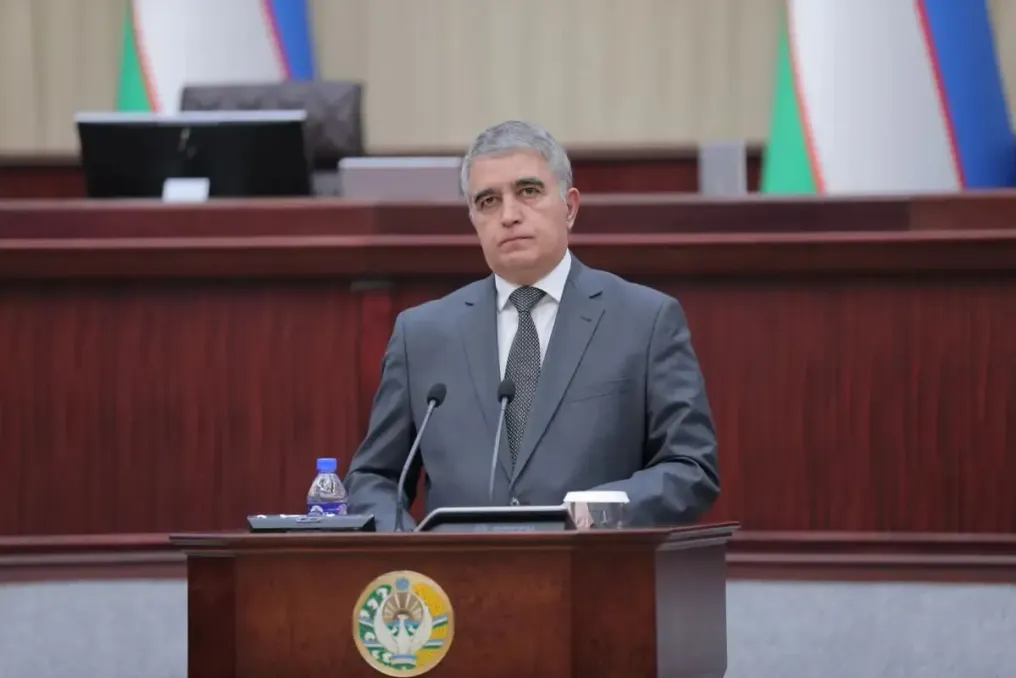
The Minister of Water Resources, Shavkat Khamraev, announced on November 11 that irrigation projects involving Chinese companies in Uzbekistan have faced delays due to disagreements over construction costs.
These statements were made during a Q&A session in the Legislative Chamber of the Oliy Majlis. Imomjonnar Tursunov, a deputy from the People's Democratic Party of Uzbekistan, noted that work on several investment projects scheduled for 2026 has not yet begun.
He requested clarification regarding the reconstruction of irrigation infrastructure in the regions of Surkhandarya, Kashkadarya, Bukhara, and Namangan. A project valued at 130 million US dollars was supposed to be financed with the participation of the Export-Import Bank of China.
Tursunov emphasized that, according to the presented table, no funds had been disbursed for these projects. He asked the minister to explain the reasons for the delays and present a plan to ensure the timely use of foreign investments.
Khamraev explained that the ministry initially planned to involve Chinese companies CITIC and CAMC. It was assumed that they would begin construction at their own expense, with costs later reimbursed through preferential Chinese loans.
However, the companies submitted price proposals significantly exceeding the ministry's expectations. The minister stated that during negotiations, the companies offered to perform the work not 10% or 20% more expensive, but more than double the expected cost, proposing to start work with subsequent coverage of expenses through loans.
According to the minister, the ministry spent over a year trying to agree on acceptable terms, but negotiations were unsuccessful. Subsequently, the government approached the Chinese side to arrange financing through the Export-Import Bank of China in accordance with established procedures.
Khamraev specified that the bank's project assessment takes about six months, after which a contractor is selected from several companies. These procedures took an additional year. The tender winner offered a price exceeding the initial estimate by 20%.
Following this, a tender was held involving three companies, and CITIC won it; however, its proposed price was still 20% higher than the initial plan. The ministry tried to persuade the company to lower the price, but the parties could not reach an agreement.
Subsequently, the ministry began negotiations with another major Chinese company, Sinohydro. Another meeting with representatives took place on the morning of November 11, before the parliamentary session. Khamraev stressed that the ministry will not agree to inflated prices simply to speed up construction.
He added that if they agreed to a high price for quicker completion, the funds would ultimately have to be returned from the state budget, so the issue is currently suspended. According to the minister, the program will take at least two years. Project documentation has already been prepared and passed the necessary evaluation. It is planned that the canals will be lined with concrete between 2027 and 2028. Khamraev assured the legislators that the ministry intends to carry out the work at a high level and within the allocated budget.
On November 29, 2024, President Shavkat Mirziyoyev signed Decree PP-409 on the reconstruction of irrigation infrastructure in the regions of Bukhara, Namangan, Surkhandarya, and Kashkadarya with the participation of the China Eximbank. This document provided for two projects with a preliminary total value of 220 million US dollars. Of this, 160 million US dollars were allocated for irrigation infrastructure in the regions of Bukhara, Namangan, and Surkhandarya, and 60 million US dollars for Kashkadarya.
The client was designated as the Center for Implementation of Foreign Investment Projects in Water Resource Management under the Ministry of Water Resources. Financing was to be carried out through preferential loans from the China Eximbank. The decree also exceptionally designated the general contractors: CITIC Construction Co. Ltd was chosen for the project covering Bukhara, Namangan, and Surkhandarya. In the Kashkadarya region, CITIC Construction Co. Ltd and China CAMC Engineering Co., Ltd were appointed as general contractors.
The Ministry of Investment, Industry and Trade and the Ministry of Water Resources were instructed to negotiate with the China Eximbank to agree on preferential financing terms without insurance payments. The evaluation of feasibility studies was to take place within one month, and the approval of state decisions within two months. The Ministry of Water Resources, the General Prosecutor's Office, and the administrations of the four regions were obliged to reduce unnecessary expenses and monitor the effective use of allocated funds. It was expected that loan agreements with the China Eximbank would be signed starting in 2025 after the approval of feasibility studies, and the final funding amounts would be determined based on the actual volume of work. For the project in Kashkadarya, 120 billion soums were allocated from the local budget for 2025 to cover a 15% advance payment.