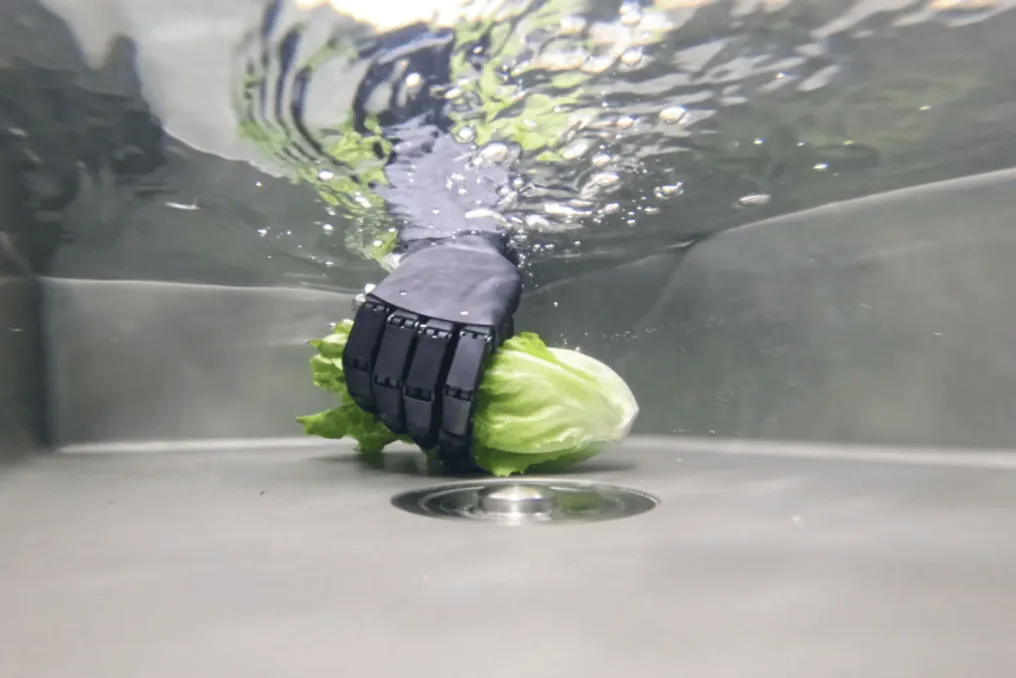
Dexterous arms are becoming a central theme in the humanoid robotics industry, where companies strive to improve robots' capabilities in terms of degrees of freedom, gripping force, and movement accuracy. However, a new question arises: can these arms function normally when performing everyday tasks, such as washing dishes or vegetables, or when conducting delicate operations underwater?
To investigate this issue, the HeymanDex team discussed how the company is entering the dexterous arm market through underwater applications, as well as its technological strategy and commercialization plans.
Unlike most dexterous arm manufacturers focused on terrestrial use, HeymanDex has chosen a different approach, prioritizing protective features to enhance the reliability of robotic arms in harsh environments.
Competition in the dexterous arm industry is mainly concentrated on performance metrics such as degrees of freedom, fingertip strength, and response speed. Nevertheless, HeymanDex has chosen a differentiated path, making underwater conditions the starting point for developing its products.
This choice reflects the team's experience in underwater and specialized robotics. The core HeymanDex team previously participated in projects related to deep-sea vehicles of the 8000-meter class and sampling equipment for the manned submersible 'Jiaolong'. This experience gave the team practical insight into the engineering challenges inherent in underwater operations, especially water pressure, corrosion, and sealing.
In the team's view, for robots to become truly versatile machines, they must be able to operate outside dry, flat laboratory conditions. Everyday household tasks, such as washing vegetables and dishes, industrial processes involving liquids and lubricants, and deep-sea engineering operations—all require the robot to withstand severe conditions. Therefore, HeymanDex aims to make protective features an integral part of dexterous arms, not just an added function.
For a multi-jointed dexterous arm, waterproofing is much more complex than simply installing a sealed outer casing. The fingers must continuously bend and extend while numerous internal joints and transmission mechanisms must remain flexible. Achieving reliable dynamic sealing in these moving components without compromising transmission efficiency is one of the biggest engineering challenges.
HeymanDex considers its independently developed integrated dynamic sealing system for underwater conditions a key technical advantage. The company has developed two technical solutions for different depth requirements. For depths from 0 to 1000 meters, its technology includes axial dynamic sealing with high linear speed, high-reliability radial static sealing, and magnetic dynamic sealing. For ultra-deep-sea environments from 1000 to 10,000 meters, the company has developed additional technologies, including hydraulic compensation for dynamic pressure, oil-filled dynamic pressure balancing with magnetic coupling, and two-stage static sealing.
The company also optimizes materials, manufacturing processes, and overall product design to increase corrosion resistance and long-term operational reliability. Simply put, traditional dexterous arms mainly focus on more precise object grasping and faster movement. Underwater dexterous arms must achieve the same capabilities while ensuring stable operation under constant water pressure and other complex environmental conditions.
HeymanDex has released its first commercial product—the underwater dexterous arm WA100. According to the company, the standard engineering configuration supports operation at depths up to 300 meters. Custom versions for various depth requirements, from 100 to 10,000 meters, can also be developed.
The WA100 features a five-fingered structure with six active degrees of freedom and 11 articulated joints. Its weight does not exceed 1250 grams, it provides a minimum output force of 10 N per finger, and supports a total lifting capacity of at least 5 kilograms. According to HeymanDex, the WA100 has passed 500,000 durability test cycles without damage. The company also states that its dynamic sealing system has a service life of up to 4000 hours, and the entire system can operate continuously for hundreds of hours without failure. HeymanDex claims that the product achieves 80% success in underwater operations and offers approximately five times greater generalization capability compared to ordinary two-finger grippers.
The WA100 is primarily aimed at universities and research institutes, clients requiring specialized operations, as well as manufacturers of underwater robots, robotic manipulators, and Remotely Operated Vehicles (ROVs). HeymanDex is also collaborating with a leading domestic pool cleaning robot manufacturer to explore applications in underwater cleaning and maintenance. The commercialization of the first product marks the company's transition from technical development and prototype testing to product delivery. Nevertheless, improving reliability, controlling costs, and expanding the customer base remain important tasks.
HeymanDex does not intend to limit its business only to underwater applications. Instead, the company hopes to use underwater technologies as a starting point and disseminate its core capabilities in sealing, drive systems, transmission, and control across a wider range of robotic products.
The company has begun expanding into industrial production, general commercial applications, and research and education sectors. For example, its industrial dexterous arm Dasheng 1 explores the integration of multiple configurations with industrial manipulation requirements. Foreign markets are also part of the company's expansion strategy. The WA100 was previously demonstrated at IFA in Berlin, Germany, and the industrial dexterous arm Dasheng 1 was presented at IROS in the USA. The company has also started working on adapting the product with a leading German robotics company and is focusing on the US, European, and Japanese markets.
By entering the technically complex underwater market, HeymanDex aims to create a technological platform that can ultimately be applied across a wider range of industries. In the future, robots may work not only on factory production lines but also at home, in hospitals, in oceans, and even in more extreme conditions. As robots take on increasingly complex real-world tasks, the simple ability to grasp an object will cease to be sufficient. The real challenge for the next generation of dexterous arms may lie in ensuring their reliable and consistent operation in diverse environments.