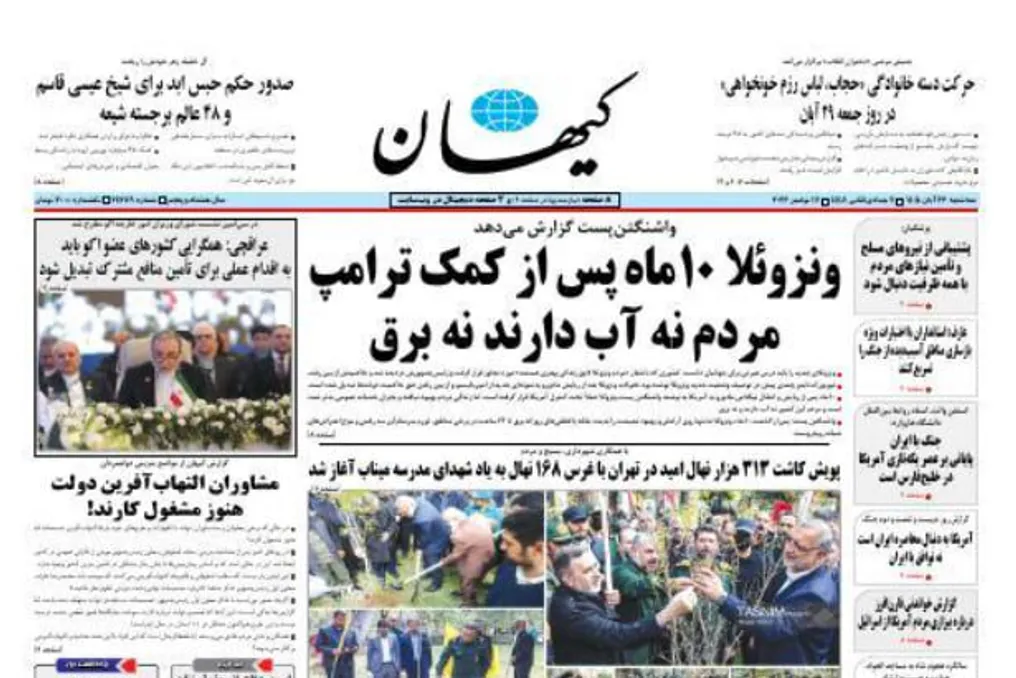
Kayhan put forward the thesis that recent glitches in the United States' aviation system reflect deeper internal weaknesses of the country. The publication notes that when a nation claiming global leadership experiences difficulties managing a basic domestic function, such as the air transport network, and when high-ranking officials openly admit technological shortcomings, it signals the beginning of a new phase of structural decline.
According to the publication, the Trump administration neglected serious internal issues, including economic difficulties, a significant budget deficit, and aging infrastructure. Instead, resources were directed towards costly external confrontations, particularly with Iran. Kayhan concluded that flight disruptions say more than just technical malfunctions; they underscore the image of an empire whose priorities are distorted by a failed pursuit of hegemony at the expense of internal stability and development.
Sobh-e-No: Beyond War or Peace
The publication Sobh-e-No explored ways to overcome the protracted state between war and peace. The answer, according to the newspaper, is not in starting a new conflict nor in simply declaring a desire for peace. Instead, a strategy is required that reduces the probability of future aggression, creates conditions for achievable agreement, and strengthens Iran's economic and social resilience in the face of external pressure. The newspaper emphasized the difference between supporting peace and developing policies capable of ensuring it. While supporting peace is a valuable aspiration, effectively building peace requires understanding threats, assessing the balance of power, and choosing tools capable of influencing the opponent's behavior. Peace is a national necessity for Iran, but long-term stability cannot be achieved by ignoring threats or constantly accepting them. Sustainable stability must be built through deterrence, political management, and strengthening national potential. From this perspective, peace is not merely a demand, but the result of a targeted strategy and policy.
Sazandegi: Integrated Network of US and Allies' Missile Defense
Sazandegi focused on the significance of Iranian drone attacks on the Al-Riffa base in Bahrain. The publication argued that the importance of this facility should be viewed in the context of Iran's broader efforts to disrupt the integrated air and missile defense system supported by the US and its regional allies in the Persian Gulf. Weakening early warning radars and fire control systems became the main goal of Iranian operations during the 40-day conflict. The logic is simple: radar installations and observation centers serve as the eyes of the defense network, and their disruption can reduce the ability to detect and intercept future attacks. From this perspective, the strike on Al-Riffa was part of a wider effort to impose costs on American military infrastructure in the region. Sazandegi contended that Tehran seeks to demonstrate that the presence of US forces in Arab countries of the Persian Gulf does not guarantee the security of their facilities and equipment. The attack was presented as a signal that regional military assets remain vulnerable despite extensive defensive measures.
Arman-e-Melli: Strait of Hormuz on the Verge of a New Order
Arman-e-Melli described the Strait of Hormuz as one of Iran's most vital strategic assets. The newspaper asserted that Tehran recognizes both the significance of this waterway and the leverage it provides in regional and international affairs. According to the article, the 40-day war involving Iran, the US, and Israel highlighted the importance of the strait more than ever. Without such a confrontation, neither Iran nor external powers could fully assess its strategic value. The conflict also forced regional neighbors, as well as European and American participants, to reconsider the role of this waterway. Despite the losses and costs incurred by Iran, the conflict demonstrated the significant influence associated with Hormuz. In the newspaper's view, if Iran faces threats to its national security or territorial integrity, it has several ways to respond, including actions affecting the security and functioning of the strait, thereby increasing pressure on other states.
Hamshahri: Europe on Alert Over Concerns Regarding Iran
Hamshahri discussed the possibilities of deterring Iran and the concern it raised among the US and its allies. The newspaper argued that the evolution of the Iran deterrence doctrine, especially the idea of responding without geographical limitations, created new security challenges for American military facilities in Europe. According to the article, growing concern is manifested in increased security measures at American bases, the movement of combat and refueling aircraft, warnings for military families, and efforts by European countries to strengthen air defense systems. Hamshahri interpreted these events as evidence of anxiety over the possible expansion of threats against American military interests. Amid ongoing tensions between Tehran and Washington, the newspaper concluded that the potential for deterring Iran and the possible consequences of military action against the country have once again become central factors in international security calculations, demonstrating Iran's continued influence on military planning across a wide geographical area.