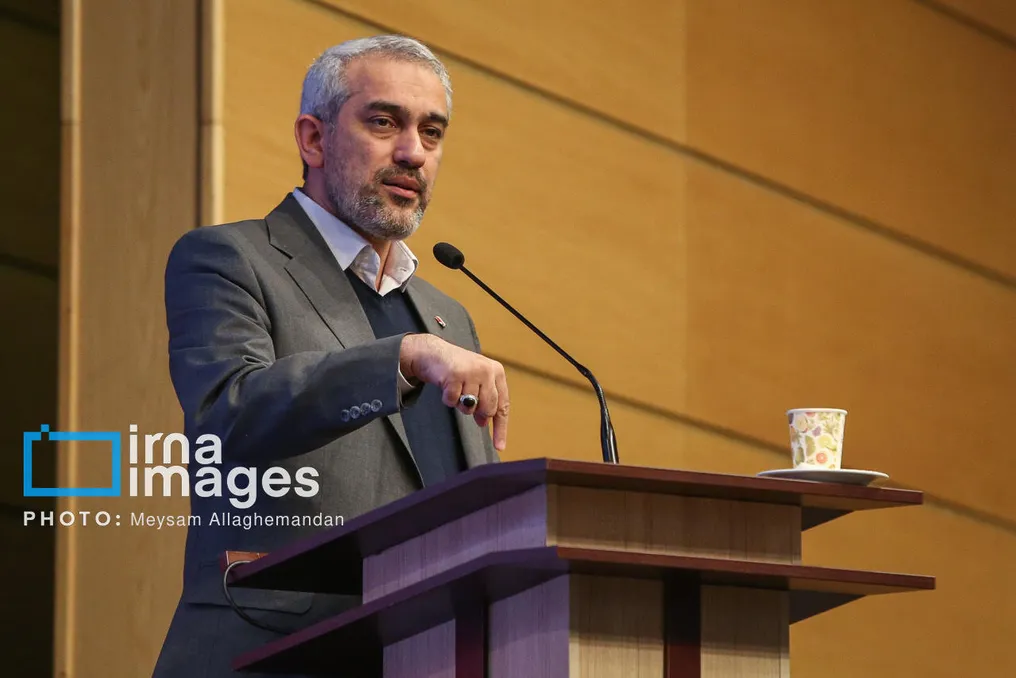
At the opening of the XVIII International Exhibition of Financial Systems, Investments, and Digital Infrastructure of Iran, known as the Iranian Finance and Banking Exhibition (IFEX 2026), the Minister of Economic Affairs and Finance, Seyed Ali Madanizadeh, stated that the country has overcome the stage of economic stability and entered a new era focused on construction.
He emphasized that the main strategy is now centered on developing production through investment, increasing productivity, and involving the population and the private sector. The exhibition, held at the Tehran International Exhibition grounds, features over 100 organizations, including 11 banks, 9 insurance companies, and more than 50 capital market participants, under the slogan 'We will build.'
Madanizadeh recalled the serious economic difficulties of the last two years: existing imbalances that could have triggered recession and inflation even without war, as well as the consequences of the 40-day imposed war, the atmosphere of 'neither war nor peace,' and the currency upheaval orchestrated by enemies. Despite forecasts of hyperinflation and loss of economic control, the government of the XIV focused all programs on ensuring economic stability to prevent negative consequences. He noted that although many expected a severe recession and inflation, active government measures prevented the worst outcomes. Now, after restoring relative stability, the focus is shifting to growth and production.
The Minister stressed that economic stability and predictability require fiscal sustainability, monetary policy reform, and curbing excessive liquidity growth. He pointed out that some currency reforms were aimed at creating stability and predictability, and a return to growth requires investment and increased productivity. The central element of the ministry's plans remains economic justice—equal opportunities and fairness in distribution and standard of living.
Acknowledging the wartime conditions and border restrictions, he reported that trade flows have been growing over the past two months, and efforts to maintain employment and keep businesses running show signs of improvement in some macroeconomic indicators. He stated: 'Today our agenda features the slogan 'We will build'; it is a season of construction, and this cannot be achieved otherwise than by focusing the government's main attention on production.'
Priorities include easing investments and removing obstacles. The organization of foreign investment has been restructured into the Iran Investment Organization, which is expected to be presented within two weeks and will oversee major strategic investments. Madanizadeh also noted that the financial system must direct resources toward more productive, efficient, and profitable activities, and banks have been tasked with guiding economic entities toward higher-yield projects.
It is crucial to move away from a coercive economy where resources are purchased at a rate of 23–30% and lent at 18%, or firms are forced into unprofitable projects. Privatization and proper management of state-owned companies should aim at transferring them to private hands and increasing productivity.
The Minister presented several specific programs. The 'Ruyesh' plan provides currency instruments for returning currency resources to circulation; a fund for foreign direct investment was opened last month, and obstacles for projects with foreign currency and foreign currency deposits are being removed. Next week, the Fund for Monetization of Unused Assets will be presented, and the National Guarantee Fund will act as a guarantor for large projects, while the Iran Investment Organization will offer investors 800 opportunities generating foreign currency income.
Regarding the digital economy, Madanizadeh emphasized that artificial intelligence and digital technologies should be integrated into industries such as steelmaking, mining, and the oil industry to enhance productivity, rather than being viewed as replacements for these industries. Although Iran may not compete with China and the US in core AI, it can succeed in applying AI and digital transformation across various sectors.
The second participant in the digital economy was recently listed on the stock exchange, and more such companies are expected to appear. This data economy is the second axis: infrastructure must be provided for economic entities, and data must be used to reduce government spending and empower businesses. Credit scoring systems can replace collateralized lending, and a major digital transformation project has begun in the insurance sector, including health insurance.
The stock exchange organization is also reforming processes to simplify and lower the cost of financing. Regarding trade, the minister noted that the dominant view was not export-oriented, but legal and economic barriers are being removed, and a bill will be submitted to parliament to promote trade. Over the past two weeks, a seamless cargo transit project has been implemented at the border so that borders become transit points, not storage locations.
Reforms have been made in monetary, debt, and monetary policies, and the markets related to management are fully ready for economic activity. Madanizadeh concluded: 'What we must do in this economic war is start building Iran and set aside stability in favor of focusing on production,' calling on all financial sector participants to help increase production.
This exhibition session is held under the slogan 'We will build,' emphasizing the development of financing tools, expansion of investment capacity, and the use of new technologies in financial services. Financing and the digital economy are among the axes upon which the Ministry of Economic Affairs and Finance bases its economic policy, and holding this exhibition provides an opportunity to present the existing capabilities of the banking network, capital market, and insurance industry, as well as to study solutions for developing interaction between these sectors. Topics of interest within this event include the introduction of new financial instruments, supply chain financing, project financing, expansion of digital banking services, development of financial technologies, and implementation of new investment solutions. IFEX 2026 will run until November 19th at the permanent site of the Tehran International Exhibition and is considered a platform for interaction between economic policy developers, financial institution leaders, investors, and private sector activists, as well as for presenting new opportunities in the country's financial system.