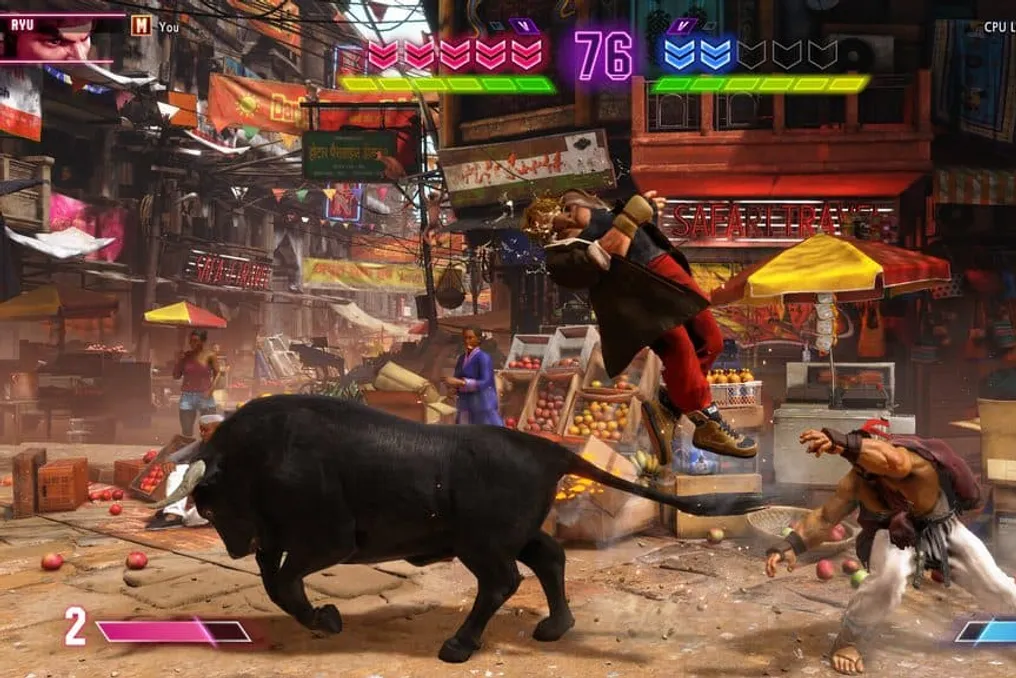
Frame Data Explanation: The Fundamental Concept in Video Game Fights
Read more
Olhar Digital
olhardigital.com.br

Frame Data Explanation: The Fundamental Concept in Video Game Fights

The Brazilian fighting game community is celebrating a significant event: EVO, recognized as the largest and most prestigious world fighting game championship, will hold its edition in Brazil between March 26 and 28, 2027, at the Expo Center Norte in São Paulo/SP.

With this international focus, confrontations in titles such as Street Fighter, Tekken, and Mortal Kombat tend to gain even more prominence. Alongside this, technical jargon unfamiliar to the general public emerges, such as references to a hit having a '–5 on block' value or punishment delivered with a four-frame punch.

For those who wish to follow professional commentators and players in 2027 while understanding what is happening on screen, the concept of Frame Data can be seen as the key to understanding the hidden mechanics of these games, and this does not require being a professional player.

Video games operate analogously to a traditional cartoon, where fluidity is created by the rapid succession of images. The vast majority of fighting games operate at a rate of 60 frames per second, meaning that 60 distinct images are displayed every second of combat.

In this context, a single frame represents the smallest temporal unit existing in the game, corresponding to a sixty-hundredth of a second. Frame Data functions as a metric that quantifies the time each character action takes to execute.

When executing an attack, for example, the character's movement does not happen instantaneously; it is segmented into distinct phases. It is at this point that the game transcends the simple action of randomly pressing buttons. Whether hitting the opponent or when they manage to defend themselves, one competitor recovers from the animation at a slightly different moment than the other.

This time difference generates concepts that define the advantage or disadvantage of each move. Although it is not necessary to memorize complex tables to play casually, understanding the logic of Frame Data profoundly alters the perception of the game.

This eliminates the feeling of unfairness, because when an opponent's hit seems to land first, it is usually due to their attack having a faster startup time than yours. Furthermore, it transforms the game into something similar to high-speed chess, requiring reading and rhythm rather than just superhuman reflexes.

By paying attention to the rhythm of attacks in finals or casual matches, one realizes that behind every impressive combo and every notable defense, there is a mathematical choreography occurring at 60 frames per second.

Similar stories

Phantom Blade Zero captures the dynamic of Chinese action cinema
Read more
super.abril.com.br

Phantom Blade Zero captures the dynamic of Chinese action cinema

The Chinese gaming industry has gained international attention with titles such as Genshin Impact (released in 2020), a free and popular mobile game, and Black Myth Wukong (released in 2024 for PC and consoles), which reached 20 million copies in its first month. Recently, the developer S-Game launched a new title, Phantom Blade Zero, last Thursday, the 29th, available for PlayStation 5 and PC.

Phantom Blade Zero is inspired by the cultural genre known as wuxia, which means 'martial arts and chivalry' in Chinese and has over two thousand years of history. This genre narrates the journeys of fighters, with a recent cinematic example being the film The Tiger and the Dragon, which won four Oscars in 2001.

The game presents a basic premise: the main character, Soul, is unjustly accused of a crime. Although S-Game has strived to develop the narrative, the plot features moments that are excessively simple and others vague, resulting in loose ends.

However, much like is characteristic of wuxia, the main focus lies on the action, which is considered excellent. The confrontations are highly acrobatic, displaying dramatic and exaggerated movements, maintaining fidelity to the genre. S-Game reported dedicating three years to replicating all character gestures, with the collaboration of over twenty martial arts experts.

The controls are described as agile and precise, the camera functions adequately, and the combat system is well-balanced, neither too complex nor too simple. It is possible to start playing quickly, but it is also advantageous to spend time learning new techniques and exploring the swords and skills collected throughout the game, which includes 30 primary and 25 secondary weapons.

The difficulty level is configurable, and the standard mode is suitable for most players, offering the ideal challenge, particularly in boss fights. Furthermore, there is the peculiar '66-day mode': if the player is defeated 66 times (a number with significance in the game's mythology), the game ends and restarts, losing all accumulated progress.

Phantom Blade Zero is not classified as an open-world or strictly linear game; it requires and allows for some exploration, albeit within defined limits. The game has its own pleasant rhythm. Graphically, the title is good, presenting beautiful scenery and numerous light effects, especially during the most intense fights. It was tested on the PlayStation 5, where it operates stably at 60 frames per second.

With over 30 hours of content offered at a reasonable price below the average of releases, the game is recommended for those who enjoyed Black Myth Wukong or are looking for a good action experience. Currently, Phantom Blade Zero is available for PlayStation 5 and PC (Steam) for the price of R$ 229.90.

Analysis of the factors that lead players to abandon games, such as difficulty and duration
Read more
olhardigital.com.br

Analysis of the factors that lead players to abandon games, such as difficulty and duration

Many players acquire a title, dedicate a few hours to exploring the game's universe, but end up not returning. This pattern of behavior is more frequent than imagined, given that in many games, less than half of participants manage to reach the end of the narrative, which raises the question: what leads so many people to quit a game?

The cause may seem simple, such as excessively challenging games or campaigns that are too prolonged. However, examples like Elden Ring and Senua’s Saga: Hellblade 2 demonstrate that the correlation between difficulty, playtime, and completion is much more intricate.

Although the notion that only four in ten players finish a game serves as a starting point for debating this phenomenon, there is no universal completion rate applicable to all titles. These indices fluctuate depending on the specific game, the platform used, and the period when the data was collected.

When Elden Ring was released, nearly three weeks after its launch in March 2022, achievement data released by Gamereactor indicated that only 17% of players on the Steam platform had reached one of the endings of the RPG developed by FromSoftware. At that time, approximately 30% had still not managed to defeat Margit, one of the first major bosses in the adventure.

These numbers highlight how difficulty can act as an obstacle to progress, especially in games that require continuous learning, exploration, and repeated confrontations.

There is also the element of perceived challenge. In 2025, creators of The First Berserker: Khazan observed that a portion of players chose to stop the campaign instead of selecting Easy difficulty. Creative Director Junho Lee reported that the name of this mode generated a stigma that discouraged its use. In response, the team implemented new difficulty settings, including a Beginner mode. This case demonstrates that simply providing alternatives is not enough; the way they are presented also influences the decision to continue playing the game.

If duration were the determining factor, shorter campaigns should show considerably higher completion rates. However, this is not always the case. Senua’s Saga: Hellblade 2, released in May 2024, has an estimated duration of six to seven hours. Despite this, about two weeks after its release, only 13% of players had unlocked the completion achievement on Xbox. On Steam, the completion rate was approximately 33% during that period.

The disparity between platforms suggests that access to the game can also impact the results. Since Hellblade 2 was available on Xbox Game Pass from the start, subscribers could experience the game without an individual purchase cost, making it easier for players to start the campaign out of mere curiosity and abandon it if they were not interested in the experience.

It is crucial to note that these percentages reflect specific moments after the releases and do not constitute final completion rates, given that many players continued advancing in their respective campaigns.

Although difficulty and duration can contribute to abandonment, they are not the complete explanation. A game may lose public interest due to repetitive progression, a slow narrative pace, unengaging mechanics, or simply by competing with other releases for players' available time.

There is also a distinction between quitting a game out of frustration and pausing a campaign because the experience has already satisfied what the player was looking for. In open worlds, for example, exploring the map and completing side activities can be more appealing than finishing the main plot.

Additionally, achievement statistics cannot reveal individual motivations. They only quantify how many people reached a specific goal, but they do not clarify why the others stopped.

The cited examples of Elden Ring, Hellblade 2, and Khazan converge on one conclusion: there is no single reason why players leave a campaign. More than seeking ideal duration or difficulty, the developers' challenge lies in sustaining the public's interest throughout the journey, as finishing a game is not necessarily the only way to appreciate it.

Popular