Meta launches Achados app for buying and selling used goods in Brazil
Read more
Olhar Digital
olhardigital.com.br

Meta launches Achados app for buying and selling used goods in Brazil

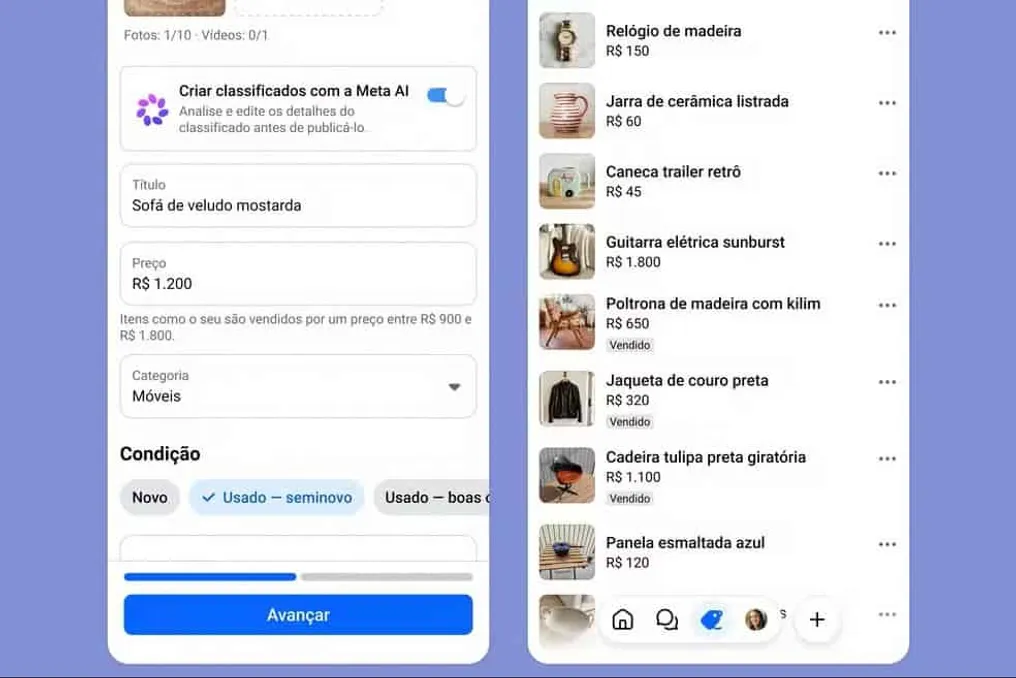
Meta introduced Achados this Tuesday (the 17th)—a free mobile application designed for the buying and selling of pre-owned items. This service aggregates listings posted on Facebook and Instagram platforms. Brazil was the first country to gain access to this new service, which aims to compete with platforms such as Enjoei.

Currently, the application is available exclusively for Android users. It allows users to search for items, view seller information, and directly agree on delivery and payment terms. Information regarding the release of an iPhone (iOS) version has not yet been provided by the company.

Achados aggregates offers published on Facebook Marketplace, in Facebook groups, and on Instagram. Users can communicate with sellers through the Achados app itself or using WhatsApp. The payment and delivery mechanism is fully agreed upon between the parties, and Meta does not take a commission from sales.

Before making a transaction, buyers have the opportunity to review seller profiles on Facebook and Instagram, as well as check reviews, other listed items, and transaction history. The company also states that it uses automated tools to detect and remove fraudulent schemes. If suspicious activity is detected, users can report listings or sellers.

The search functionality includes two notable tools. At the top of the feed is the 'Garimpo de hoje' section, which showcases various items daily. Additionally, the 'selo de achado' helps identify selected listings by comparing prices with similar offers on Facebook Marketplace.

The service does not yet have its own website. The app's launch comes amid growing interest in purchasing second-hand items online. According to a study by the Confederation of National Store Directors (CNDL) and SPC Brasil Credit Protection Service, 46% of consumers who made online purchases in the last 12 months acquired some used item.

For the Executive Manager of CNDL, Daniel Sakamoto, the industry already has stable demand, but further development requires improvements in guarantees, security, and simplifying the sales process. He noted that the used goods market is no longer a niche, and the main driver for consumers is the desire to save money.

The study also showed which categories of used goods are most popular among Brazilian consumers. Among the purchasing platforms, in order of popularity, are Mercado Livre, OLX, Facebook Marketplace, and Enjoei.

Similar stories

Meta turns to Chinese company Fourier for humanoid robot development
Read more
technode.com

Meta turns to Chinese company Fourier for humanoid robot development

Meta has engaged Shanghai-based company Fourier to create 'Max,' a five-foot tall humanoid robot that was developed in approximately three months. Work on the second version of this device has already begun. This agreement draws attention to the startup, which has transformed from a developer of rehabilitation robotic systems into creators of humanoids. According to Omdia, in 2025, the company ranked sixth in global humanoid robot shipments and attracted investments from funds such as SoftBank Vision Fund 2, Prosperity7 Ventures, supported by Aramco, and IDG Capital.

At the end of August, Meta demonstrated Max to employees at an internal robotics summit. This humanoid weighs 48 kilograms and stands 1.5 meters tall. It was jointly created with Fourier from Shanghai and operates on Nvidia Jetson Thor, capable of displaying facial expressions and manipulating objects using five-fingered hands.

The development of Max took about three months, during which Meta's Vice President of Robotics Products, Li-Chen Miller, spent nearly two months at Fourier's factory in Shanghai. Work on the Max 2 model started in September. It should be noted that Meta's efforts in collaboration with Fourier are aimed at research and experimentation and are not yet intended for commercial sale. Fourier later informed The Paper that further information would be disclosed through official channels.

This collaboration may indicate that Fourier provided not just a finished robot, but also an established hardware platform, engineers capable of rapid adaptation, and access to a developed robotics supply chain.

Fourier was founded by Gu Ze in Shanghai in 2015 and initially specialized in rehabilitation robots, including exoskeletons and hospital training systems. This experience gave the company years of expertise in motion control, force feedback, and human-machine interaction. The company gradually transitioned to developing humanoids, starting this project in 2019, and reached a significant milestone in 2022 when an early prototype could stand and walk unassisted.

In 2023, Fourier introduced the full-sized GR-1 model, followed by GR-2 in 2024. In 2025, the company released the open N1 and GR-3—a 'Care-bot' with 55 degrees of freedom designed for interaction via vision, sound, and touch. Such extensive background allows Fourier to focus not only on industrial and logistics tasks but also on fields like rehabilitation, care, and public services, where robots must understand gestures, speech, and physical contact.

Fourier's capabilities perfectly matched Meta's requirements for the Max robot. According to The Information, Meta wanted the robot to recognize voices from five meters away, interpret gestures from three meters away, maintain eye contact, and signal its status, such as attentiveness or uncertainty. Fourier's experience in multimodal human-robot interaction, gained in the field of rehabilitation, provided a suitable starting point.

The company's broader ecosystem also played a role. In 2024, Nvidia included Fourier in the list of humanoid developers working on the GR00T project, after which researchers demonstrated manipulation of household items on the GR-1 model. Speed and supply chains may also have been important. Meta noted that the industry faces difficulties finding certain components within the US, whereas Fourier managed to create a customized prototype in about three months within China's mature robotics ecosystem.

Investors noticed Fourier's potential even before Meta. IDG Capital supported the company in its early stages, and SoftBank Vision Fund 2 led a Series D round of 400 million yuan in 2022, joined by Prosperity7 Ventures, supported by Aramco, and Vision Plus Capital. Prosperity7 stated that this deal represented a record funding size in this area for Fourier at that time. In January 2025, Fourier's Series E funding approached 800 million yuan, intended for advancing humanoid robots and expanding commercial applications. Later that same year, Runyang Technology invested 300 million yuan in the E3 round at a pre-money valuation of 8 billion yuan. Fourier also began demonstrating scale: Omdia estimated that 300 humanoid robots were shipped in 2025, securing it sixth place globally.

The Meta project is a significant confirmation of the company's capabilities. Whether Fourier can translate its engineering advantage into sustainable commercial scale remains to be seen.

Popular