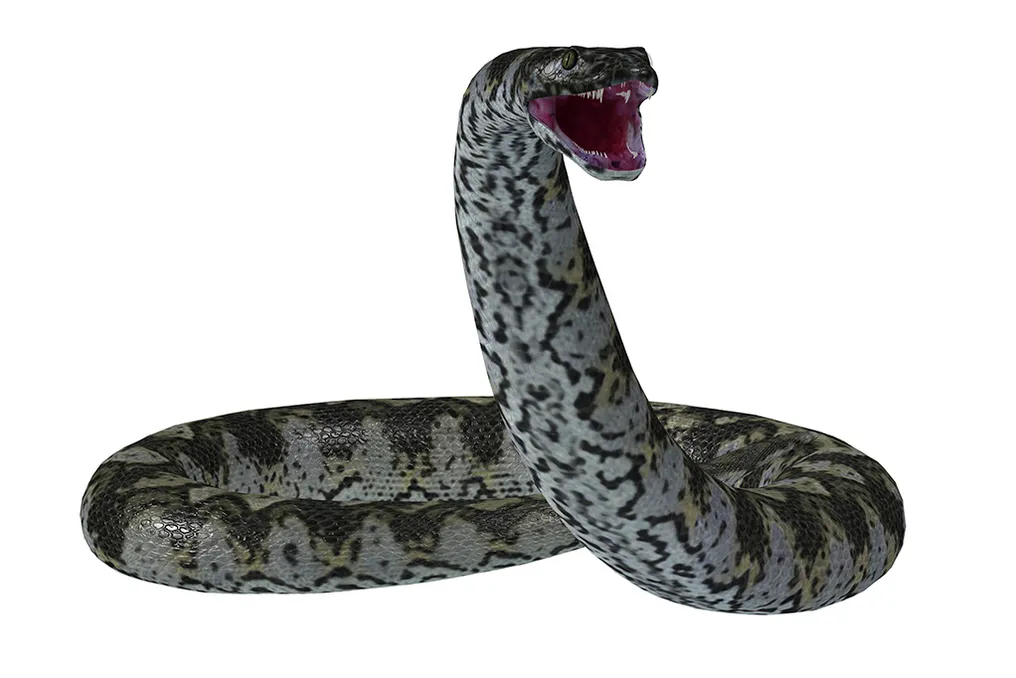
Approximately 60 million years ago, after the extinction of non-avian dinosaurs, a colossal reptile roamed the territory that is now South America. The Titanoboa is recognized as the largest snake ever recorded on Earth, capable of reaching up to 14 meters in length and weighing about one ton.
For comparison, the largest snake currently existing is the reticulated python (Malayopython reticulatus), found in Southeast Asia, whose largest specimens reach 7 meters. In Brazil, the green anaconda (Eunectes murinus) is the heaviest, reaching up to 100 kg.
Thus, the Titanoboa (Titanoboa cerrejonensis), belonging to the same family as anacondas, was twice the length and up to ten times heavier than the most voluminous contemporary snakes.
The first fossil traces of this species were discovered in the early 2000s, specifically in northern Colombia. The formal scientific description of the species occurred in 2009. Although most of the fossilized bones consist of rib and vertebrae fragments, pieces of skulls and teeth were also found.
However, a complete and well-preserved skeleton was not found. Scientists base their size estimates on the fact that the vertebrae are exceptionally large.
It is believed that the Titanoboa was a predator that spent time in the water, feeding primarily on fish and other aquatic creatures. Due to its immense size and weight, it would have been difficult for it to survive and hunt on dry land. At the time of its existence, northern Colombia was likely characterized by a dense, humid forest, full of rivers.
For many years, the Titanoboa held the title of the largest snake in history. However, this dominance is being questioned: in 2024, researchers announced the discovery of Vasuki indicus, a snake that lived in India 47 million years ago. This species is also gigantic, with an estimated length between 11 and 15 meters. If the upper estimate is correct, the Vasuki indicus could have surpassed the Titanoboa in size.
Despite this, the scarcity of Vasuki fossil fragments makes the estimates uncertain. For now, the Titanoboa remains the dominant snake in terms of historical record.