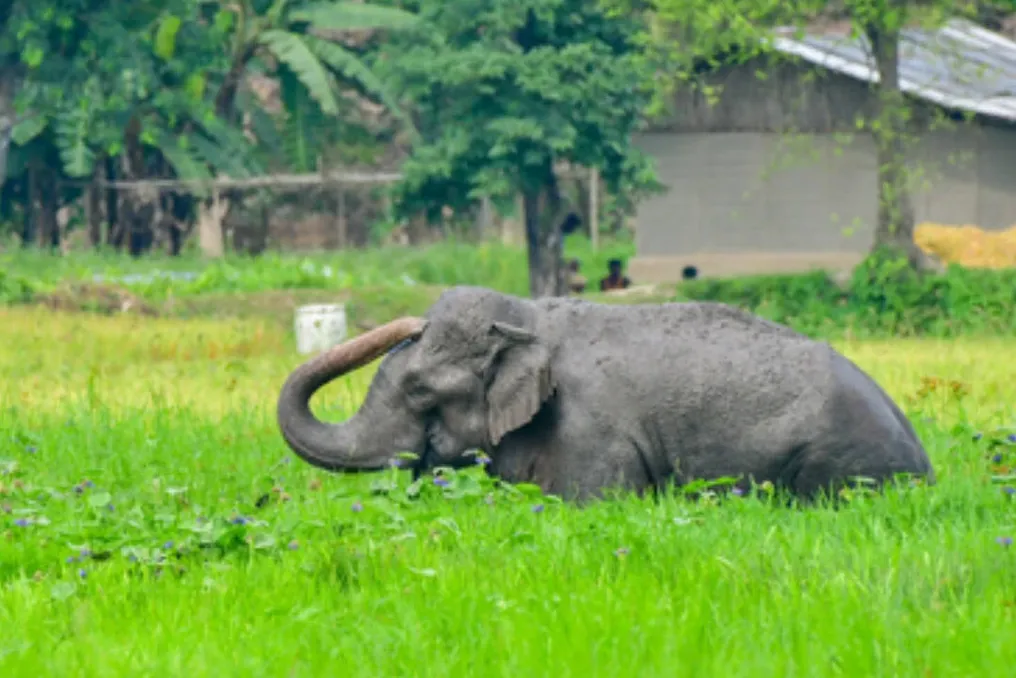
1765 elephants died in India over 17 years; Odisha recorded the highest number of casualties
Read more
The times of India
timesofindia.indiatimes.com

1765 elephants died in India over 17 years; Odisha recorded the highest number of casualties

According to data from the Union Ministry of Environment, up to 1765 elephants have died in India over the last seventeen years due to unnatural causes. The main cause of death was electric shock, followed by train collisions, poaching, and poisoning.

Statistics show that only electric shock led to the death of 1185 elephants between 2009 and 2026, accounting for just over 67% of the total casualties. This number is more than five times higher than the number of elephants killed by poachers (222).

Train collisions resulted in 277 deaths, while poisoning claimed the lives of 81 elephants during this period.

Considering all causes, the state of Odisha registered the highest number of elephant deaths (371), followed by Assam (356) and Karnataka (223).

Regarding the causes of death, the highest number of fatalities from electric shock was recorded in Odisha (238), followed by Karnataka (195) and Assam (191). On the other hand, Assam reported the highest number of deaths from train collisions (90), followed by West Bengal (68) and Odisha (45).

Amit Gupta, an environmentalist from Noida who filed a request under the Right to Information (RTI) Act, stated: 'Electric shock is not an accident. It is negligence—illegal electric fences, sagging wires, and uninsulated lines in elephant corridors. This needs to be stopped, and appropriate measures must be taken.'

Although the ministry did not respond to his request, one official told TOI that deaths from electric shock can be both 'accidental and intentional.' He clarified that when elephants trespass on crops, farmers often illegally install live electric wires to deter ungulates and wild pigs, leading to elephant deaths.

He also noted that although the state is the sole responsible body, the ministry is taking steps to minimize such deaths and mitigate Human-Elephant Conflict (HEC) episodes.

Measures taken by the ministry include surveying sensitive areas along railway lines, developing field guides (also in local languages) to reduce HEC, identifying and confirming elephant corridors, and conducting long-term research to identify trends, patterns, and factors affecting HEC in eight vulnerable states—Assam, Chhattisgarh, Jharkhand, West Bengal, Odisha, Karnataka, Kerala, and Tamil Nadu (second phase), as well as preparing Regional Action Plans focused on HEC.


Similar stories

Approach to Coexistence of Humans and Elephants Developed in Hathihuli Village (Assam)
Read more
thebetterindia.com

Approach to Coexistence of Humans and Elephants Developed in Hathihuli Village (Assam)

In the village of Hathihuli, located in Assam, elephants previously caused fear and were chased when moving through agricultural fields, leading to conflicts between local residents and wildlife.

However, a simple concept changed this situation: instead of fighting, residents began feeding the animals. Under the guidance of 90-year-old conservationist Pradip Kumar Bhuyan, Binod Dulu Bora, and the local community, Hathihuli started looking for ways to ensure the coexistence of humans and elephants.

Local residents began planting feed for the elephants, mapping their migration routes, and working on creating safer corridors for these majestic animals.

Today, more than 300 elephants pass through Hathihuli annually, serving as a vivid example of what is possible when communities choose understanding over confrontation. This case is not just an inspiring story of nature conservation; it reminds us that protecting wildlife does not always imply separating people and animals. Sometimes it means mastering the skills of sharing the same landscape.

India A achieves historic victory over Nepal with a score of 306-26 in the Asian Cup
Read more
www.aajtak.in

India A achieves historic victory over Nepal with a score of 306-26 in the Asian Cup

The India A team confidently began its participation in the Rising Stars Asia Cup 2026 by playing a match in Doha. In the game held on Friday, India A secured a convincing victory over Nepal with a score of 306 runs.

Coming out first, India A scored 332 runs in 50 overs, losing nine wickets. In response, the Indian bowlers managed to restrict the entire Nepal team to just 26 runs. Nepal's innings concluded after only 11.3 overs.

The heroes of this major victory were captain Tilak Verma, Kumar Kushagra, Harshit Rana, and Prince Yadav. Tilak and Kushagra demonstrated outstanding batting performances, while Harshit and Prince put pressure on the Nepali batsmen with the ball. Prince took five wickets, and Harshit took four.

The start of the game for India A was not the most successful: the team lost its first three batsmen at 42 runs. However, captain Tilak Verma and experienced batsman Kumar Kushagra managed to stabilize the game. They built an impressive partnership of 206 runs for the fourth wicket, allowing India A to take a strong position.

Tilak scored 107 runs off 113 balls, including 6 fours and 4 sixes. Kushagra played more aggressively, scoring 117 runs off 102 balls, which included 10 fours and 5 sixes. These century scores from both batsmen completely negated the efforts of the Nepali bowlers.

In the final overs, Suryaansh Shedge also played actively, scoring 36 runs off 14 balls without getting out, including 4 sixes and one four. Thus, India A formed an impressive total of 332 runs in 50 overs, losing 9 wickets.

From Nepal's side, the left-arm spinner Lalit Rajbanshi and the left-arm spinner Sandip Lamichane took three wickets. Medium-pace bowlers Nandan Yadav also achieved two successes.

The Nepal team, which was aiming for a target of 333 runs, could not withstand the Indian fast bowlers. Harshit Rana and Prince Yadav created real chaos with the new ball, forcing the Nepali batsmen to come out one after another. Harshit Rana secured the first wicket, dismissing Arjun Kamal via LBW on the third ball of the innings. Following this, Prince Yadav also showed skill, troubling Nepal by dismissing Dipak Dumre and Basir Ahmed consecutively.

The top order of Nepal completely collapsed under the onslaught of the Indian bowlers. By the seventh over, the team had lost five batsmen for only 17 runs. However, the flow of dismissals did not stop. Harshit and Prince together dismissed nine Nepali batsmen. Shahbaz Ahmed took one wicket.

Harshit Rana took 4 wickets, conceding 16 runs in 6 overs. Prince Yadav, conversely, took 5 wickets, spending only 6 runs in 5 overs. As a result, the entire Nepal team was bowled out for 26 runs in just 11.3 overs. Notably, no Nepali batsman was able to reach the score of ten runs.

The score of 26 runs, at which Nepal was dismissed, entered cricket history in List A format as one of the lowest team totals. This is the fifth lowest score in this format. The list of the lowest team totals in List A includes: 18 runs (West Indies Under-19 vs Barbados, 2007), 19 runs (Sarasens Sports Club vs Colts Cricket Club, 2012), 23 runs (Middlesex vs Yorkshire, 1974), 24 runs (Oman vs Scotland, 2019), and 26 runs (Nepal vs India A, 2026).

Under the leadership of Tilak Verma, this was a brilliant start for India A. While the batsmen scored an impressive 332 runs, the bowlers turned the match into a one-sided affair, restricting Nepal to 26 runs.

The White Elephant Opposing Ravana: The Story of Airavata and the Curse
Read more
www.aajtak.in

The White Elephant Opposing Ravana: The Story of Airavata and the Curse

In the Indian epic 'Ramayana,' the elephant depicted carrying the god Indra during the battle with Ravana is no ordinary animal. According to sacred scriptures, this elephant was named Airavata, also known as the king of elephants. Many mythological texts mention that Airavata had four tusks.

Airavata appeared during the Mandara Mountain churning, when fourteen divine jewels were extracted from it. After dividing these jewels among the gods, the god Indra chose Airavata as his mount.

In the city of Dharasuram in Tamil Nadu, there is the famous Shiva temple Airateshwara. It is said that the name of this temple is directly related to the elephant Airavata. According to legend, due to a curse from the sage Durvasa, Airavata's white color changed. Following this, he turned to worshipping the god Shiva and bathed in the sacred waters of the temple. Thanks to Shiva's grace, he regained his original white coat. This is why Shiva is revered here as Airateshwara, which means 'God worshipped by Airavata.'

The Vishnu Purana tells the story of a curse that befell Airavata. One day, the sage Durvasa was returning from Vaikuntha Loka. On his way, he met the god Indra riding on the elephant Airavata. Recognizing him as the lord of the three worlds, Durvasa gave him a garland as a blessing. However, Indra, consumed by arrogance, did not show him due respect and threw the garland given by Durvasa onto the head of the elephant Airavata. Then, Airavata took this garland in his trunk and trampled it with his hooves. After this, the sage Durvasa placed a curse upon him, stating that he would lose his splendor in the three worlds and lose his divinity. It is believed that after this curse, Airavata began to lose his supernatural white radiance. Only by seeking refuge with the god Shiva could he rid himself of this curse.

Popular