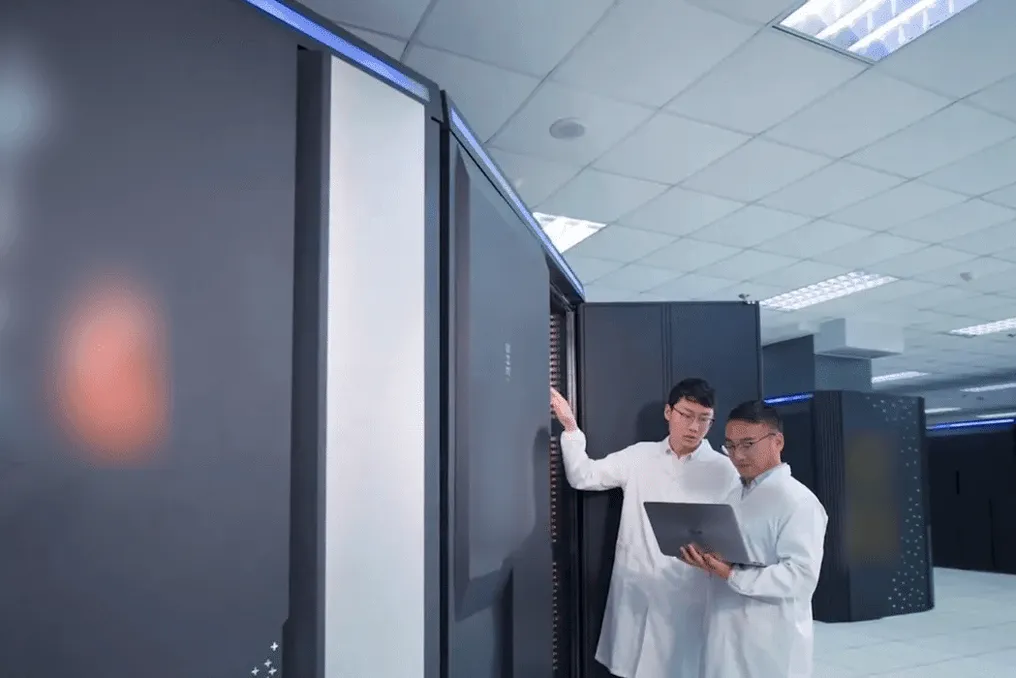
METASTONE introduces multimodal inference service and reports 2.48x video acceleration
Read more
Pandaily
pandaily.com

METASTONE introduces multimodal inference service and reports 2.48x video acceleration

The Chinese computing infrastructure provider METASTONE has released a multimodal model service. This service combines video generation acceleration, cache and memory management, token compression, and a Context Engine that transforms source materials into structured instructions for generation.

According to a report from the Chinese tech publication QbitAI on November 16, this service is aimed at production workflows. The company notes that the problem of quickly creating a single video is only part of the task; throughput and reliability are also affected by memory pressure, concurrent tasks, and the process of moving from understanding the source material to creating the final clip.

The video acceleration method uses residual information from historical caches to determine which computations can be reused. If the assumed risk is low, previous results are used; in cases where errors might accumulate, the computation is updated and recalibrated. METASTONE presents this as an alternative to simply skipping additional generation steps.

Under the conditions presented by the company, an average end-to-end acceleration of 2.48 times compared to baseline high-density computation is reported, while generation quality is maintained. It is important to note that these are internal tests conducted by the company, not independently verified data. In November, it was not established whether the same increase or quality preservation would be observed when using different hardware, models, and workloads.

The figure 2.48 is not new: in September, Chinese sources referenced this result for METASTONE's Meta-Infer engine in the MiniMax H3 image-to-video conversion test. The current news focuses on the broader multimodal service and its workflow components, rather than a new acceleration record or a directly comparable fresh benchmark.

For resource management, the company integrates its caching solutions with SGLang, utilizing reuse, chunking, compression, and scheduling techniques to minimize redundant work and unnecessary video memory overhead. The system provides adjustment of reuse decisions during task execution through runtime feedback.

Regarding the understanding aspect, METASTONE describes a modality-adaptive, training-free token compression method using modality awareness based on AudioCLIP. The company reports a 1.33x acceleration on WorldSense and favorable performance on VideoMME and DailyOmni. These claims are also based on the provider's own assessment, not independent reproduction.

The Context Engine links these stages. It extracts characters, voices, and constraints from images, videos, audio, and text, and then organizes frames, actions, and dialogues into structured instructions. The goal of material binding, timeline checking, and error correction is to maintain relationships between the source data.

METASTONE asserts that the service architecture covers API access, task orchestration, model routing, inference, and delivery, including parallelism control and recovery mechanisms. Thus, the launch packages multiple levels of optimization into a production service, but it does not prove consistent quality across all acceleration settings on its own.


Similar stories

Sand.ai releases full video model MAGI-2 with promise of open weights
Read more
pandaily.com

Sand.ai releases full video model MAGI-2 with promise of open weights

Sand.ai has introduced the full audio-video generation model MAGI-2, announcing its release on its Chinese website and detailing the system in a technical post dated November 24th. According to the company's statement, the new version is capable of creating clips up to 30 seconds long at 1080p resolution and 25 frames per second, including synchronized original sound.

This model is not merely a renaming of the previous MAGI-2 Preview version. Sand.ai reports that the full model possesses a total of 480 billion parameters, with approximately 28 billion active during inference. This is significantly larger than the Preview, which had 114 billion total parameters and about 6 billion active.

The release emphasizes the focus on prompt-driven production. Sand.ai claims that up to 20 input data points can be used as references for generation: ten images, five video clips, and five audio clips. Control tools include the ability to specify events on a timeline and control frame blending, as well as editing functions designed to preserve selected content when other elements are changed.

It should be noted that the stated limitations are product capabilities within the company's implementation, not a guarantee that any combination of references will perform equally well. Availability also requires clarification: Sand.ai points to hosted access via Higgsfield, which itself describes the MAGI-2 integration.

Nevertheless, the developer states that the open weights and a more complete technical report will be released later. Consequently, the full 480-billion parameter model cannot yet be considered available for local download, and the early Preview release should not be viewed as its final weights.

The demonstrations and benchmark comparisons presented by the company remain evidence provided by the issuer itself. The technical discussion acknowledges certain shortcomings, such as maintaining trajectories during fast movement, inter-frame consistency, some animation movements, and complex audio layers. These limitations are particularly relevant for longer clips, as a convincing short segment does not always ensure reliable continuity throughout the entire sequence.

The main news is the appearance of a larger production model and a hosted release with more explicit control over audio, references, and timing. The promised weights release will be a separate milestone; developers considering local deployment still require an actual downloadable artifact, its accompanying license, and reproducible hardware requirements.

LightSprint.ai creates a multi-user software development factory, uniting product managers, designers, and engineers
Read more
yourstory.com

LightSprint.ai creates a multi-user software development factory, uniting product managers, designers, and engineers

At the beginning of the work week, it is often the case that a product manager faces an escalation from a client, a designer discovers a user drop-off point, and both know what changes are necessary. They formalize the task as a ticket that enters the backlog, awaiting instructions from engineers who are already overloaded. Several weeks later, the change goes into release, but often not exactly as planned.

Although AI coding agents have significantly increased the speed of individual engineers' work, the software creation process in most companies has practically remained unchanged. This is where LightSprint.ai comes in, developing a multi-user software development factory—a unified space where engineers, product managers, and designers collaborate on the existing codebase, with the engineer approving every merge.

Modern coding tools function in a single developer environment or terminal. One person manages the process, while others lose synchronization. Planning remains locked in documents, context is stored in one person's memory, and reviewers approve large volumes of AI-written code without a deep, shared understanding of why it was created.

Prototyping tools allowed non-engineers to create software, but only on a clean canvas. Real companies rely on complex codebases with years of established conventions and validation rules. A prototype may ignore all these limitations, whereas a change in the working version cannot, leading to the need to recreate the prototype and loss of speed.

The bottleneck is not the code development itself, but the coordination between participants. For large organizations, it is critically important that every change is traceable: where it came from (the requirement), what acceptance criteria it meets, and what tests confirm its functionality. Teams must follow approved packages and design systems, and security departments require knowing where the code and data are located and who gave their approval.

Granting access to AI tools to more people without proper structure creates risks, while restricting access leaves tasks in the backlog. LightSprint.ai integrates on top of the coding agents already used by teams, transforming them into a shared workspace for the entire product team. This system is based on three core principles.

The result is not a reduction in the number of engineers, but rather that engineers spend their time making decisions that require their professional judgment, while people closest to the customers release the changes they understand best.

Through participation in the NetApp Excellerator program, LightSprint.ai is collaborating with NetApp teams to assess the applicability of the multi-user software development factory in an enterprise environment. Aspects such as specification-driven development, traceability from requirement to test, adherence to approved packages and UI standards, and an enterprise-grade security model are being discussed.

SenseTime releases open-weight Loop-9B model using layer reuse for deep processing
Read more
technode.com

SenseTime releases open-weight Loop-9B model using layer reuse for deep processing

SenseTime unveiled the weights and source code for the SenseNova Loop-9B model on Tuesday. This multimodal model is distinguished by increasing computational depth through multiple passes of some of its layers.

The model, which has approximately nine billion parameters, can accept both text and image data as input, generate text, and support functions such as reasoning, code writing, data analysis, and tool usage. Its context window has been expanded to 512,000 tokens.

Despite having 32 decoder layers, it runs its common average layers twice. This allows it to perform computations equivalent to 56 layers in a single forward pass. SenseTime claims that its performance is comparable to Qwen3.8-27B on certain agent and data analysis benchmarks.

According to the model documentation, the official four-bit quantized version reduces the weight size to approximately 4.9 GB. Using a 256,000-token context window and an eight-bit KV cache requires about 15 GB of memory.

Popular