Rahul Gandhi spoke about his mother's family memories during the presentation of Sonia Gandhi's memoirs
Read more
The times of India
timesofindia.indiatimes.com

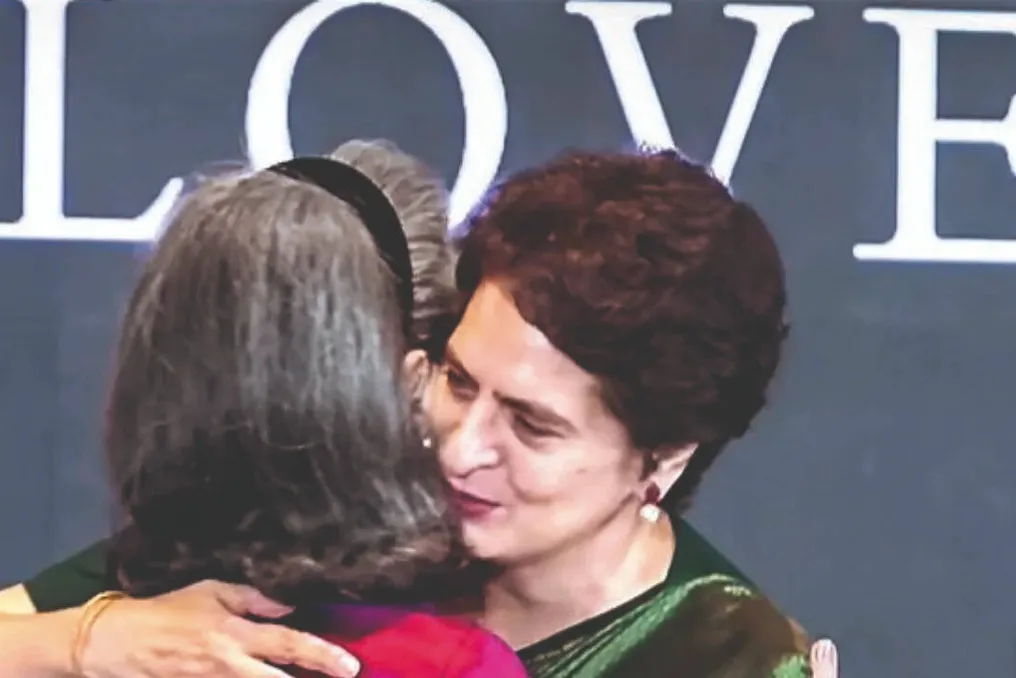
Rahul Gandhi spoke about his mother's family memories during the presentation of Sonia Gandhi's memoirs

During the presentation of his mother's memoirs, a book titled 'Belonging: A Journey of Love,' in Delhi on Monday, Rahul Gandhi jokingly shared advice: 'And listen, if you want to fall in love, go to Varsity restaurant in Cambridge. But never eat chasseur chicken, okay?'

Years after hearing the story of his parents' first meeting in Cambridge, he recounted visiting the Varsity restaurant with his girlfriend to see where they met. When Rahul told the person at the entrance that his parents met there, the person claimed to know them well and recommended the chasseur chicken dish from the menu. However, the meal did not live up to the romantic aura surrounding this story.

Rahul contrasted his parents' memories of the restaurant with his own experience, stating: 'It seems they remember the food was fantastic. The food is terrible!' he said, eliciting laughter from the audience.

This anecdote became part of a series of family stories shared by the opposition leader after mentioning that he was instructed to avoid politics. Nevertheless, many saw a political undertone in the seating arrangement. The front row included several opposition leaders, including Samajwadi Party President Akhilesh Yadav, Trinamool Congress MP Abhishek Banerjee, National Conference President Farooq Abdullah, Supriyo Sule from NCP-SP, Jharkhand State Chief Hemant Soren, and Tamil Nadu Chief C Joseph Vijay.

The former Punjab Chief Minister Captain Amarinder Singh, who left the Congress in 2021 after a bitter split with the Gandhi family, was also present in the front row. Rahul mentioned Amarinder and said he had seen his parents argue only once. Rajiv Gandhi talked to Amarinder on the phone while Sonia repeatedly tried to say something to him. Rajiv was stressed and eventually got angry. 'We saw them argue many times, but it was the only time we saw them fight,' Rahul said.

Sonia Gandhi also tried to keep the conversation away from politics. When asked why she decided to write memoirs despite having meticulously guarded her private life in the past, she explained that she wanted to clarify her family's story amidst the 'unreal stories' woven around them. 'So much has been said about my mother-in-law, husband, son, daughter, and myself; and most of it is unreal. It really has nothing to do with who we are. Stories are woven around you, falsehoods are woven around you, and hurtful things are said that are far from the truth. And I thought, perhaps this is a way to express my feelings, what I know about my family, and perhaps people will be willing to listen to my story,' said Rajya Sabha MP.

She recalled feeling like an outsider when she first moved to India, realizing the risk of making mistakes. She linked this experience to Indian women who enter a new family after marriage and must adapt to its customs. According to her, the memoir's title reflects the 'effort to be accepted and belong, finally belonging.'

While telling the story of how she and Rajiv went to the Indian Gate for ice cream (she had a favorite ice cream vendor, Sardarji), Rahul spoke of his parents' tenderness and a habit he considered common in every home: 'At every meal, there was Papa, and Mama was on Papa's lap.' He noted that he only realized this was unusual when visiting friends' homes.

However, everything changed after the murders of Indira Gandhi and Rajiv Gandhi, he said: 'The cheerful mother, the smiling mother disappeared.' Sonia, once an extrovert, became withdrawn.

Rahul also spoke about his mother's resilience in the face of cancer, noting that he had never seen her scared or giving up. He concluded by saying how, in his opinion, Rajiv would have been proud of her: 'Mom, Dad loved you. But I can't even tell you how proud he would have been of you.'


Similar stories

The Amodey Brothers Formed the Eccentric Culture of Anthropic
Read more
olhardigital.com.br

The Amodey Brothers Formed the Eccentric Culture of Anthropic

Dario and Daniela Amodey formed the culture of Anthropic under the unofficial motto 'Keep Anthropic weird'. The artificial intelligence company, valued at approximately $1.18 trillion (equivalent to about 6.96 trillion Brazilian reais), reflects the beliefs and personalities of its founders.

The company's identity began to take shape even before its founding in 2021, thanks to the relationship between the brothers, their personal experiences, and a circle of friends with similar interests.

Having grown up in the Mission District of San Francisco, Dario, who was 43 at the time, and Daniela, who was 39, followed different academic paths. He studied physics and biology, while she earned a degree in literature from the University of California, Santa Cruz, receiving a scholarship for classical flute.

Their closeness was also linked to a desire to find ways to improve the world. Dario became acquainted with the concept of effective altruism—a movement that uses analysis and reasoning to maximize the positive impact of individual actions. During visits to his family, he would discuss these ideas with his sister for hours.

In 2013, Daniela returned to San Francisco to work at Stripe and began living with her brother and Holden Karnofsky, Dario's friend and Daniela's future husband, in a dormitory. This place became a gathering point for people connected to this movement, and more than half of the Anthropic founding team lived there for many years.

This shared living arrangement fostered the closeness of people with similar values and interests. When they founded the company, the brothers pledged to dedicate 80% of their initial shares to charity.

Dario joined OpenAI in 2016, and Daniela arrived at the organization about a year later. Disagreements with Greg Brockman, one of the company's founders, regarding internal disputes and AI safety led to Dario and other employees leaving in 2020. The group, known as the 'pandas' after Dario's favorite animal, founded Anthropic the following year.

From the beginning, the brothers aimed to maintain a relatively small team and hire people who shared their views on artificial intelligence. Some practices adopted to preserve this identity include:

The distribution of responsibilities also reflects the complementarity of the brothers. Dario, as CEO, serves as Anthropic's main ideological compass and organizes regular employee meetings called 'Dario Vision Quests,' where he shares his views on artificial intelligence, politics, and technology. He also circulated a 14,000-word essay among the team on the potential of AI, known as the 'Little Blue Book.'

Daniela, President and Board Member, oversees daily operations and coordinates the executive team. In an interview with biographer Walter Isaacson, recorded in July, she summarized the partnership: 'Dario makes us ambitious; I make us successful.'

The company attributes part of its success to its internal culture. Over the 12 months ending in September, only 1% of regrettable departures were registered, according to the document submitted for the IPO.

During Anthropic's debut on Nasdaq, Daniela admitted that the company's identity goes beyond the ordinary: 'Some will say we are weird. And many have indeed said so.'

Ilha Grande inaugurates permanent exhibition on seahorse conservation
Read more
viagemeturismo.abril.com.br

Ilha Grande inaugurates permanent exhibition on seahorse conservation

Since the end of October, visitors to Ilha Grande, located in Angra dos Reis, have had access to a new, free permanent exhibition. This display details the connection between the destination and the efforts to preserve seahorses along the Brazilian coast, promoted by the Seahorse Project.

Titled “Ilha Grande, Sea of Seahorses,” the exhibition was created to commemorate the 24th anniversary of the project, which began in November 2002. Using photographs, infographics, informational materials, and even specimens preserved in alcohol, the show revisits the preservation work of a species facing a global extinction threat, a situation that also occurs in Brazil.

The Seahorse Project conducts research and wildlife monitoring in various areas, including Guanabara Bay, Ilha Grande, and Sepetiba, as well as Búzios, Arraial do Cabo, and Araruama Lagoon. The population of this species is affected by human factors, such as pollution, predatory fishing, and the destruction of natural habitats, leading to its collapse.

The space also provides visitors with information about the locations in Ilha Grande where seahorses are frequently seen. If a sighting occurs, the visitor can help monitor the species by accessing the project's website and reporting the date and location. It is important to emphasize that the exhibition reinforces the researchers' guidance that any interaction with the animals must be purely observational, without touching them or interfering with their natural environment.

The permanent exhibition is open daily from 8 am to 5 pm and can be found at the headquarters of the Ilha Grande State Park, located in Vila do Abraão, on Av. Nacib Monteiro de Queiroz, known as Rua da Praia.

Rakesh Bedi claims film 'Ek Duje Ke Liye' was a huge hit, surpassing 'Dhurandar'
Read more
www.aajtak.in

Rakesh Bedi claims film 'Ek Duje Ke Liye' was a huge hit, surpassing 'Dhurandar'

At the International Film Festival of India (IFFI) 2026 in Goa, actor Rakesh Bedi recalled his 1981 film 'Ek Duje Ke Liye' and called it more successful than 'Dhurandar'. He also mentioned that he received death threats after the success of this movie.

During a press conference held with production designer Sani S. Johari, they discussed the film 'Dhurandar', which was screened as the opening film of the 'Indian Panorama' section. Memories of the old days led Rakesh Bedi to compare the success of his 1981 film with contemporary movies.

Speaking about his career achievements, Rakesh Bedi noted that the current generation probably does not grasp the immense excitement surrounding 'Ek Duje Ke Liye' at the time. He emphasized that while he had many major successes, 'Ek Duje Ke Liye' achieved a colossal success that is hard to imagine.

He compared both films, noting that although 'Dhurandar' is popular due to social media, social media did not exist in that era. Rakesh Bedi shared an interesting detail: 'Ek Duje Ke Liye' was shown in various cities across India for 4-5 years. The film was so loved by the audience that they completely identified with the characters.

The actor recalled how his character, a 'comic villain', provoked a strong reaction from the public. His actions led to the deaths of the main characters, and some viewers became so angry that they sent him threatening letters. He remembered this situation humorously, recounting that as the villain, he caused the death of the hero and heroine, and received letters like: 'We will kill you. These people died because of you.'

He added that despite such reactions, his subsequent TV show 'Ye Jo Hai Zindagi' was also successful, but its popularity was limited due to the absence of social media. In contrast, the success of 'Dhurandar' is entirely different. Rakesh Bedi noted that in the last 10-15 years, he has never achieved as much success as with 'Dhurandar', calling it unprecedented. Some film experts now divide Indian cinema into three great eras: 'Mughal-e-Azam' (1960), 'Sholay' (1975), and 'Dhurandar'.

The film 'Ek Duje Ke Liye' was released in 1981 and directed by K. Balachander. This movie, starring Kamal Haasan and Rati Agnihotri, tells the story of Vasu and Sapna, who fall in love despite opposition from their families from different cultural backgrounds. The film was a massive commercial success, and Rakesh Bedi played the role of 'Chakrama', which created difficulties for the main couple and became an iconic image.

'Dhurandar', directed by Aditya Dhar, stars Ranveer Singh and also features actors such as Akshay Khanna, Sanjay Dutt, R. Madhavan, and Arjun Rampal. In this film, Rakesh Bedi played the role of 'Jamil Jamali'. 'Dhurandar' was released last December and was a box office sensation. Its sequel, 'Dhurandar: The Revenge', followed in March. These two parts became the first Indian franchise to cross the mark of 300 billion rupees globally.

Popular