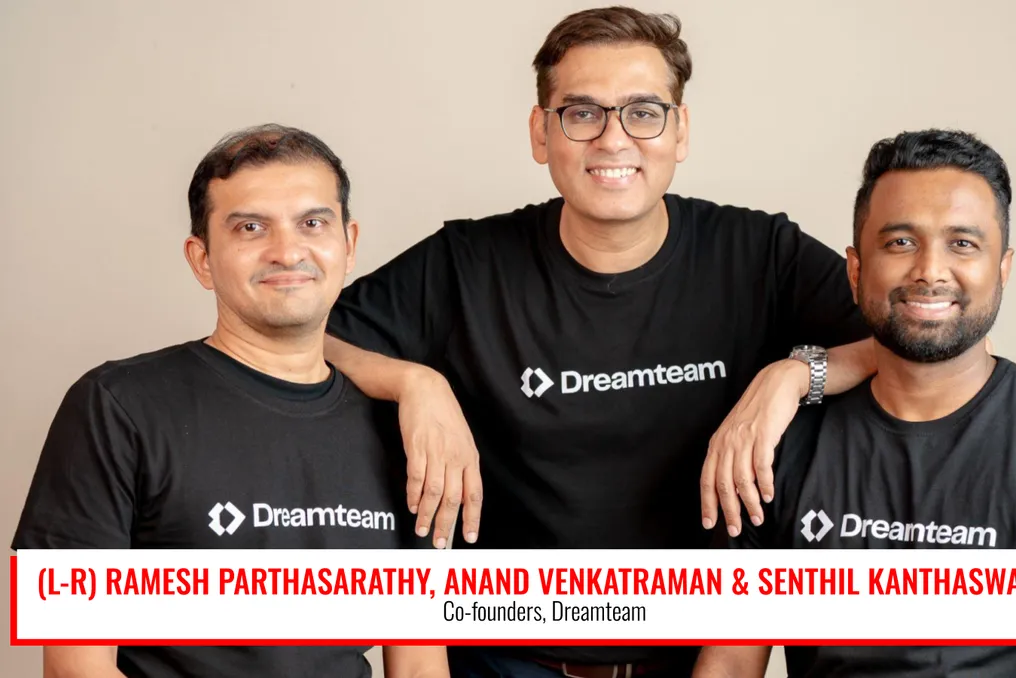
Startup Dreamteam, founded by former Freshworks executives, raises $53 million to develop AI-based CRM
Read more
YourStory [india, en]
yourstory.com

Startup Dreamteam, founded by former Freshworks executives, raises $53 million to develop AI-based CRM

Dreamteam, an artificial intelligence-powered customer relationship management (CRM) startup founded by former Freshworks employees, has secured $53 million in funding. The investment was provided by Together Fund, Accel, and Premji Invest.

Dreamteam was established in 2025 by Anand Venkatraman, Ramesh Partasaratty, and Senthil Kantaswamy. The company's headquarters are located in California, while the main engineering team is based in Chennai. The company is developing a technological platform capable of understanding customer context and enabling specialized AI assistants.

Anand Venkatraman, co-founder and CEO of Dreamteam, noted that traditional CRM systems could not provide a complete picture of customers because the most valuable insights were often outside these systems. He added that artificial intelligence allows for this paradigm shift, enabling Dreamteam to learn from the team's current work, maintain context, and provide sales representatives with qualified AI colleagues to advance deals. This way, sales reps and managers can focus on relationships, judgment, and closing deals while Dreamteam handles everything else.

According to Dreamteam, their technological platform is used by companies across various industries, including healthcare, consulting, manufacturing, online media, and AI.

Girish Matrubutam, founder of Together Fund, the first institutional investor in Dreamteam, stated that CRM is one of the largest software categories ripe for radical change. He emphasized that he worked with the founders of Dreamteam from the beginning, observing how their vision for AI-based CRM was taking shape. According to him, the team's deep expertise in CRM and proven experience scaling enterprise software give them a unique advantage in this reimagining.

Dreamteam plans to expand its level of intelligence beyond sales to cover the entire customer lifecycle, including lead generation, onboarding, customer support, and upselling. Furthermore, the company offers Magic Apps, which allows business users to create custom applications and dashboards using natural language without needing to write code.

Shekhar Kirani, Partner at Accel, noted that in the age of AI, companies that deeply understand their customers have a huge advantage. He pointed out that today, every team member sees a different version of the customer because there is no centralized system storing all the information. Dreamteam is building such a system using AI agents.

Similar stories

CataX AI raises 40 million yuan to implement AI agents in drug development
Read more
technode.com

CataX AI raises 40 million yuan to implement AI agents in drug development

Shanghai-based company CataX AI has successfully raised 40 million yuan in a seed round. The sole investor in this round was Qiming Venture Partners, which also incubated the startup.

CataX AI plans to license or co-develop drug candidates at the preclinical or early clinical stage, and then advance them through the proof-of-concept clinical stage.

The company's operational model is called 'Clinical-of-One'. Under this model, a clinical director oversees each project with the support of specialists and AI agents. These agents are responsible for analyzing research, drafting documents, and processing data. Key decisions are made by human experts, and the company aims to utilize the knowledge gained across various projects.

Founder and CEO Wang Ziyun has experience in clinical medicine and AI research at Microsoft Research Asia, while co-founder Jiang Zheming has over fifteen years of experience in clinical development.

Sand.ai raised $200 million ahead of the release of video model MAGI-2
Read more
technode.com

Sand.ai raised $200 million ahead of the release of video model MAGI-2

The Chinese video generation company Sand.ai announced the closing of a Series A+ funding round worth $200 million on November 5. Thanks to this investment, the company achieved unicorn status, and its total funding raised this year reached $300 million across three rounds.

This round was co-led by Cornerstone Capital and Wangsu Science & Technology. Sand.ai plans to use the funds to develop infrastructure for training and inferencing video models, conduct research in this area, develop products, and expand internationally.

Furthermore, the company announced the upcoming release of the full version of MAGI-2—a larger video generation model built on an expert mixture architecture.

Sand.ai raises $200 million in Series A+ round to compete with Kling and Seedance using open AI video
Read more
ventureburn.com

Sand.ai raises $200 million in Series A+ round to compete with Kling and Seedance using open AI video

In ten months, Sand.ai has transformed from an early-stage project into one of the most discussed artificial intelligence startups in China. The company raised $200 million in a Series A+ round, aiming to become a unicorn valued at over $1 billion. Cornerstone Capital and Wangsu Science & Technology led this round. New investors include Times Capital, Panlin Capital, Orient Securities Capital, Pudong Venture Capital, and Shanghai Guofang.

Sand.ai has raised approximately $300 million in funding and is now targeting competition with video generation giants—Kling and Seedance. The company was founded in 2024 by Chao Yue, who previously worked as a senior research scientist at Microsoft Research Asia. His prominence stems from the joint development of the Swin Transformer model, which won the best paper award at the ICCV conference.

This experience shaped the company's strategic decision: Sand.ai chose an autoregressive approach to video, while most of the industry favored diffusion models. Chao later admitted that the team underestimated the complexity of the chosen path.

In May 2025, Sand.ai released the open-source project MAGI-1, which won the Physics-IQ video continuation benchmark. Then, in August 2026, a preliminary version of MAGI-2 was presented—a mixture-of-experts model with 114 billion parameters. Because it is only active about 6 billion times per pass, its cost remains low. The distilled MAGI-2 model can generate a 10-second video in 1080p resolution for approximately 0.5 yuan.

According to BigGo Finance data, the cost per second of video is about one-tenth the cost of mainstream models. Developers also point to the MagiAttention library, used by Tencent's Hunyuan team and supported via NVIDIA's NeMo AutoModel. This is a quiet but significant endorsement. Furthermore, there is a product side: the AI video creation application VidMuse generated $10 million in annual recurring revenue within two months.

It is important to note that many AI labs demonstrate impressive examples but struggle with product sales. Sand.ai demonstrates the ability to do both, which is exactly what investors are currently looking for.

Wangsu is not just providing financial support; 300 million yuan ($45 million) of capital from this company, a giant in CDN and edge computing, is directed toward this project. Wangsu is interested in collaborating with Sand.ai on low-latency edge video inference. Given clients such as ByteDance, Tencent, and JD.com, this partnership could provide Sand.ai's models access to very large customers.

The raised funds will be used for model research, training, inference infrastructure, product improvement, and expansion into overseas markets. In a broader context, the AI video race in China is accelerating as major players already have their own platforms. Kuaishou recently raised about $2.9 billion, valuing the company at $18 billion. ByteDance's Seedance reportedly generates over 1 billion yuan in monthly revenue.

Sand.ai is choosing a different path: it is independent, open-source, and operationally economical. This is attractive to developers and brands that do not want to depend on competitors' platforms. Nevertheless, risks exist: foundational models continuously consume capital, and early successes can quickly fade. However, if MAGI-2 meets expectations, Sand.ai could become a neutral choice in the AI video sphere, which warrants close monitoring.

Popular